Indonesia is home to a remarkable diversity of bird species, and among the most captivating are the various species of kingfishers that inhabit its vast archipelago. These vibrant birds, known for their striking plumage and impressive fishing skills, play an important role in the ecosystems of Indonesia’s forests, rivers, and coastal areas. The country’s unique geography, spanning thousands of islands across diverse habitats, provides perfect conditions for a wide range of kingfishers, many of which are endemic or found only in limited regions. This article explores the fascinating world of Indonesia’s kingfishers, delving into their scientific classification, distribution, physical characteristics, behavior, diet, breeding habits, conservation status, and some intriguing facts that highlight their ecological and cultural significance.
Scientific Classification
Kingfishers belong to the family Alcedinidae, a diverse group encompassing over 90 species worldwide, known for their bright colors and specialized hunting techniques. Within Indonesia, kingfishers are represented by multiple genera, including Todiramphus, Tanysiptera, Alcedo, Ceyx, Pelargopsis, and Actenoides. These genera cover a wide range of species, from small, brightly colored forest dwellers to large, robust birds that hunt along rivers and coastal zones.
For example, the Beach Kingfisher (Todiramphus saurophaga) and the Collared Kingfisher (Todiramphus chloris) are members of the genus Todiramphus, which is widespread in the Indo-Pacific region. Paradise kingfishers, such as the Biak Paradise Kingfisher (Tanysiptera riedelii) and the Common Paradise Kingfisher (Tanysiptera galatea), belong to the genus Tanysiptera and are renowned for their elongated tail feathers and vivid coloring.



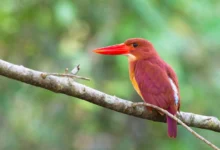
Other notable genera include Alcedo, which contains smaller species like the Little Kingfisher (Alcedo pusilla), and Pelargopsis, home to the large and powerful Stork-billed Kingfisher (Pelargopsis capensis). The genus Actenoides represents forest kingfishers like the Green-backed Kingfisher (Actenoides monachus). Each genus exhibits unique adaptations that allow these birds to thrive in Indonesia’s varied ecosystems.
Geographic Range & Distribution
Indonesia’s kingfishers are distributed widely across the archipelago, from the western islands of Sumatra and Java to the eastern reaches of Papua and the numerous smaller islands in between. Their habitats include coastal mangroves, riverbanks, lowland and montane forests, and even open woodlands and plantations. Some species have broad ranges, such as the Collared Kingfisher, which is found throughout much of Southeast Asia and the Pacific, including many Indonesian islands.
In contrast, several species have extremely limited distributions and are endemic to specific islands or regions. The Numfor Paradise Kingfisher (Tanysiptera carolinae) is found solely on Numfor Island off the north coast of Papua, while the Biak Paradise Kingfisher (Tanysiptera riedelii) is restricted to Biak Island. The Lilac Kingfisher or Celebes Flat-billed Kingfisher (Cittura cyanotis) is endemic to Sulawesi. These localized species often inhabit dense forests, making them challenging to study but critical indicators of ecosystem health.
Elevation also influences kingfisher distribution. While many species prefer lowland coastal or riverine habitats, others, such as the Mountain Kingfisher (Syma megarhyncha), inhabit montane forests at elevations up to 2,000 meters. This diversity in habitat preference underscores the ecological versatility of kingfishers in Indonesia.
Physical Description
Kingfishers in Indonesia exhibit a wide range of sizes, shapes, and color patterns, but they typically share common features such as large heads, long, sharp bills, compact bodies, and short legs. Their plumage is often bright and iridescent, combining blues, greens, whites, and reds into eye-catching patterns that aid in species identification.
The smallest species, like the Little Kingfisher (Alcedo pusilla), measure around 12-14 centimeters in length and weigh approximately 14-16 grams. In contrast, the large Stork-billed Kingfisher can reach lengths of up to 40 centimeters with a wingspan of about 50 centimeters and weigh around 230 grams. It is characterized by its massive bill and a striking combination of a bright blue back, rufous underparts, and a white throat.
Many paradise kingfishers, such as the Common Paradise Kingfisher (Tanysiptera galatea), are noted for their elongated tail feathers and brilliant blue and white plumage, which make them popular subjects for birdwatchers and photographers. The Blue-and-white Kingfisher (Todiramphus diops) displays a distinctive blue cap and wings contrasting with a clean white belly and throat.
Several species like the Blue-banded Kingfisher (Alcedo euryzona) show a more subtle yet striking coloration, with deep blue bands across their chest and dark upperparts. The Hook-billed Kingfisher (Melidora macrorrhina) is notable for its uniquely curved bill, adapted for foraging in specific habitats.
Behavior & Diet
Indonesia’s kingfishers are predominantly solitary and territorial birds, often observed perched silently on branches overlooking water bodies or forest clearings. Their hunting technique is highly specialized, involving a rapid dive to catch prey with their strong, pointed bills. While many kingfishers are strongly associated with fish, especially those living near rivers and coasts, the diet of Indonesian kingfishers is diverse and varies by species and habitat.
Species like the Stork-billed Kingfisher feed mainly on fish, crustaceans, and amphibians, often hunting along streams, rivers, and mangroves. They use their keen eyesight to spot prey from a perch before plunging down for capture. Conversely, forest-dwelling species such as the Green-backed Kingfisher and various paradise kingfishers primarily consume insects, small reptiles, and occasionally small mammals, supplementing their diet with worms and other invertebrates.
Some smaller kingfishers, like the Oriental Dwarf Kingfisher (Ceyx erithaca), are known for their agility in dense forest undergrowth, catching insects and small frogs. The diversity in feeding strategies reflects adaptation to different ecological niches, allowing multiple kingfisher species to coexist across Indonesia.
Kingfishers are often vocal, using loud, sharp calls to communicate and defend territories. Their calls vary from high-pitched whistles to harsh rattles, depending on the species. These vocalizations are important for birdwatchers to detect the presence of elusive species in dense habitats. According to eBird, this species is well documented.
Breeding & Reproduction
Breeding behaviors among Indonesia’s kingfishers share common traits but also show adaptations to their varied environments. Most species nest in burrows excavated into riverbanks, termite mounds, or decaying trees. These tunnels can extend up to a meter in length, providing a safe, concealed location for eggs and chicks. According to Audubon Society, this species is well documented.
During the breeding season, which often coincides with the rainy season when food is abundant, males perform elaborate courtship displays to attract females. These may include vocalizations, aerial chases, and presenting food items. The female typically lays between 2 and 7 glossy white eggs, depending on the species.
Incubation periods range from 17 to 21 days. Both parents usually share incubation duties and are involved in feeding the chicks after hatching. The nestlings remain in the burrow for several weeks, growing rapidly before fledging. Juvenile kingfishers often have duller plumage than adults, gaining their vibrant colors after their first molt.
Some species, particularly those in dense forests or isolated islands, have been less studied, and details about their breeding ecology remain limited. However, ongoing field research continues to shed light on these fascinating birds’ reproductive strategies.
Conservation Status
Indonesia’s kingfishers face a range of conservation challenges linked to habitat loss, deforestation, and environmental degradation. According to the International Union for Conservation of Nature (IUCN), most widespread species like the Collared Kingfisher and Stork-billed Kingfisher are currently listed as Least Concern due to their broad distributions and adaptability.
However, several island endemics and forest-dependent species are considered threatened or near threatened. For instance, the Green-backed Kingfisher (Actenoides monachus) is classified as Vulnerable due to rapid deforestation in Sulawesi. The Rufous-collared Kingfisher (Actenoides concretus) also faces habitat pressures and is listed as Near Threatened.
The fragmentation of lowland and montane forests, as well as pollution of waterways and coastal habitats, pose ongoing risks to kingfisher populations. Conservation efforts in Indonesia include habitat protection through national parks and reserves, environmental education, and research to better understand species’ ecology and population trends.
Local communities and birdwatching initiatives play vital roles in monitoring kingfisher species, promoting sustainable habitat management, and fostering appreciation for Indonesia’s rich avian biodiversity.
Interesting Facts
One of the most striking features of many Indonesian kingfishers is their iridescent plumage, which results from microscopic structures in their feathers that refract light, creating brilliant blues and greens that seem to shimmer in the sunlight. This makes them some of the most photogenic birds in the region, highly prized by wildlife photographers.
The Paradise Kingfishers are famous not only for their colors but also for their extremely long tail feathers, which can be twice the length of their bodies in some species. These magnificent plumes are used in courtship displays and signaling to other birds.
Kingfishers have specialized vision adapted for hunting underwater. Their eyes have a transparent third eyelid called a nictitating membrane that protects them and allows clear vision when diving to catch prey. They can also compensate for light refraction between air and water, enabling precise targeting of fish beneath the surface.
Although commonly associated with fishing, many Indonesian kingfishers are equally adept at hunting terrestrial prey, illustrating their versatility. In fact, some species, such as the Hook-billed Kingfisher, have evolved unique beak shapes to exploit niche food sources.
The cultural significance of kingfishers in Indonesia is evident in local folklore and art, where they are often symbols of beauty, agility, and the health of aquatic ecosystems. Their presence is a positive indicator of environmental quality, emphasizing the importance of conserving their habitats.
Indonesia’s kingfishers are a vivid testament to the country’s extraordinary biodiversity. From the smallest, most elusive forest species to the large, bold birds of coastal waters, these kingfishers captivate with their beauty, behavior, and ecological roles. Protecting their habitats ensures that future generations can continue to enjoy and learn from these remarkable birds, which are integral to the natural heritage of the Indonesian archipelago.