The Lilac Kingfishers or Celebes Flat-billed Kingfisher, Cittura cyanotis, is a resident breeding bird in the lowlands of the Indonesian island of Sulawesi and the neighbouring Sangihe and Talaud Islands. It is the only member of the genus Cittura.

Behaviour
Lilac Kingfisher, a shy bird with a reputation for being elusive and secretive, prefers quiet areas of lowland forests and hill forests that are drier and more secluded. They can be found as high as 1000 meters above sea level. It spends most of its time on low branches perched motionless, watching the ground for its favourite prey – large insects. Its patience and stillness make it an expert hunter that blends seamlessly with its forest surroundings.



The Lilac Kingfisher is a mysterious bird despite its stunning plumage. Its behaviour is unknown, and nests have not yet been found. Bird enthusiasts are eager to discover more about this species’ secretive behaviour.
Description
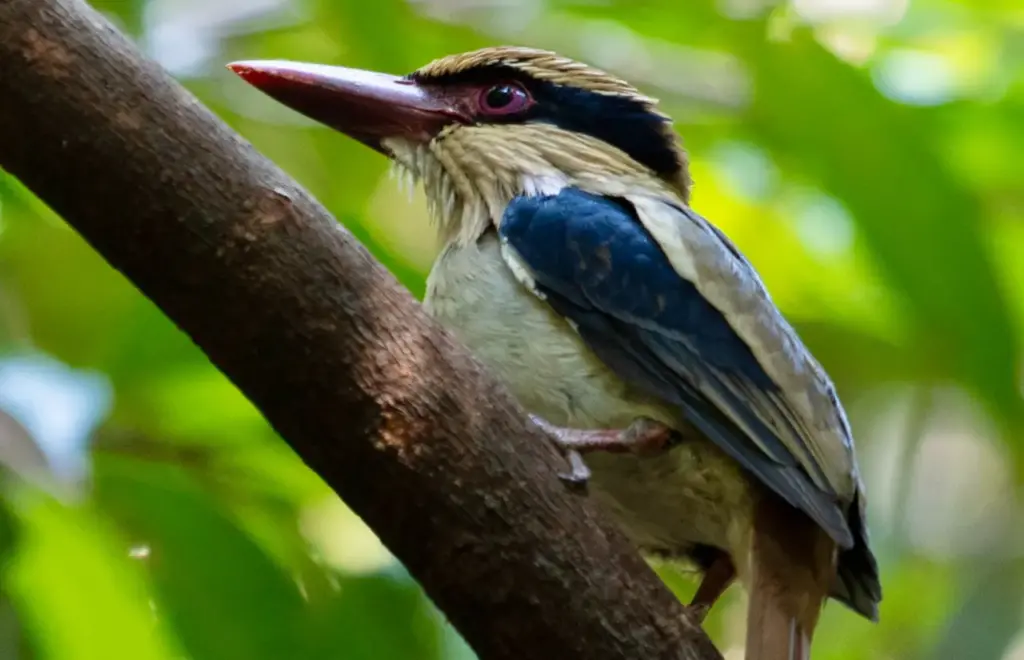
The Lilac Kingfisher is 28 cm (11 inches) long. It has the typical kingfisher shape, with a short tail and long bill. The adult male of the nominate race, C. c. cyanotis, has a brown crown and back and a rufous rump and tail.
It has a blue eye mask, separated from the crown by a white line, and a pale lilac ruff of long, stiffened, dear covert feathers.
The underparts are white, and the wings are blue, separated by a white line from the brown back.
The red bill is large and flattened. In flight, the underwings are white with a black wrist patch.
The female has a black, rather than blue, mask and upper wing cover, and her supercilium is black, spotted with white. The juvenile resembles the adult but is duller and browner with a grey-brown bill.
There are two or three subspecies.
- C. c. cyanotis, northern Sulawesi
- C. c. modesta, eastern and southeastern Sulawesi. This form, which is not recognised by some authorities, has less stiff ear coverts than nominate cyanotis. These feathers are lilac in the male and rufous in the female. The throat is rufous-lilac in both sexes.
- C. c. sanghirensis, Sangihe and Talaud islands. This subspecies is substantially larger and has a longer bill than the nominate race. It has brighter, more rufous upperparts, a black forehead and mask, stiff, bright lilac ear coverts and upper breast, and a white chin.
The call of this large tree kingfisher is a rapid ku-ku-ku-ku.
The Lilac Kingfisher is unlikely to be confused with any other kingfishers in its range.
Habitat Distribution
It is the only species in the genus em data-end=”3289″ data-start=”3280″>Cittura/em>/strong>. This is the only species of the Cittura genus, which makes it unique not only regionally but also taxonomically.
The species is found in lowland rainforests, including primary and secondary forests. It has also been observed in hill forests that are drier and up to 1,000 metres above sea level. However, its distribution is fragmented. The Lilac Kingfisher does not appear in the southern part of Sulawesi, despite the vast forest areas. It is not known why it avoids the southern part of the island, but this could be due to its habitat or biogeographic barriers.
It was thought that it was rare due to its low rate of detection. Its secretive nature and preference for dense forest cover may have contributed to the underreporting. Its limited range and its reliance on an altered habitat put it at risk of environmental changes. According to iNaturalist, this species is well documented.
Feeding and Diet
The Lilac Kingfisher, like most kingfishers, is a Perch-Hunter. It relies on its sharp vision and patience to catch prey. The Lilac Kingfisher, unlike other fish-eating birds that dive into the water to catch their prey, hunts primarily terrestrial insects and especially large bugs. According to IUCN Red List, this species is well documented.
Lilac Kingfisher sits in the understory of the forest, watching intently the forest floor. It quickly and silently pounces on prey, such as a beetle or grasshopper, with its flattened red bill. The bird’s special bill shape allows it to handle insects with tough bodies and extract prey from the leaf litter. It is a perfect hunter for its forest habitat.
While direct research on its diet is lacking, its hunting behaviour and morphology strongly suggest that it is a forager of tround forager. It may supplement its insectivorous food with small amphibians or other invertebrates if available.
It is necessary to conduct more detailed ecological studies to understand the breadth of its diet and how seasonal variations in prey availability may affect its feeding strategy.
Breeding and Nesting
One of the most fascinating aspects of the Lilac Kingfisher may be how little we know about its biology of breeding biology. There have never been any nests, and no observations have been made of the behaviour of chicks or mating in the wild. The lack of data is due to the bird’s elusiveness and the fact that there has been limited field research conducted in its native range.
It’s reasonable to expect that, given its close relation to other ground and tree-nesting kingfishers such as the Lilac Kingfisher, it might nest in naturally occurring cavities. These include termite mounds or earthen banks. Kingfishers dig their own holes or reuse existing ones, where they lay two to six eggs, and raise their chicks under dark, protected conditions.
Lack of nesting data represents a major gap in our knowledge of this species. The lack of nesting data is a significant gap in our understanding of the species.
Vocalizations
It is not known what the vocal behaviour of Lilac Kingfisher sounds like, but it is believed to be relatively silent in comparison to other forest birds. The majority of kingfishers produce a sharp and high-pitched call. This is often used to signal territory or communicate between mates. Although field observations are lacking, the Lilac Kingfisher may use similar calls.
In the dense rainforest, being quiet can help you survive. It may also be vocal at certain times of day or seasons. For example, the season for breeding has not yet been observed.
It is necessary to conduct more field recordings and acoustic monitors in order to better understand the vocalisations of this species. This could provide valuable insights into their social structure and behaviour.
Conservation Status
This species is classified as Near Endangered by the IUCN Red List. This classification is a result of a combination of factors that pose ongoing threats to the Lilac Kingfisher’s survival. Most notably, habitat destruction is caused by deforestation.
Over the last several decades, logging and agricultural expansion, as well as human ssettlementhave had a significant impact on the lowland forest of Sulawesi. These pressures led to fragmentation in the habitat of the kingfisher, which isolated populations and reduced the availability of suitable territory for foraging and breeding.
The bird is particularly vulnerable to environmental change and stochastic events, such as extreme weather conditions or localised outbreaks of disease.
The Lilac Kingfisher’s rare observation makes it difficult to monitor population trends. Conservationists are concerned that the bird may be declining more rapidly than is currently estimated. Because of its cryptic habits, it may disappear from a particular area before it is confirmed.