birds

Bird Respiration, Air Sacs & Lungs: How a Bird Breathes Explained

Overview of Bird Respiration

Bird respiration is a remarkable and highly specialized biological system that supports the intense metabolic demands of flight. Unlike mammals, birds have evolved a unique respiratory mechanism that enables them to efficiently extract oxygen from the air, even at high altitudes where oxygen is scarce. This complex respiratory system involves not only lungs but also a series of air sacs and hollow bones, creating a continuous airflow that maximizes oxygen intake and carbon dioxide expulsion. Understanding how birds breathe offers fascinating insights into the evolutionary adaptations that make flight possible.

Physical Characteristics of Bird Respiratory System

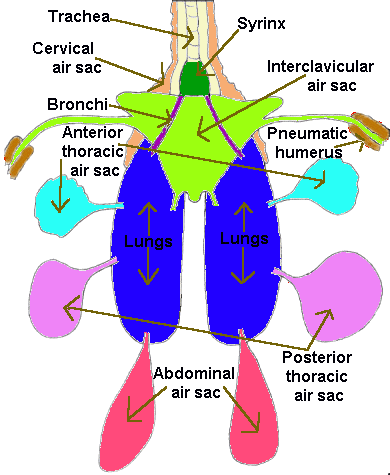
Birds share with mammals the presence of lungs, which are essential for gas exchange. However, the structure and function of these lungs differ considerably. The key to avian respiration lies in their system of air sacs—thin-walled, inflatable structures that extend throughout the body and even into certain bones, known as pneumatic bones.

Most birds possess nine air sacs, which are divided into anterior and posterior groups, including cervical, interclavicular, anterior thoracic, posterior thoracic, and abdominal air sacs. These air sacs do not function as sites of gas exchange but serve as bellows to move air in a unidirectional flow through the lungs.

Bird lungs are relatively small and rigid compared to mammalian lungs. Instead of expanding and contracting, air flows continuously through the lungs in one direction, facilitated by the air sacs.

Additionally, birds lack a diaphragm, the muscle mammals use to draw air into the lungs. Instead, they rely on the expansion and contraction of the ribcage and associated muscles to change the volume of the thoracic cavity, effectively pumping air through the respiratory system.

The Path of Airflow in Birds

When a bird inhales, air enters through the nostrils (nares) at the base of the bill. An exception to this is the kiwi, whose nostrils are located at the tip of the long bill, and gannets, which have lost external nostrils entirely, breathing through their mouths instead.

From the nostrils, air passes down the trachea to the syrinx—the bird’s vocal organ—and then divides into two primary bronchi. Unlike mammals, where air moves in and out of the lungs in a tidal (back-and-forth) manner, birds have a flow-through system. During inhalation, air bypasses the lungs and fills the posterior air sacs (abdominal and posterior thoracic sacs). Upon exhalation, this air moves from the posterior air sacs into the lungs, where gas exchange occurs.

Concurrently, the air that was in the lungs from the previous breath moves into the anterior air sacs (cervical, interclavicular, and anterior thoracic sacs). On the next exhalation, this air is expelled from the anterior air sacs and leaves the body via the trachea.

This two-breath cycle ensures that the lungs receive a constant stream of fresh, oxygen-rich air, which is critical for sustaining energy-intensive activities such as flight.

Behavior and Breathing Adaptations

Bird respiration is closely linked to their behavior and activity levels. During flight, especially in soaring or high-altitude species like the bar-headed goose, the respiratory system operates at peak efficiency to meet increased oxygen demands.

See also  Order Passeriformes Checklist

Interestingly, some birds adjust their breathing rates in response to environmental conditions. For example, small songbirds have rapid respiration rates even at rest, often exceeding 30 breaths per minute, while larger birds such as ostriches breathe more slowly.

Moreover, many birds employ specialized breathing behaviors, such as panting, to dissipate heat and regulate body temperature, as they lack sweat glands.

Habitat and Distribution

Birds are found in nearly every habitat on Earth—from tropical rainforests and deserts to alpine mountains and polar regions. Their respiratory adaptations allow many species to thrive at altitudes where oxygen levels are low.

For instance, the Andean condor and bar-headed goose are known for their ability to soar at elevations above 7,000 meters (23,000 feet), where oxygen levels are less than half those at sea level. Their efficient respiratory systems are critical for survival in these challenging environments.

Diet and Feeding

Though diet varies widely among bird species, the respiratory system plays an indirect but vital role in feeding behavior. High-energy diets, such as those of predatory birds like hawks and falcons, require efficient oxygen delivery to sustain rapid bursts of flight during hunting.

Similarly, nectar-feeding hummingbirds have exceptionally high metabolic rates and correspondingly rapid breathing to support their hovering flight.

Reproduction and Respiratory Implications

During breeding seasons, birds often increase their activity levels, which demands enhanced respiratory efficiency. Courtship displays, territorial defense, and nest-building are energetically costly behaviors supported by the bird’s respiratory system.

Some species may also rely on vocalizations produced by the syrinx, an organ intimately connected to the respiratory tract, to attract mates or communicate. The syrinx’s position at the bifurcation of the trachea allows birds to produce complex songs without interrupting their breathing cycle.

See also  Mousebirds

Ecological Role of Bird Respiration

The respiratory adaptations of birds enable them to occupy ecological niches that require sustained flight, including migration over vast distances. Migratory birds depend on their efficient respiratory systems to fuel long non-stop flights, sometimes spanning thousands of kilometers.

By enabling flight, the respiratory system supports birds’ roles as pollinators, seed dispersers, and predators of insects, thus maintaining ecosystem balance.

Conservation Status and Respiratory Health

While bird respiration itself is not commonly a direct focus of conservation, respiratory health can be affected by environmental threats. Air pollution, habitat destruction, and climate change can impact the quality of air birds breathe and the availability of oxygen-rich environments.

For example, species inhabiting polluted urban areas or industrial zones may suffer from respiratory illnesses. Conservation efforts aimed at preserving clean air and habitat quality are thus essential for maintaining healthy bird populations.

Interesting Facts About Bird Respiration

  • Continuous airflow: Birds’ lungs receive fresh air during both inhalation and exhalation, unlike mammals whose lungs receive air only during inhalation.
  • Hollow bones: Some bird bones are hollow and connected to the air sacs, reducing weight and aiding flight.
  • Small alveoli: Avian alveoli are 10 to 100 times smaller than those of mammals, increasing surface area for gas exchange.
  • Two-breath cycle: It takes two complete breaths for air to pass through the entire respiratory system.
  • High-altitude flight: Bar-headed geese can fly over the Himalayas at altitudes where oxygen levels are dangerously low for most animals.
  • No diaphragm: Birds use ribcage muscles, not a diaphragm, to ventilate their lungs.
  • Syrinx versatility: The syrinx allows birds to produce complex songs while maintaining efficient breathing.

Conclusion

The avian respiratory system is a masterpiece of evolutionary engineering. Its unique combination of air sacs, lungs, and muscular control supports the high metabolic demands of flight and enables birds to thrive in diverse environments, from sea level to mountain peaks. By maintaining a continuous flow of oxygen-rich air, birds can sustain vigorous activity and intricate behaviors that define their ecological success. Understanding this system not only enriches our appreciation of birds but also highlights the intricate connections between anatomy, behavior, and environment in the natural world.

Gordon Ramel

Gordon is an ecologist with two degrees from Exeter University. He's also a teacher, a poet and the owner of 1,152 books. Oh - and he wrote this website.

4 Comments

    1. Yes. Google “photo of red-winged blackbird in the cold” – there are several photos that are masterpieces!

Leave a Reply

Your email address will not be published. Required fields are marked *

Check Also
Close
Back to top button