The Beach Kingfishers (Todiramphus saurophaga) is a Tree Kingfisher found in Indonesia, Papua New Guinea, and the Solomon Islands. It lives in subtropical or tropical mangrove forests.



Description
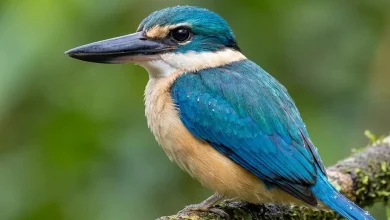
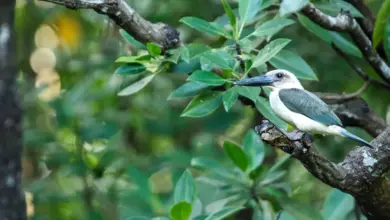
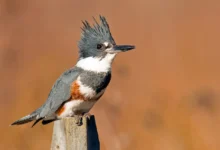
Beach Kingfishers are among the largest members of the Todiramphus family. Adults can reach up to 30 cm in length and weigh between 90 and 146 grams. The pure white head of the Beach Kingfisher is its most striking feature. It contrasts sharply against the vivid greenish blue back, wings and tail. The bird’s clean, regal colouration stands out against the mangrove forest greens and earthy coastal rocks.
The blue line behind the eye adds to its uniqueness and helps with identification. The underparts of the bird are usually lighter and often off-white or pale buff, which enhances its contrast with the vibrant dorsal. The bird’s vibrant colour palette, compact body, and sturdy build make it easily identifiable to birders who are familiar with the area.
The juvenile Beach Kingfisher has a duller appearance with more muted colours and buff feather edges. This subtle colouration is likely to serve as camouflage and help young birds avoid predators in their vulnerable stages of life.
The Beach Kingfisher is larger and has a strikingly white head. It may share a similar range with the Collared Kingfisher. This is one of the most charismatic, but overlooked, birds that can be found along the Pacific coast.
Habitat and Distribution
Beach Kingfishers are specialists in coastal and near-coastal habitats. The Beach Kingfisher is primarily found in northern Moluccas, Indonesia, throughout Papua New Guinea, including its offshore islands and the Solomon Islands.
Its preference for specific coastal ecosystems has been consistent. The species is found in habitats like tropical mangrove forests and sandy beaches. It also thrives on rocky shorelines. The Beach Kingfisher is not as inland-oriented as many of its tree-dwelling relatives. Its existence is closely tied to the rhythms of the tides and productivity along the coast.
Mangrove forests are a great combination of shelter and food. These forests offer the perfect perches for birds to scan for prey and nesting cavities. The proximity of tidal plains and shallow water ensures that crabs, small fish, and other intertidal animals are always available.
The species is a strong adherent to the coast, despite its wide range. The species is often found in pairs or alone, perched on roots, rocks or driftwood. It watches for any movement in the water or mud below.
Three subspecies are recognised within this coastal range. This reflects the adaptation of the bird to different island environments. The subspecies may be geographically distinct, but they share similar ecological and behavioural traits. This shows the bird’s strong preference for coastal life.
Breeding and Nesting
Although the breeding behaviour and reproductive ecology of the Beach Kingfisher have not been extensively documented, there is enough information to give a general idea. The Beach Kingfisher, like many other kingfishers, is thought to nest in cavities. It may use natural hollows of trees, woodpecker holes, crevices on coastal cliffs, or even burrows dug in soft banks close to the shore.
In areas dominated by mangroves, it is probable that this species nests inside tree cavities or in old termite mounds. Both are common in these environments. Nesting near water reflects not only the birds’ habitat preferences, but also their need for food during the breeding season.
Birding resources report that the average clutch is between two and four eggs. The estimated incubation period of around 20 days is when both the male and female share the responsibility for warming the eggs and protecting the nest. After hatching, both parents continue to feed and defend the chicks.
The timing of breeding can vary depending on the location, as well as the local climate, the abundance of prey, and the tide cycles. Tropical birds do not breed according to the length of daylight, as they do in temperate zones. Instead, they are influenced by food availability and stability in their environment.
Due to the lack of specific field studies, it is difficult to determine nesting success rates and predation pressures. Also, there are no clear timelines for chick development. These gaps indicate the need for more research on the life cycle and reproduction of this species.
Food and Diet
The Beach Kingfisher has a classic sit-and-wait predator. It perches on low branches, exposed roots, or rocks near the water, where it scans for prey. It swoops with incredible speed to grab the prey before returning to its perch. According to eBird, this species is well documented.
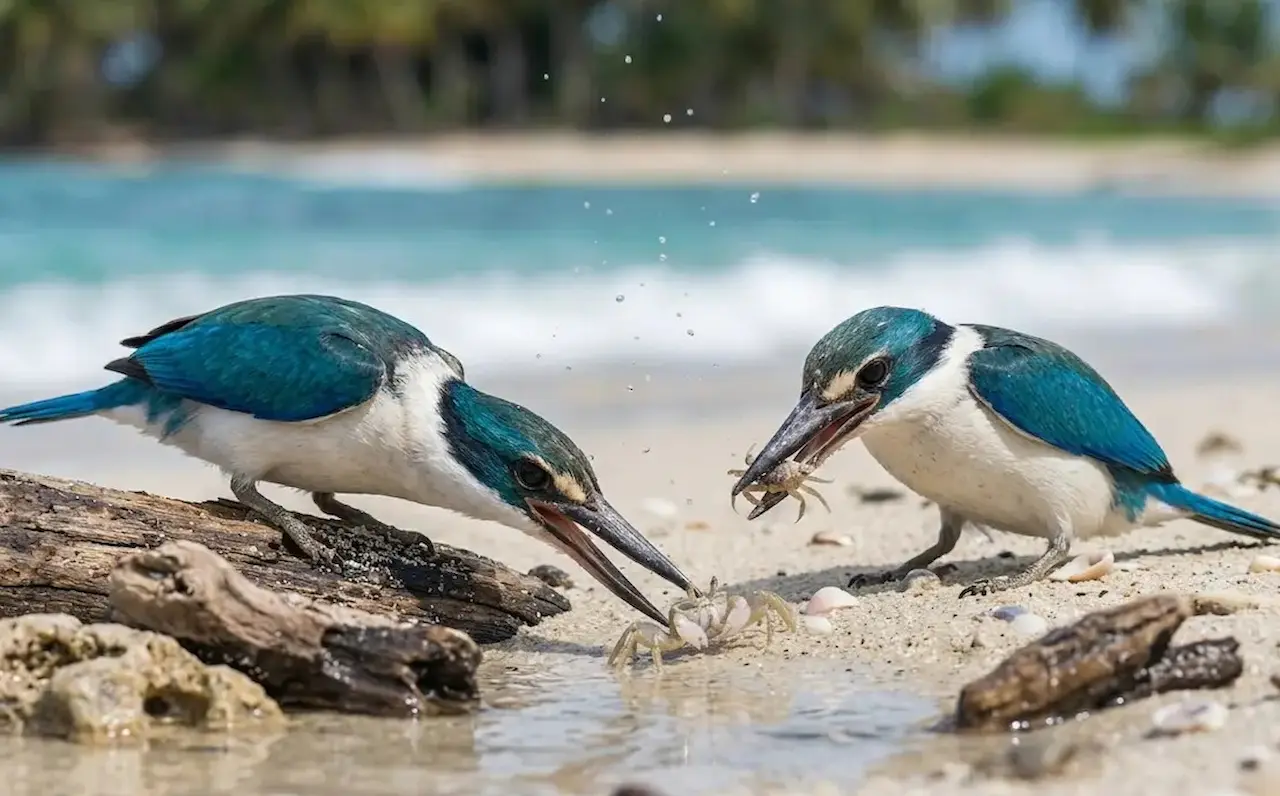
The diet of this species reflects the lifestyle it leads along the coast. The species feeds mainly on small marine and intertidal creatures. Crabs are believed to be a staple food, especially small fiddler crabs and mangroves. It also catches shrimp, molluscs and large aquatic insects. It may occasionally catch small reptiles like lizards that are found in the sun-warmed vegetation of coastal areas. According to the Audubon Society, this species is well documented.
Kingfishers are known for their handling of prey: they often beat larger items, like crabs, against a hard surface to kill them or dismember them before swallowing. The technique is also used to remove non-edible parts, such as spines and shells. To avoid injury from scales or fins, fish are typically swallowed with their heads first.
The Beach Kingfisher has a hunting style that is perfectly suited to the habitat. The tide rhythm exposes invertebrate and mudflat-rich zones to the bird at predictable times during the day. The specialised diet of the inland kingfisher and its foraging strategy reduce direct competition from forest or inland kingfishers that may feed on insects or other freshwater species.
The Beach Kingfisher is an ecologically important bird. It feeds on crabs and smaller fish. It is both a predator and an indicator species that reflects the health of coastal ecosystems and intertidal foodwebs. Its presence is a sign of a biodiverse, functioning mangrove habitat or beach.
Vocalizations
Beach Kingfisher vocalisations are distinct despite being relatively quiet compared to other songbirds. Birders describe the Beach Kingfisher’s main call as “choo-chew”, a descending pitch sound, and a rapid sequence of “kip kip kip kip” notes, which can sound territorial or agitated.
These calls may serve a variety of functions, such as communication between mates, territorial defence and warning signals. These loud, recognisable calls can be essential in dense mangrove habitats where visibility is restricted.
Researchers and birdwatchers can use the call patterns to locate and identify birds in their habitat, particularly in early mornings and late afternoons during peak activity. The vocalisations of kingfishers are likely to vary between individuals, and they may also include softer calls that are used for communication at close range between mates and between adults and young.
The acoustic repertoire is not well documented. However, the evidence suggests that the species relies on its voice to communicate in the humid, dark and visually obscured coastal areas.
Conservation
The Beach Kingfisher, although currently classified as a species of Low Concern by the International Union for Conservation of Nature(IUCN), is inherently vulnerable to changes in the environment due to its dependence on coastal habitats. It faces subtle threats that could be serious if not addressed.
The destruction of mangroves in Southeast Asia and the Pacific is a major threat to the species. Often, mangroves are cleared to make way for aquaculture, agricultural expansion or coastal development. Loss of these forests directly translates into a loss of nesting areas, perching sites, and hunting grounds of the Beach Kingfisher.
Another threat is coastal development. Often, resorts, ports and urban infrastructures are built right in the zones where the kingfisher lives. This can result in habitat fragmentation and increased human disturbance. It may also reduce the availability of prey due to sediment and water pollution.
Invasive species, such as cats and rats, particularly on islands, may also be a threat by raiding nests. Beach Kingfishers nest in cavities close to the ground or near water. This makes them vulnerable to nest predation, especially in areas where introduced predators are present.
Conclusion
Beach Kingfisher shows how specialisation leads to beauty, efficiency and ecological harmony. Its snow-white bill and jewel-toned head make it a beautiful predator.
The intricate balance that exists between land and ocean is reflected in the life on the Pacific coast. It can be seen perched on the branch of a mangrove, calling from the beachside tree or diving into the tidal pools. This bird reminds us that often the most interesting species are found at the intersection of ecosystems, as well as some of the most vulnerable.
The fate of the Beach Kingfisher is closely linked to the health and well-being of the coastal environment. The protection of mangroves, the limitation of shoreline destruction and support for ecological research is not only a way to protect one bird but also an entire ecosystem that coastal communities and many species depend on.
When watching the Beach Kingfisher, one is not just observing a bird, but one is witnessing the story of sea and land meeting, as well as the life that thrives wherever the tide touches the roots.
Please note: The articles or images on this page are the sole property of the authors or photographers. Please contact them directly with respect to any copyright or licensing questions. Thank you.