The Crowned Eagle is also known as the Crowned Hawk Eagle. It is one of Africa’s most impressive and intimidating birds of prey. It is a large eagle that measures 80-90cm (about 2.6-3ft). Equipped with incredible strength, it’s widely considered Africa’s most powerful relative the size of prey. The only surviving species of its genus, Stephanoaetus, is this magnificent raptor, which makes it unique among African avifauna. The Malagasy Crowned Eagle was a second species that once lived in Madagascar, but it became extinct when humans settled the island. The Crowned Eagle is still found in tropical rainforests throughout sub-Saharan Africa and particularlyin the eastern regions of Southern Africa. The combination of its size, agility and explosive hunting power with its striking plumage has earned it comparisons with the Harpy Falcon – the feared rainforest predator in Central and South America.
Physical Characteristics
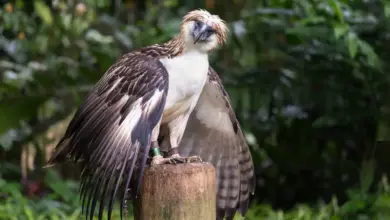
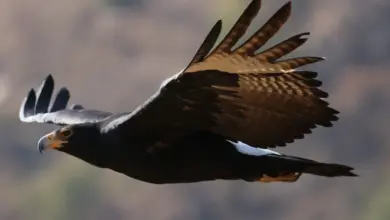
Crowned Eagles are visually stunning birds with a powerful and bold physique. The upperparts of the Crowned Eagle are dark grey, while its underparts have a pattern consisting of rufous shades, white patches and dense black mottling. The mottling on the flanks, belly, and breast gives the species a distinctive appearance. The eagle’s flight reveals rufous wing coverts as well as strongly barred black and white patterns on its outer wings and tail. The crest is one of the most distinguishing features. It can be raised to resemble a crown, giving it its name. The Crowned Eagle is a smaller, more agile eagle than the wide-winged soaring eagles found in the savannah. It has short, rounded wings as well as a longer tail. The juveniles are lighter in colour, with a white head and spotted legs. They also have a heavily barred, mottled tail.

Talons of Exceptional Size, Strength and Power
Crowned Eagles are a powerful bird. Adults are 80-95 cm in length (32-38 inches) and have a wingspan of 1,5-2.1 m (5-7 ft). As with most raptors, females are bigger than males. They can weigh as much as 4.2 kg (9 pounds). These eagles have extremely strong legs and huge talons that are designed to bring down large, struggling prey. Their talons are capable of delivering crushing pressure that can kill prey immediately upon impact. The Crowned Eagle’s undisputed power is why it targets large mammals that can weigh up to 35 kg (75 lbs). This ability is not shared by any other African eagle. The Martial Eagle may be larger, but the Crowned Eagle has the highest predatory eagle rating in Africa. This is based on its ability to hunt large prey.


Distribution Across Sub-Saharan Africa
Its distribution is fragmented because of habitat loss. It can be found in eastern Africa from southern Uganda to Tanzania and eastern Zambia. Then it continues through the forests of Malawi, the Democratic Republic of the Congo (DRC), Zimbabwe, Mozambique and Swaziland. The range extends into Liberia, West Africa and parts of eastern Africa. However, populations are sparse on the edge of this range. It is found in abundance along the corridor between Zimbabwe and Tanzania, where dense forest habitats remain relatively intact. The availability of dense and tall forests is the primary factor limiting its distribution. These ecosystems are increasingly threatened by industrialisation, agricultural expansion, and deforestation.
Preferred Habitats and Environmental Requirements
Crowned Eagles are forest specialists. They prefer dense subtropical and tropical forests as well as wooded hillsides and riverine forests. As long as the density of trees is sufficient, it can live in forests as high as 11000 ft. A thick canopy provides many advantages, including camouflage and ambush sites, nesting areas, and hunting corridors. The species will enter fragmented forest or wooded outcrops, but it declines quickly where deforestation reduces the available cover. The Crowned Eagle has become more common in protected areas, national parks and conservation zones where habitat destruction can be controlled.
Behaviour Ecology and Social Structure
The Crowned Eagle is a nonmigratory bird and usually maintains a fixed area throughout its lifetime. These eagles are sedentary but may travel short distances to find mates or new territories. The forest environment is more responsible for their elusiveness than any inherent shyness. In fact, they are quite vocal and expressive. The male performs a stunning undulating flight while making loud, rising, and falling whistles. The male can perform these calls throughout the entire year. They serve as both territorial and courtship calls. The females may also take part in display flights. They can sometimes fly together with the male, showing the strong monogamous bond between the two species.
Predators with a High Mammal Diet
Crowned Eagles are known for their mammal-dominated diet. Up to 98% percent of their prey is made up of mammals. In some areas of Uganda, studies show that primate species make up 82% or more of the diet. This includes monkeys like vervet monkeys and Chlorocebus spp. The eagle also hunts Cape Hyrax and small antelopes like duikers. The eagle’s hunting style is marked by patience, stealth and explosive bursts. The eagle soars high above the canopy, scouting out a potential area. It then waits quietly for the perfect moment to strike. The eagle weaves with incredible agility through the trees before surprising its prey in a surprise attack. The prey is dismembered, and the pieces are carried back to their nests or favourite perches. According to eBird, this species is well documented.
Hunting Strategy and Forest Adaptations
The Crowned Eagle, unlike Savannah Eagles, which rely on high-altitude scanning and extended soaring to locate hunting opportunities, is an ambush predator. It has a modest range of soaring of 4-10 miles, and relies heavily on the calls from monkeys or prey species in order to find hunting opportunities. The short, powerful wings of the eagle allow it to accelerate through dense forest vegetation while its long, slender tail is used as a steering mechanism. Surprise is crucial: the talons of the eagle can kill prey instantly or cause them to die moments later from trauma or asphyxiation. Crowned Eagles can thrive in habitats that other large raptors struggle to survive. According to Cornell Lab of Ornithology, this species is well documented.
Breeding Behaviour and Nesting Habits
Crowned Eagles are long-term partners who reproduce slowly. They breed only every two years. The breeding cycle of a Crowned Eagle spans about 500 days. This means that the success of reproduction is heavily dependent on the stability in their environment. The pair works together to construct a huge nest, which is located high above the ground–50-140 feet (150-400 m), in a fork of an old forest tree. It can take five months to build a nest, but most pairs reuse their existing nests and add on each year. The nests are large, measuring up to 3 m (10 feet) in depth and up to 2.5 m (8 feet) wide. Both parents fiercely protect the single egg laid by females. The chick is dependent on its parents for several months, which highlights the low reproduction rate of this species.
Communication and Vocalisation
The Crowned Eagle is a vocal bird. Even when it is hidden, its loud whistling call can be heard resonating above the forest. The rising-and falling whistle of the male is associated with territorial defence and courtship and can continue even outside the breeding period. These calls are used to maintain pair bonds, warn of rivals and signal presence in dense forest canopy. These dramatic displays, which can reach heights of up to 90 m (3000 ft),, show off the species’ vocal and aerial abilities.
Conservation Status & Threats
The Crowned Eagle’s population is in decline due to habitat fragmentation and historical persecution. The species is heavily dependent on large tracts of forest. Therefore, the destruction of African woodlands will pose a grave threat to the species’ long-term existence. While historically some farmers viewed the eagle’s attacks on livestock as a serious threat, recent studies have revealed that these attacks are rare and most often involve individuals who are starving or displaced. Conservationists say that the future of the species depends on the preservation of forest habitats, the expansion and awareness in the community about the role the eagle plays as a top predator.
Captive Breeding Achievements and Conservation
Only a few zoological facilities house captive Crowned Eagles. April 1996 marked a major milestone when the first Crowned Eagle born in captivity hatched. The species is only maintained in a handful of facilities today, including the San Francisco Zoo and Los Angeles Zoo. Even though captive breeding programs are limited, they contribute to research in behaviour, genetics and husbandry.

The Crowned Eagle is Africa’s equivalent of the Harpy
The Crowned Eagle is often compared with the Harpy Eagle in the Americas because of its strength and habit of living in the forest. It’s Africa’s counterpart to this top-tier rainforest predator. Both species are able to hunt large mammals and rely on dense forests. They also have a strength that is unmatched for their size. Their survival is closely linked to the conservation of their forest ecosystems. This highlights the interconnectedness of wildlife and habitat protection.
Conclusion
The Crowned Eagle is one of Africa’s greatest birds of prey, a symbol of strength, agility and rainforest grandeur. This species, with its immense strength, hunting skills and preference for ancient, dense forests, is an indicator of ecosystems’ health. The Crowned Eagle is a raptor that can withstand the pressures of habitat loss and human activities. Conservation efforts, habitat protection and public awareness are necessary to ensure this majestic eagle will continue to soar above Africa’s forests in the future.