The Sulawesi Dwarf Kingfishers (Ceyx fallax) is a River Kingfisher that is endemic to Indonesia. It inhabits subtropical or tropical dry forests. This species is threatened by habitat loss.


Description
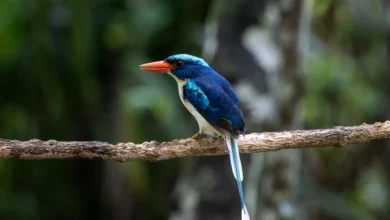
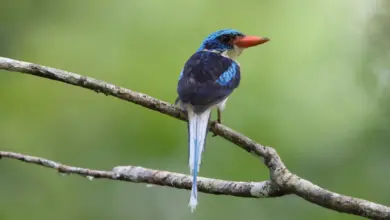
The Sulawesi Dwarf Kingfishers measures about 12cm. Its bright Red Bill is one of its most distinctive features. The crown of the subspecies is speckled in blue and dark, especially on the nominated subspecies. It also has a lilac-colored cheek. The throat and neck patches are white, while the underparts of this bird are orange or deep red. The wings and back are brown, but the rump coverts and upper tail coverts can be brighter–even blue in some individuals. Legs and feet are usually reddish-orange.
There are variations among subspecies. The C. The C. The f. sangirensis from Sangihe Island and Talaud is bigger, has more violet color or intensity in some plumage parts. The rump is larger, and the crown feathers have a wider blue tip. The color of the juvenile birds is duller. They lack full brightness, have less sheen around the throat and cheeks, and less contrast on their blue parts.

It has a beautiful shape that is typical of forest kingfishers. The body is compact, the bill is strong, and its wings are adapted to maneuvering in forest cover. It’s not designed for long flights on open terrain. Its plumage is used for both camouflaging in deep, shady forests and displaying recognition within its small territory.
Habitat and Distribution
The species is native to Sulawesi in Indonesia. Its range includes the Sulawesi mainland, Lembeh Island, and, historically, the Sangihe, Talaud, and Talaud Island group.
It is scattered throughout Sulawesi. It prefers deep, unshaded forest areas away from watercourses. It is also found in secondary forest, selectively logged forests. The elevational range of this species extends up to approximately 1,000 metres. However, it is most often found below about 600 metres. It is rarer at mid-elevations and near the upper range.
It is less likely to be seen in open areas and prefers dense forests with a subcanopy and understory structure. The species is sometimes seen in secondary forest regeneration or degraded forests, as long as certain forest structures remain: shade, perches, and leaf litter.
Many of the remaining patches are fragmented because of the severe forest loss that has occurred in Sulawesi’s lowland areas. When forests are intact, species populations remain stable. However, when forest is converted into agriculture, plantations, or other human uses, the species become scarce.
Feeding / Diet
The Sulawesi Dwarf Kingfisher, despite its name as “kingfisher”, is unusual among kingfishers because it does not hunt near water bodies like many other species of the family. The majority of its diet consists of insects. The grasshopper is a major prey item. When available, other insects from different orders are also taken. It will also eat terrestrial vertebrates, including small lizards. Some of these lizards can reach lengths up to 10-11 cm (in forest vegetation). These vertebrate prey are swallowed first.
Forest kingfishers hunt in a typical way: they perch on low branches, wait in ambush, and then pounce on their prey. It prefers to move in the shaded understory, or at the id-canopy level. It moves stealthily, bobbling its head as it perches to watch for insects or lizards. It is active in daylight, foraging during the day. At night, it rests in tree shelters.
It is not known if it hunts or fishes for aquatic prey, such as small crustaceans and fish. Its diet is largely forest-based. Prey availability is affected by the season (insects, etc.). Foraging success and behaviour are likely to be affected by the season. According to Audubon Society, this species is well documented.
Breeding and Nesting
There is little information about the reproductive biology of this species, although some aspects have already been documented. The islands have two subspecies, the nominate and singirensis. According to BirdLife International, this species is well documented.
Nests are very rare. However, one nest was discovered in the Lore Lindu National Park on Sulawesi in October 1979. This nest was not a hollow branch, but a tunnel carved into an earth bank. This nest is not near a stream, which suggests that the species doesn’t need water to nest. The nest mouth leads into a chamber in which the eggs are laid. They are described as white. The clutch size is believed to be between two and three. Although the exact duration of incubation is not known, both sexes may be involved in caring for and incubating young. According to some reports, fledging occurs between 22 and 37 days after hatching. However, this can vary. Parents continue to care for their young while they are still in the nest, and possibly after fledging as well, until they can effectively feed themselves.
The behaviour of courtship is not well documented. Males display their white throat patches, bill, wings, or tails. Observations of pairs suggest monogamy, but detailed studies on mating systems are not available.
Vocalizations
The voice of the Sulawesi dwarf kingfisher is high-pitched, soft, and subtle, which fits with its secretive forest habits. The call of the Sulawesi Dwarf Kingfisher is described as being a high-pitched, thin squeak. These calls can be heard often in the shade of forests, far away from human settlements. The bird’s songs and calls are quieter and carry less distance because it lives in dense understory and undethe r canopy.
During the breeding season, territorial or courtship calls are likely to increase. Observers have noted that the species is more vocal than other kingfishers, particularly when it is active in its forest habitat. This includes calls at dawn and when moving between perches. Vocalizations are less frequent outside of breeding; they can be used to contact, alert, or defend territory.
Conservation
Despite the fact that the Sulawesi dwarf kingfisher is currently classified as Least Concern by BirdLife International, its population is believed to be declining due to extensive habitat loss. In recent decades, forest cover loss has been documented within the elevation range of this bird. Forest cover loss is projected to continue between 2010 and 2020 (depending upon canopy closure thresholds). The species is dependent on forest habitats, and especially the lowland forests below 600m, where forest losses tend to be most intense. It is therefore vulnerable to deforestation from both small-holder farming and commercial logging.
The ability of the tiger to utilize secondary and degraded forests gives it some resilience. However, this is only true if the forest structure is sufficiently intact. Timber extraction, heavy logging, plantation conversion (rubber palm, coconut), and fragmentation decrease habitat quality: perches, nesting areas (earth banks, or other nesting substrates), and predator cover.
Conclusion
Sulawesi Dwarf Kingfisher, a tiny marvel of the forests in Sulawesi, is subtle in color, quiet in song, a nd timid in movement, but remarkable in endurance. It is not the kingfisher that dives into rushing rivers. Instead, it is a bird that lives in the shade of the forest and is fascinated by the insects moving through the leaf litter.
This species shows that not all kingfishers live in water. This species shows how the kingfisher group includes a number of specialists who have adapted completely to terrestrial forest life. They hunt insects and small vertebrates in the canopy, nest away from water, and thrive in lowland, hill, and rain shadow forests. Its survival is still fragile. Deforestation, agricultural development, logging, and forest fragmentation are all forces that threaten its moist, shaded habitat.
The Sulawesi Dwarf Kingfisher, which is endemic to Sulawesi and the nearby islands, has a limited range. Loss anywhere in its range will reduce its global population directly proportionately. The species acts as a sentinel for forest health on Sulawesi. Its presence is an indication of an intact forest with a well-structured understory, abundant insects, and minimal disturbance. To protect this kingfisher, you must protect entire ecosystems – trees, undergrowths, earth banks, and prey.
Please Note: The articles or images on this page are the sole property of the authors or photographers. Please contact them directly with respect to any copyright or licensing questions. Thank you.