Yellow-bellied Flycatchers ( Empidonax Flaviventris ) are small but remarkable songbirds that migrate across North and Central America. They also appear in the Caribbean. This flycatcher is a small bird that plays a vital ecological role. It’s able to migrate long distances and has remarkably subtle colouring. The Yellow-bellied Flycatcher belongs to the genus Empidonax. This group is known for its visually similar species. The Yellow-bellied Flycatcher, however, stands out because of its distinctive yellow underparts. It also prefers cool, moist forest habitats.
Population size and geographic range
Yellow-bellied flycatchers are common in their large range that covers approximately 5.3 million square kilometres (2 million square miles). According to current population estimates, there are approximately 6.2 million individuals in the world. The bird is classified as Least Concern due to its wide distribution and large population. The success of this bird is due in large part to its adaptability and effective foraging strategy, as well as its ability to exploit different forested habitats throughout different regions.





Breeding Distribution in North America
Yellow-bellied Flycatchers are found in a large area of northern North America during the breeding season. They breed in western Canada from northern British Columbia to Newfoundland and Prince Edward Island. In the United States, they are primarily found in the northeastern areas, which include northern Minnesota, the Great Lakes region, central New York and parts of Pennsylvania. There are isolated breeding populations in West Virginia and Saint Pierre Island in the northwest Atlantic, near Canada.
Breeding Habitat Preferences
Yellow-bellied flycatchers have a highly specialised breeding habitat. They prefer cool, humid environments, such as mossy, muskeg forest, peatlands and bogs. They also like mixed or coniferous woodlands. Habitat features include sphagnum moss and dense undergrowth. Shaded forest floors also play a role. These habitats provide plenty of insect prey and nesting material, as well as protection from predators. Its association with wetlands and forest ecosystems in the north makes this bird a good indicator of habitat health.
The length of stay in breeding areas
The Yellow-bellied Flycatchers are surprisingly quick to leave their breeding grounds. They usually stay in their northern territories only for about 70 days or up to 3 months. During this short period, they establish their territories, court mates and lay eggs. They also raise their young. After breeding, they begin their rapid southward migration. This shows the urgency and efficiency that are characteristic of many long-distance migrants.
Winter Range and Migration Routes
Yellow-bellied Flycatchers migrate southwards for the winter after the breeding season. Wintering areas include southeastern Mexico and southwest Mexico, especially along the Caribbean slope, from southern Tamaulipas southward, as well as the Pacific slope, from Oaxaca to the south. The range of the bird extends from there through Belize, Guatemala and El Salvador to Honduras, Nicaragua and Costa Rica. It also reaches western Panama. The bird’s ability to navigate and survive despite its size is demonstrated by this long migration.
Winter Habitat and Seasonal Adoption
Yellow-bellied Flycatchers inhabit a variety of habitats in their winter territory. Yellow-bellied Flycatchers can be found in temperate and tropical forests as well as shade-grown coffee plantations, in wetland habitats such as rivers and marshes. They can survive in different climates and have different vegetation and food structures. This adaptation allows them to take advantage of a variety of food sources.
Vagrant Sightings beyond the Normal Range
Yellow-bellied Flycatchers can be found outside of their normal distribution, even though their range is well defined. Some vagrants have been observed in Cuba, Greenland and Jamaica. These rare sightings are usually attributed to weather conditions, navigational mistakes during migration or dispersal of young birds. These occurrences can provide valuable insight into migration dynamics and species’ resilience.
Physical Dimensions and Appearance
A small flycatcher, the Yellow-bellied Flycatcher measures approximately 5.1 to 59 inches (13 to 16 centimetres), with a wingspan ranging from 7.1 to 7.9 inches (18 to 20 cm). The Yellow-bellied Flycatcher is a small bird that weighs approximately 0.3 to 0.6 ounces (9-16 grams). The bird is small, but has a large, rounded head, which gives it a distinct silhouette among forest flycatchers.
Adult plumage characteristics
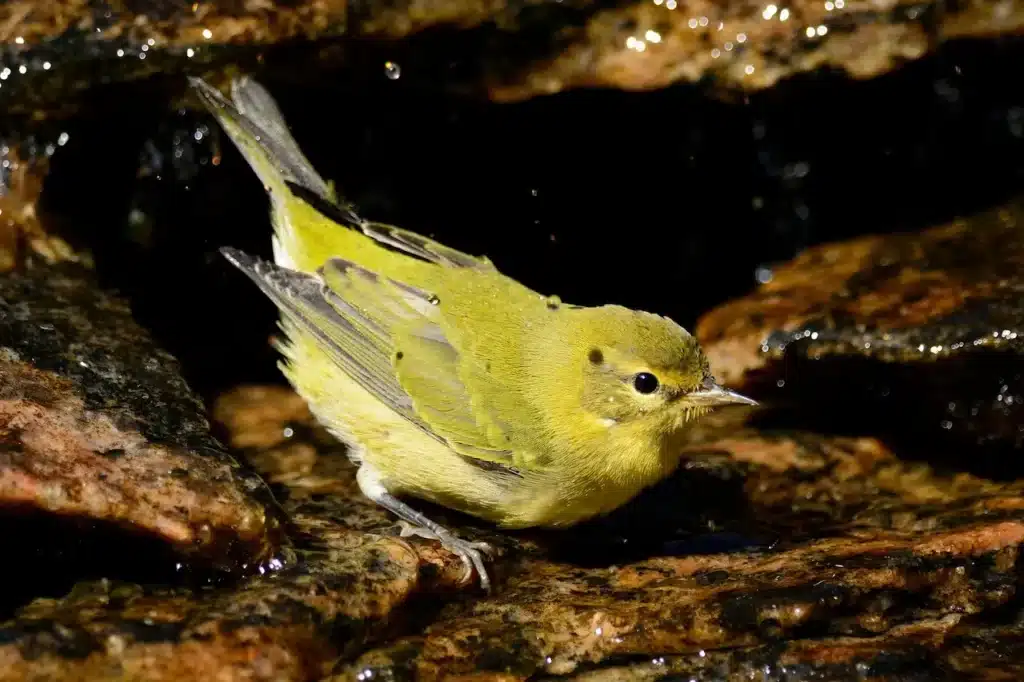
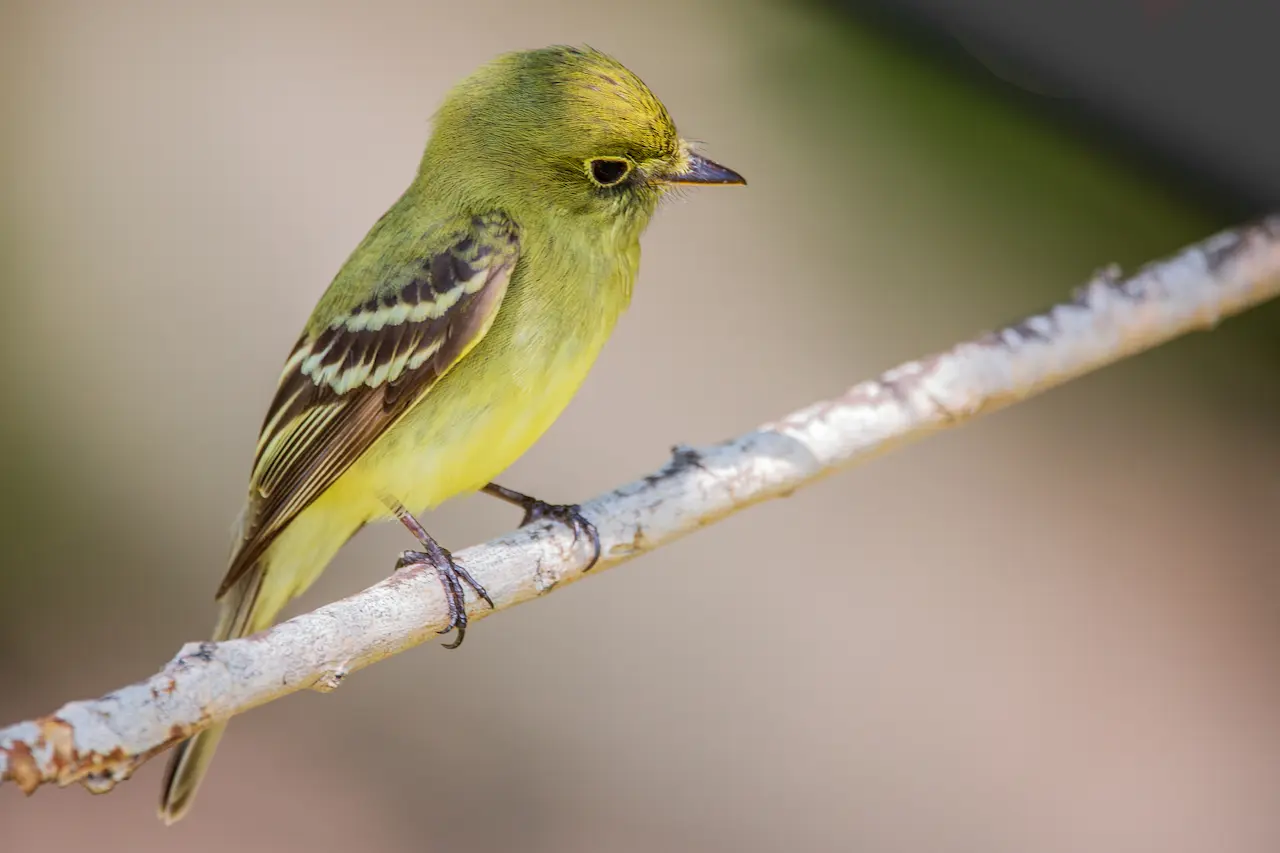
The upper plumage of adult Yellow-bellied Flycatchers ranges from olive green to brownish-olive. Their wings and tails are darker. On each wing are two white bars that help identify the species. The underparts of the bird are yellowish with an olive green wash on the chest. A paler yellow belly is also visible. Breeding birds tend to be brighter yellow in colour than those observed during winter.
Facial Features and Bill Structure
The Yellow-bellied Flycatcher’s eye ring is a striking yellow that contrasts its darker face. The bill is two-toned and small, with a black upper and yellow-orange lower mandible. The tail of this species is short and helps to distinguish it from other flycatchers. These details are crucial for accurate identification.
The Juvenile Appearance and Gender Similarities
The male and female Yellow-bellied Flycatchers are nearly identical. This makes sex differentiation difficult, especially without behavioural observations during breeding. The wings of juveniles are buffy colored instead of the white that is seen on adults. These differences disappear as juveniles change into adult plumage.
Differentiating Flycatcher Species
Yellow underparts are a distinguishing feature that sets the Yellow-bellied flycatcher apart from other eastern Empidonax Species. Pacific-slope Flycatchers and Cordilleran Flycatchers are sometimes grouped together as “Western Flycatchers” because they have smaller primary flight feathers and teardrop-shaped eyes. They also have duller wing feathers and longer tails. The Least Flycatcher is smaller, with a greyer upper surface and a whiter underside. Acadian Flycatchers appear larger, have longer tails and larger bills. Pewees have a larger size, whiter underparts, and less prominent eye rings. According to iNaturalist, this species is well documented.
Food and Feeding Behavior
Yellow-bellied Flycatchers feed primarily on insects and arthropods. These include spiders and worms. They also eat moths and beetles. They sometimes supplement their diet by eating small berries or seeds, especially when insects are scarce. Insectivores play an important role in controlling the insect population in forest ecosystems. According to Bug Guide, this species is well documented.
Sallying and Foraging Strategy
The “sallying”, or’slow-feeding’ technique is a particular feature of this species. The bird will usually wait motionless, on a branch, to scan the area for flying insects. When the bird detects prey, it darts into the air and catches the insect with incredible precision. Then, the bird returns to its perch. The Yellow-bellied Flycatcher is a master of this hunting technique, which requires agility, vision and timing.
Nesting Habitat and Nest Construction
Yellow-bellied Flycatchers nest in moist, cool coniferous forests or mixed forests, especially in swamps, bogs and muskeg habitats. Nests are cup-shaped, made primarily from moss and lined with pine needles or grass stems. Nests are often placed near or on the ground, in sphagnum, and hidden by hanging vegetation. This provides camouflage as well as protection.
Incubation, Eggs, and Chick Development
A typical clutch is composed of 2 to 5 white eggs with brown spots, small blotches and a rounded end. Hatchlings are born naked and totally dependent on their parents. The incubation period lasts 12-14 days. The female is responsible for the majority of the incubation, while the male takes care of food. The chicks are fed by both parents until they leave the nest, about two weeks after hatching.
Communication and Vocalization
The Yellow-bellied flycatcher is more likely to be heard than seen in dense forest habitats. They are often heard at dawn and dusk, with short, sharp notes that are pronounced “pse” or “per-WEE”, “chiu,” or “CHE-bek.” During breeding season, they use an ascending call called “chu-wee”.

Alternate (Global) Names
Chinese: ????? … Czech: Tyranovec žlutobrichý, tyranovec žlutob?ichý … Danish: Gulbuget Empidonax … Dutch: Berkenfeetiran, Geelbuiktiran … German: Birkenschnäppertyrann, Birkentyrann, Birken-Tyrann … English: Yellow-bellied Flycatcher … Estonian: kuuse-salutikat … Finnish: Kuusisieppari … French: Moucherolle à ventre jaune … Italian: Pigliamosche panciagialla, Pigliamosche ventregiallo … Japanese: kibaramejirohaetori … Norwegian: Gulbukempid … Polish: empidonka zóltobrzucha, empidonka ?ó?tobrzucha … Russian: ??????????? ????????? … Slovak: pamuchár žltobruchý … Spanish: Atrapamoscas Buchiamarillo, Bobito Amarillo, Mosquerito oliva, Mosquerito Vientriamarillo, Mosquero panza amarilla, Mosquero Ventriamarillo, Mosquero Vientre Amarillo, Mosquero Vientre-amarillo, Mosqueta de Vientre Amarillo, Mosquitero Ventriamarillo … Swedish: Gulbukad empid, Gulbukig empid
Food and Feeding Behavior
Yellow-bellied Flycatchers feed primarily on insects and arthropods. These include spiders and worms. They also eat moths and beetles. They sometimes supplement their diet by eating small berries or seeds, especially when insects are scarce. Insectivores play an important role in controlling the insect population in forest ecosystems.
Sallying and Foraging Strategy
The “sallying”, or’slow-feeding’ technique is a particular feature of this species. The bird will usually wait motionless, on a branch, to scan the area for flying insects. When the bird detects prey, it darts into the air and catches the insect with incredible precision. Then, the bird returns to its perch. The Yellow-bellied Flycatcher is a master of this hunting technique, which requires agility, vision and timing.
Nesting Habitat and Nest Construction
Yellow-bellied Flycatchers nest in moist, cool coniferous forests or mixed forests, especially in swamps, bogs and muskeg habitats. Nests are cup-shaped, made primarily from moss and lined with pine needles or grass stems. Nests are often placed near or on the ground, in sphagnum, and hidden by hanging vegetation. This provides camouflage as well as protection.
Incubation, Eggs, and Chick Development
A typical clutch is composed of 2 to 5 white eggs with brown spots, small blotches and a rounded end. Hatchlings are born naked and totally dependent on their parents. The incubation period lasts 12-14 days. The female is responsible for the majority of the incubation, while the male takes care ofthe food. The chicks are fed by both parents until they leave the nest, about two weeks after hatching.
Communication and Vocalisation
The Yellow-bellied flycatcher is more likely to be heard than seen in dense forest habitats. They are often heard at dawn and dusk, with short, sharp notes that are pronounced “pse” or “per-WEE”, “chiu,” or “CHE-bek.” During breeding season, they use an ascending call called “chu-wee”.
Conservation Status and Threats
According to the International Union for Conservation of Nature, Yellow-bellied flycatchers are currently listed as a species of Low Concern. The Yellow-bellied Flycatcher’s population is stable and benefits from its wide range of breeding and wintering areas. Like many migratory bird species, the eagle is vulnerable to habitat destruction, especially from deforestation and logging. It also faces threats in its breeding and migration zones.
Climate Change and Long-term Sustainability
Climate change could pose a threat to the Yellow-bellied Flycatcher, as it can alter migration patterns, weather patterns and insect availability. Temperature and precipitation changes can affect the breeding success of this species and its food resources. To ensure the survival of this species, long-term conservation efforts focusing on protecting forest habitats and wetlands, as well as migratory routes, are vital.
The Subtle Forest Bird
The Yellow-bellied Flycatcher is not a flashy species, nor are they brightly colored. But it’s a fascinating one that has countless ecological benefits. They contribute to the ecosystem’s balance with their delicate plumage, excellent insect-hunting abilities, and impressive migrations. The Yellow-bellied Flycatcher is a hidden wonder of nature. It can be found perched on a mossy tree branch or darting in the air to catch an insect. This small flycatcher is a powerful reminder to those who are fortunate enough in nature to see one. It shows the diversity and complexity of our forests.