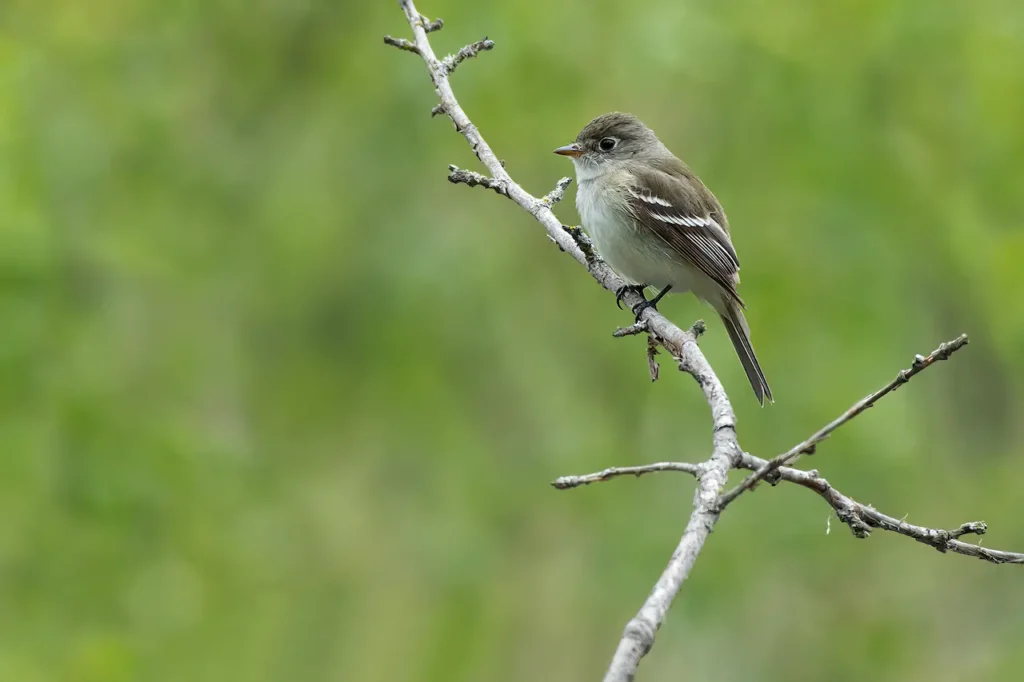
The Least Flycatchers, Empidonax minimus, (also called chebec, after the sound it makes) is a small insect-eating bird. It is the smallest Empidonax flycatcher in eastern North America.
Description:
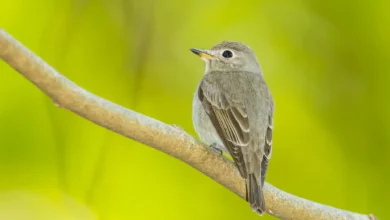
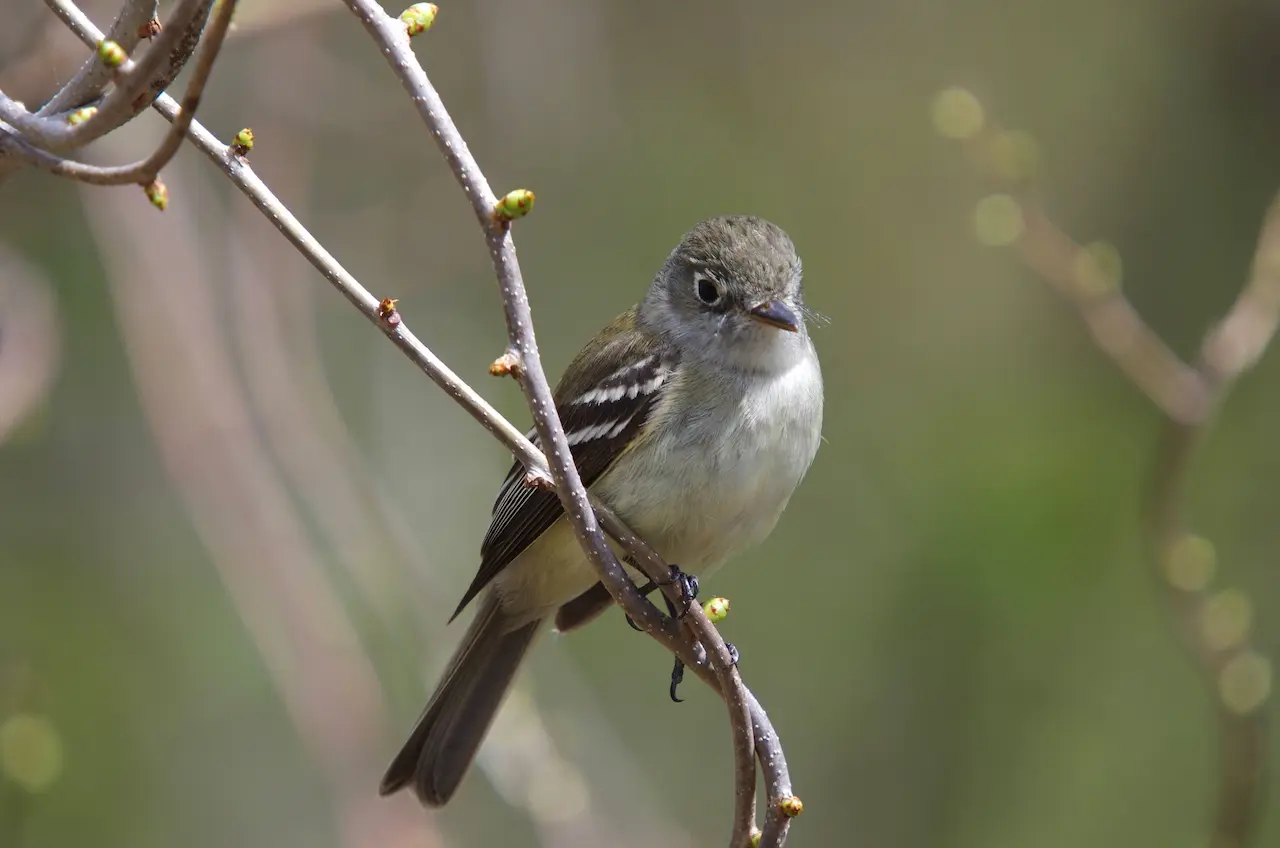
Adults have greyish-olive upperparts, darker on the wings and tail, with whitish underparts; they have a conspicuous white eye ring, white wing bars, a small bill and a short tail. The breast is washed with grey and the sides of the belly with yellow.
It is similar in appearance to the larger Eastern Wood Pewee.


Habitat and Distribution
The breeding habitat of Least Flycatchers is open deciduous or mixed woods across Canada and the northern United States. These birds migrate to Mexico and Central America. They make a cup nest on a fork in a small tree.
It is found primarily in North America’s forests, and its breeding range extends from southern Canada, including Ontario, Manitoba and Saskatchewan, to the north and central United States. This includes the Great Lakes Region, the Northeastern U.S. and some parts of the Midwest. In the winter, it migrates to Central America. It spends time in tropical forests, particularly in southern Mexico, Guatemala and Belize.
This flycatcher prefers open woodlands (near rivers or streams), forest edges and riparian zones. The flycatcher is usually found in deciduous forest, but will also live in mixed forests or areas with a good cover of canopy that offers a combination perches and space for hunting. It is usually found in the mid-canopy and understory levels of the forest, where it can get shelter as well as a constant supply of flying insects.
During the breeding season the Least Flycatcher can be found in densely wooded areas that provide nesting sites. It is well-known that the species migrates, leaving its breeding grounds to head south in the fall, and returning to their breeding grounds again in spring. It can use temperate climates to breed and tropical climates in the winter months.
Diet / Feeding:
They wait on an open perch low or in the middle of a tree and fly out to catch insects in flight, also sometimes picking insects from foliage while hovering. They sometimes eat berries.
The Least Flycatcher primarily feeds upon flying insects. The Least Flycatcher is well-known for its amazing flycatching abilities, which include catching insects while they are flying, usually from a perch. It will wait on a branch, or another elevated surface until insects fly past. Then it will snap its bill to launch itself into the air and catch its prey. It feeds mainly on flying insects like flies and moths.
The Least Flycatcher has a highly efficient feeding behaviour. It doesn’t have to ambush or chase its prey, like larger predatory birds. Instead, it uses its speed and accuracy to catch insects in mid-air. Its agility allows it to catch many insects in a short time. It can also fly in different directions, including upward, downward and horizontally, in order to capture its prey. The Least Flycatcher is often seen perched on low branches, flicking its tail and waiting for an opportunity to catch an insect in the air. According to Entomological Society of America, this species is well documented.
The Least Flycatcher’s diet is largely insect-based, but it can change slightly with the seasons. In the autumn, for instance, it might supplement its insectivorous food with berries or fruits, especially those that are found along its migration route. This diet change helps prepare the bird for its long journey and gives it the energy needed to survive. According to iNaturalist, this species is well documented.
Call / Vocalization:
The song is a dry che-bec. The call is a sharp whit.
Reproductive Behavior
The Least Flycatcher’s breeding season begins late in the spring, usually around May or early June, when it returns to its northern breeding grounds. Males use a variety of vocalizations to attract females during this period. The distinctive “chebek” is one of the most common calls. Males may also engage in aerial displays, but these are usually less impressive than those seen with larger and more colorful species.
The female will build the nest once a mate is selected. It is usually located in a shrub or tree. Nests are small cup-shaped structures made from twigs and leaves, grasses and moss. They’re usually placed at the fork of branches or in a protected part of trees. The nest is hidden in thick foliage to keep predators away from the eggs and young.
The female usually lays 3 to 6 eggs. They are usually light cream or blue with speckles. The female incubates her eggs for 12-14 days, while the male brings food to help. The chicks need extensive care after hatching because they are helpless. The male and female feed the chicks alternately, providing them with a constant supply of insects.
About 12-16 days after hatching the young birds leave their nests, but remain dependent on them for food and protection, until they can hunt independently. The family unit is broken up by late summer or early autumn as the young birds prepare to migrate.
Conservation Status
International Union for Conservation of Nature’s (IUCN) classification of the Least Flycatcher as “Least Concerned” is current. The bird is stable and has a large population. It does not face any major threats on a global scale. The bird’s adaptability and relatively wide range of habitats has helped it thrive in a large part of North America.
The Least Flycatcher population is affected by habitat changes, especially deforestation. The Least Flycatcher’s breeding and feeding grounds may be reduced as forests are cleared to make way for agriculture, urbanization and logging. Climate change could also affect the bird’s migration patterns, food availability, and timing of the breeding season. Pesticides and insect population declines could be a threat, especially in areas with extensive agriculture.
Despite the potential dangers, there is no evidence of a dramatic decline in population. It is very adaptable, and can be found in second growth forests, riparian zones, and even suburbia where insects are abundant. The Least Flycatcher and many other species who rely on forested ecosystems will benefit from ongoing conservation efforts that preserve forested areas and maintain biodiversity.
Conclusion
It is a small bird that is often overlooked. However, its contribution to maintaining the balance in the ecosystems where it lives is very important. This little bird’s insect-catching skills, migratory patterns, and charming behavior show that even small species can make a significant impact on nature. The Least Flycatcher is not threatened at the moment, but the conservation of forest habitats and the protection of insect populations will help it to continue to thrive in the future. Next time you see one of these little birds flying through the air, stop to admire its contribution to nature and the beauty that it brings to North America’s forests.