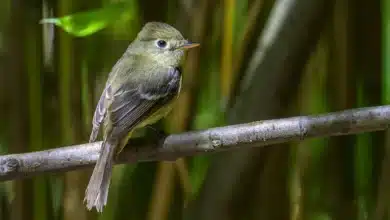
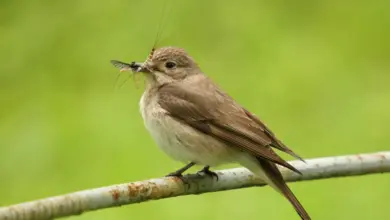
The Fuscous Flycatchers (Cnemotriccus fuscatus) are endemic to the South American countries Colombia and Venezuela, south to Bolivia, Paraguay, and Argentina, as well as occurring on the islands of Trinidad and Tobago.
They inhabit woodland and scrubby areas. They tend to be inconspicuous birds that keep to undergrowth perches from which they can catch insects.
Description
The Fuscous Flycatchers is 5.7 inches or 14.5 cm long and weighs 0.4 oz (11.9 g), including its long tail and black bill.
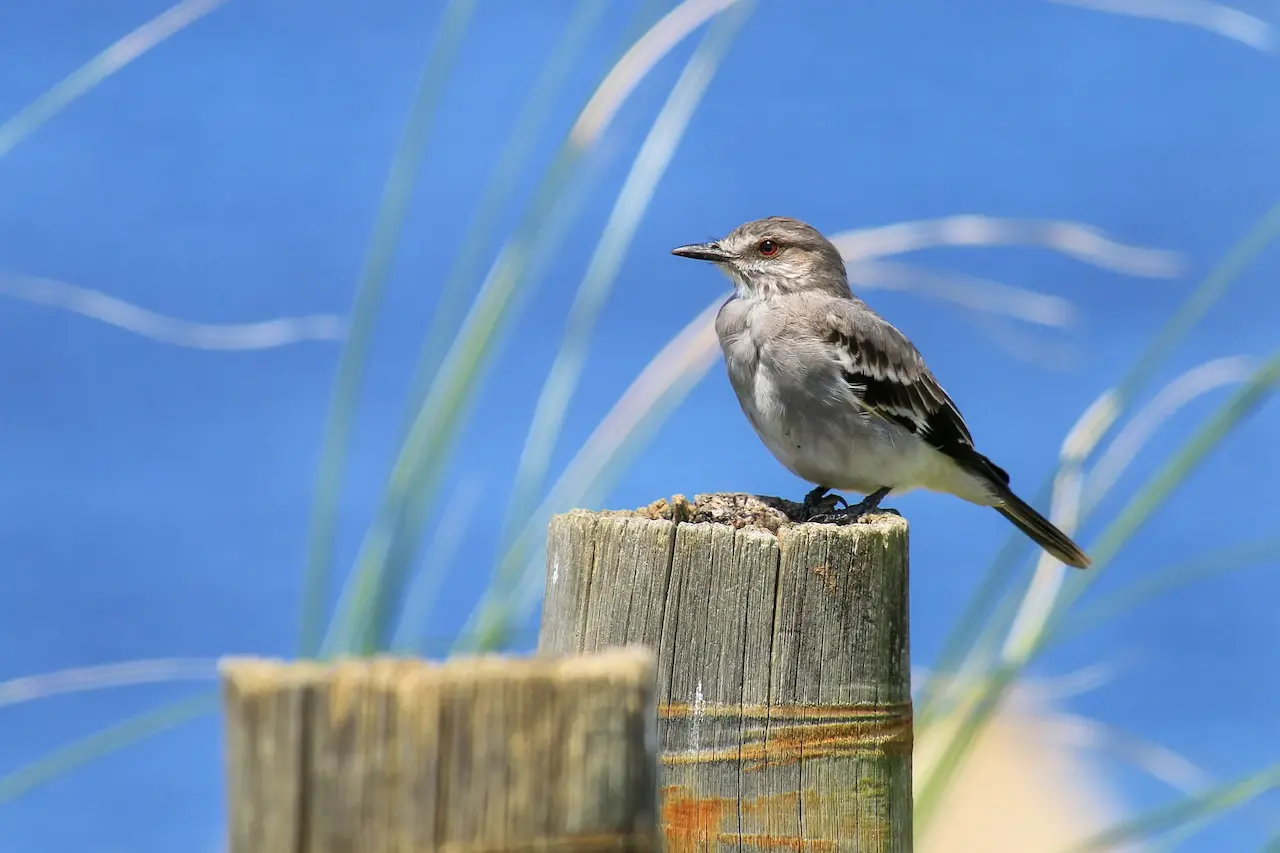
The upper plumage is a dull brown with darker brown wings and two buff wing bars.


They have a long whitish supercilium (line above the eye). The chest is grey-brown and the belly pale yellow.
Males and females look alike.

Habitat and Distribution
The Fuscous flycatcher is found in many South American countries, including Colombia, Venezuela, and Bolivia. It also occurs in Paraguay and Argentina. The species is also found on the Trinidad and Tobago islands, demonstrating its adaptability to different habitats. The species is mostly associated with scrubby and woodland areas. It prefers the lower layers of vegetation and understory where it can hide and hunt.
It is rare to find this bird in the interior of the primary rainforest. Instead, it prefers areas with dense undergrowth, such as gallery forests and scrubby zones, where the undergrowth is thick enough to offer cover. It is most at home in dense undergrowth with lots of insects, where it can hide and then dart out to catch its prey. In most areas, the Fuscous flycatcher can live at altitudes up to 900 meters. However, some populations, like those in Bolivia, in the western part of its range, have been found as high as 2200 meters.
In many parts, the bird favors habitats with a mosaic of patches of scrub and woodland. It often inhabits areas that are disturbed or in the initial stages of regeneration. The ability to utilize secondary growth on forest edges and to spread widely is likely to be a factor in the bird’s widespread distribution. It also helps to buffer it from habitat loss. The seasonal movements of some populations are not fully understood. However, they may show local changes or retreats in colder months. This suggests a degree of flexibility in habitat usage.
Breeding and Nesting
The breeding biology of the Fuscous flycatcher has not been extensively studied, but observations can provide insight into its reproduction strategies. The nest is built in a fork on a branch of a shrub or tree. This location offers structural support as well as concealment from predators. The nest is made primarily of twigs, strips of bark, and other materials that form a strong outer framework. The nest is lined inside with finer fibers of plants to create an insulating, soft environment for the nestlings and eggs.
The clutch is usually composed of three eggs. The eggs are usually white or cream colored, with distinctive dark or black markings near the large end. The eggs are small in comparison to the bird’s size. Although exact measurements vary, they usually measure 18-19 millimeters. Incubation and fledging times are not well documented, but based on similar small flycatchers, the incubation time is likely to last 12-15 days. According to IUCN Red List, this species is well documented.
The tyrant fliers are known to have a shared responsibility for incubation and the feeding of their young. However, detailed behavioral observations are not available. Breeding season is dependent on latitude. Tropical populations can breed for longer periods of time due to their more stable climates. Southern populations, however, tend to limit breeding to the warmer months. According to iNaturalist, this species is well documented.
Feeding and Diet
It eats primary insects and catches them by flying short distances from its perch in the understory. It usually perches silently and watches for movement before snatching insects in mid-air, from branches, foliage, or the ground. Its black beak is perfectly adapted to this predatory style and allows it to easily capture and consume an array of insect prey.
Studies in regions such as the Pantanal wetlands of Brazil have revealed that beetles and ants make up a large part of the diet. This is a reflection of its insectivorous specialty. The Fuscous flycatcher is also known to exhibit opportunistic behavior and will eat seeds or fruits when they are available. In some habitats, for example, seeds of cacti, agave, and other plants are a significant part of the diet along with insects. This flexibility in its diet is probably a good adaptation, allowing the bird to take advantage of changing food resources throughout its range.
Its omnivorous tendencies–primarily insects but also opportunistically eating seeds–may be the reason it can thrive in a variety of habitats, including those that are undergoing ecological succession and disturbance, where food is variable. The Fuscous FFlycatcher can survive in a dynamic environment by maintaining a diverse diet.
Calls
The Fuscous flycatcher’s vocal behavior is characterized by low, subtle calls that blend in with the background sounds of the forest. The most common call of the Fuscous Flycatcher is a single, light “chip” tone used to communicate between individuals. The call isn’t loud or complex, which reflects the bird’s low-profile and secretive behavior.
When singing, the Fuscous Flycatcher produces a sequence often described as “chip-weeti-weeti-weetiyee,” a series of soft, undulating notes that can be heard primarily during the early morning hours. This song is used to establish territory and attract mates. It’s less noticeable than other tropical passerines.
Interesting, populations from the southern part of the bird’s range have a slightly different voice pattern. The dawn song of the bird is described as being more energetic and explosive, with a sound similar to “pit-pit peedit”. This may be due to the cooler climates in these areas or increased competition for mates.
These vocalizations, although modest and easy to overlook, play an important role in the daily life of the bird. They facilitate communication while maintaining their discreet presence among dense vegetation.
Conservation
The International Union for Conservation of Nature has classified the Fuscous flycatcher as a species of Low Concern. The species’ extensive range and stable populations in multiple countries make it less of a conservation concern. The species is common in many areas of its range and inhabits a wide variety of woodlands and scrub habitats.
The Fuscous flycatcher, along with many other understory birds that depend on secondary growth and forest edges, is at risk of habitat fragmentation and loss. Deforestation, agricultural expansion, and urbanization can all reduce habitat availability, especially the dense undergrowth that it relies on to feed and nest.
Moreover, forest degradation can reduce the nesting and foraging sites of birds. Climate change is another long-term threat. It can alter habitat conditions and the seasonal cycle, which may affect food availability and reproductive success.
Conclusion
Fuscous flycatcher is a great example of how even the most quiet and inconspicuous species can have a complex life and an important ecological role. The Fuscous Flycatcher’s brown feathers and discrete habits enable it to survive in the shadows and woodlands of South America, where it nests in forks and communicates with gentle calls. It hunts insects and nests in secretive forks. This adaptable bird can be found in a wide range of habitats, from Colombia to Argentina to the Caribbean islands.
Despite not being threatened, Fuscous Flycatcher populations could be affected by habitat changes. Conservation efforts should therefore focus on habitat conservation and understanding the species’ ecological requirements. The Fuscous Flycatcher is a great reminder to bird lovers, naturalists, and conservationists that all species, however unassuming, are important in the intricate web of life found in South America’s forests.
We can learn more about the quiet understory guardians and gain a deeper appreciation of the delicate balance of nature.