Restless Flycatcher is a bird native to Australia and Papua New Guinea. This flycatcher is known for its alert and constant behaviour. It rarely stays still. This flycatcher is often seen in wooded habitats where it patrols and actively hunts for insects. Birdwatchers are often drawn to the Restless Flycatcher by its vibrant colours and upright posture. It is an important insect predator in Australian bird ecology and helps regulate insect populations. This detailed overview covers the species’ physical appearance, distribution and habitat preferences, as well as its behaviour, breeding biology and diet. It is a comprehensive guide that will appeal to bird enthusiasts and nature lovers.
Taxonomy & Scientific Classification
The Restless Flycatcher is a member of the Monarchidae family, which includes many species commonly known as monarch flycatchers. The scientific name Myiagra Inquieta reflects its insect-eating habit and restless nature. It is closely related to the other Australasian Flycatchers, which share similar body shape and feeding behaviour. Taxonomically, the species is clearly defined, and there is little confusion about its classification among ornithologists. Restless Flycatchers are considered one species, not a group of subspecies. This makes identification and study easier. Understanding its taxonomic position helps to highlight its evolutionary relationships, as well as explain certain traits shared by the species, such as its agile flying, alert posture and reliance upon insects as its main food source.
Geographical Distribution and Range
Restless Flycatchers are found in Australia and even Papua New Guinea. It is widespread in Australia’s eastern, southern and northern regions. This is especially true where woodland habitats or forests are present. In the interior, it is absent but flourishes along coastal and subcoastal regions. In Papua New Guinea, its range is smaller, and it’s usually associated with open forest edges or woodlands. The species’ ability to adapt to different environments and climates is demonstrated by its wide distribution. The Restless Flycatcher may move seasonally within its range in response to food, but it is not considered a long-distance migrant.


Preferred Habitats and Environment
Restless Flycatchers prefer open forests, woods, riverine corridors and areas near water. The species is most common in eucalypt forests and forest edges, where trees and insects provide nesting opportunities. It prefers a habitat that has a mixture of open space with dense foliage to allow it to hunt efficiently while still maintaining cover. Many nests are constructed near water, such as rivers, creeks or wetlands. The flycatcher relies on a large insect population to survive. This species’ ability to adapt both to natural bushland and semi-urban parks is a major factor in its stable presence throughout much of its range.
Physical Description and Size
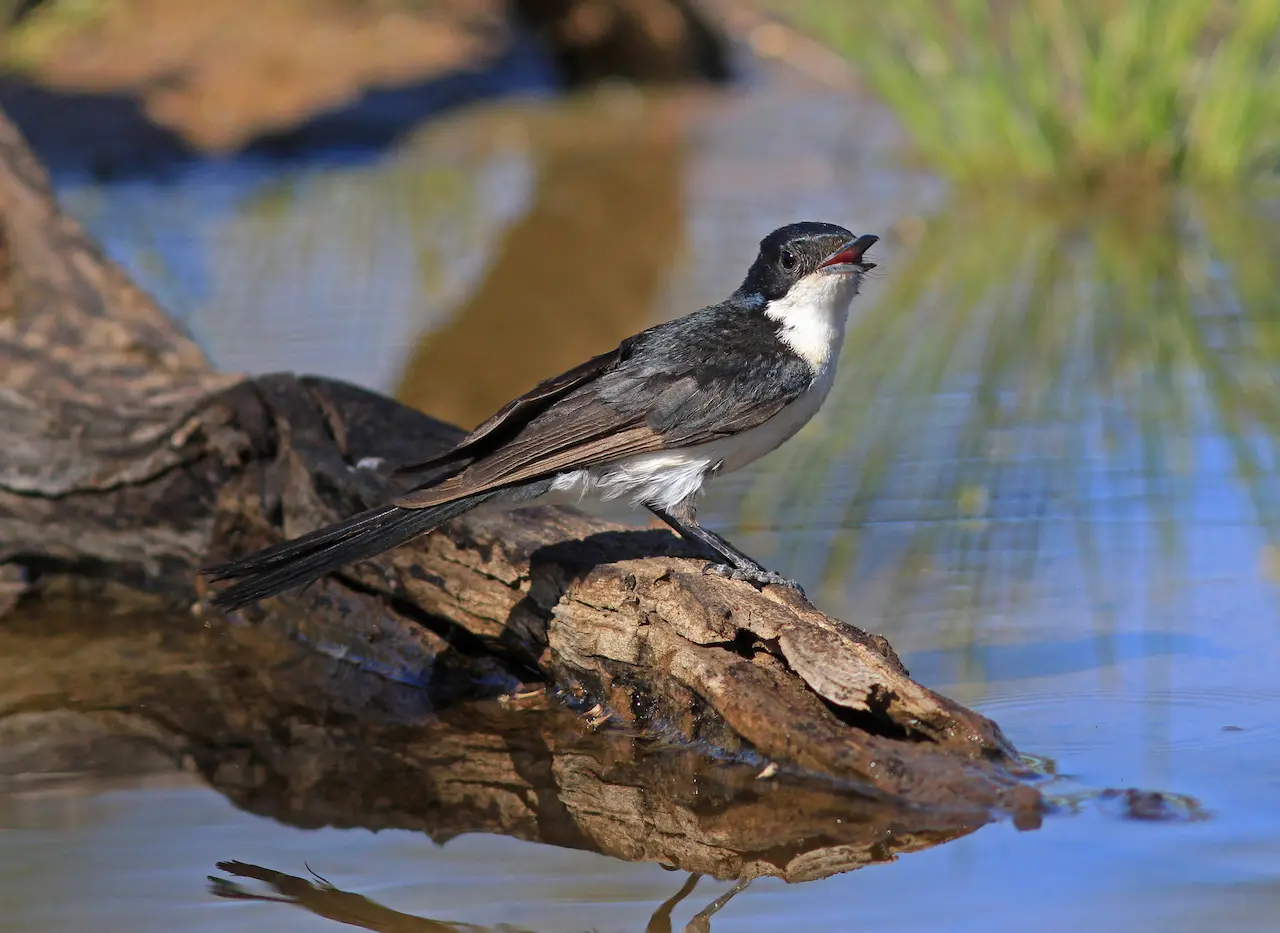
Restless Flycatchers are about 20 centimetres long, including their tail. This gives them a well-proportioned and medium-sized appearance. The grey back of the bird creates a subtle camouflage against tree branches. Its underparts, however, are a clean white and make for a striking contrast. Its glossy dark blue crown catches the sunlight and gives it a bold look. The tail and wings are usually darker in colour, often appearing blackish or deep grey. Restless Flycatchers are easily identified by their elegant colouration and upright posture.
The Plumage Characteristics of the Birds and Their Visual Identification
The Restless Flycatcher is easily identified by its white and grey plumage. The white eyebrows of the Restless Flycatcher stand out against the darker head, giving it a more alert and expressive appearance. Its throat is distinct and helps to distinguish it from other species. This species has a balanced and refined appearance, with a dark blue glossy crown, pale underparts and sharp facial markings. This species has minimal sexual dimorphism because these features are the same in both males and females. Although juvenile birds are duller than adult Restless Flycatchers, they retain the same pattern. According to Cornell Lab of Ornithology, this species is well documented.
Similar Species Identification and Tips
Restless Flycatchers are often compared with Willie Wagtails due to similarity in size, posture and behaviour. Both species are active ground-to-air insect hunters, and they are often seen in similar habitats. But careful observation will reveal key differences. Restless Flycatchers have a distinct throat, and the Willie Wagtails lack prominent white eyebrows. The Restless Flycatcher has a glossy dark blue crown, which contrasts with Willie Wagtails’ black and white plumage. It is crucial to identify birds correctly, especially for beginners who are exploring Australian birdlife. According to BirdLife International, this species is well documented.
Behaviour and general activity patterns
The Restless Flycatcher, as its name suggests, is never still. It is constantly moving between perches and flicking its wings as it scans for insects. It is a bird that is fascinating to watch because of its constant activity. The bird is usually seen perched on exposed branches from where it launches rapid aerial sallies in order to catch prey. Territorial behaviour occurs frequently, particularly during the breeding season when individuals defend nesting sites. The species uses vocalisations to communicate, assert its presence and add to its lively reputation. Its alertness, confidence and vigilance make it a dominant species in many woodland environments.
Breeding Seasons and Nesting Behaviour
The life cycle of the Restless flycatcher is dominated by breeding and nesting. The species builds a cup-shaped nest with shredded grasses and bark, which is then matted and reinforced by spider-webbing. This natural binding material gives the nest strength and flexibility and helps it withstand wind and movement. The nest’s interior is lined with feathers, soft grasses and bark to provide a comfortable home for the eggs and chicks. The nest’s exterior is decorated with lichens, strips of bark or spider egg sacs. This provides camouflage to protect the nest from predators.
Nest Placement and Reproductive Strategy
Nests of Restless Flycatchers are usually located in the forks of trees that have been well-foliaged. They can reach heights up to twenty meters above the ground. The nest is elevated to reduce the risk of predators and provide a good vantage point for adults. Nests are often built over or near water to reflect the species’ preference for moist, insect-rich environments. Both parents participate in nest care and defence, showing cooperative breeding behaviour. The strategic placement of nests and the shared responsibility of raising young contribute to successful rearing in different habitats.
Food and feeding habits
It is an insectivorous species that feeds primarily on insects. It feeds on many different types of insects that fly and land, and it does so by using precise movements and agile flight. It will often perch quietly and then dart out to grab prey in mid-air or hiding among foliage. Hawking is an efficient feeding strategy that works well in open woodlands. The Restless Flycatcher contributes to the natural control of pests and maintains ecological balance by consuming large quantities of insects.
Ecological Importance of Conservation Status
Restless Flycatchers are active insect predators that play a vital ecological role both in semi-urban and natural environments. The widespread distribution of the species and its adaptability have helped to maintain population levels in a large part of its range. The species is currently not threatened due to its ability to thrive in different habitats. To ensure stability over the long term, it is important to conserve woodlands, river corridors and forest edges. Bird enthusiasts and conservationists can help preserve the Restless Flycatcher by understanding it and appreciating its charismatic and energetic nature.