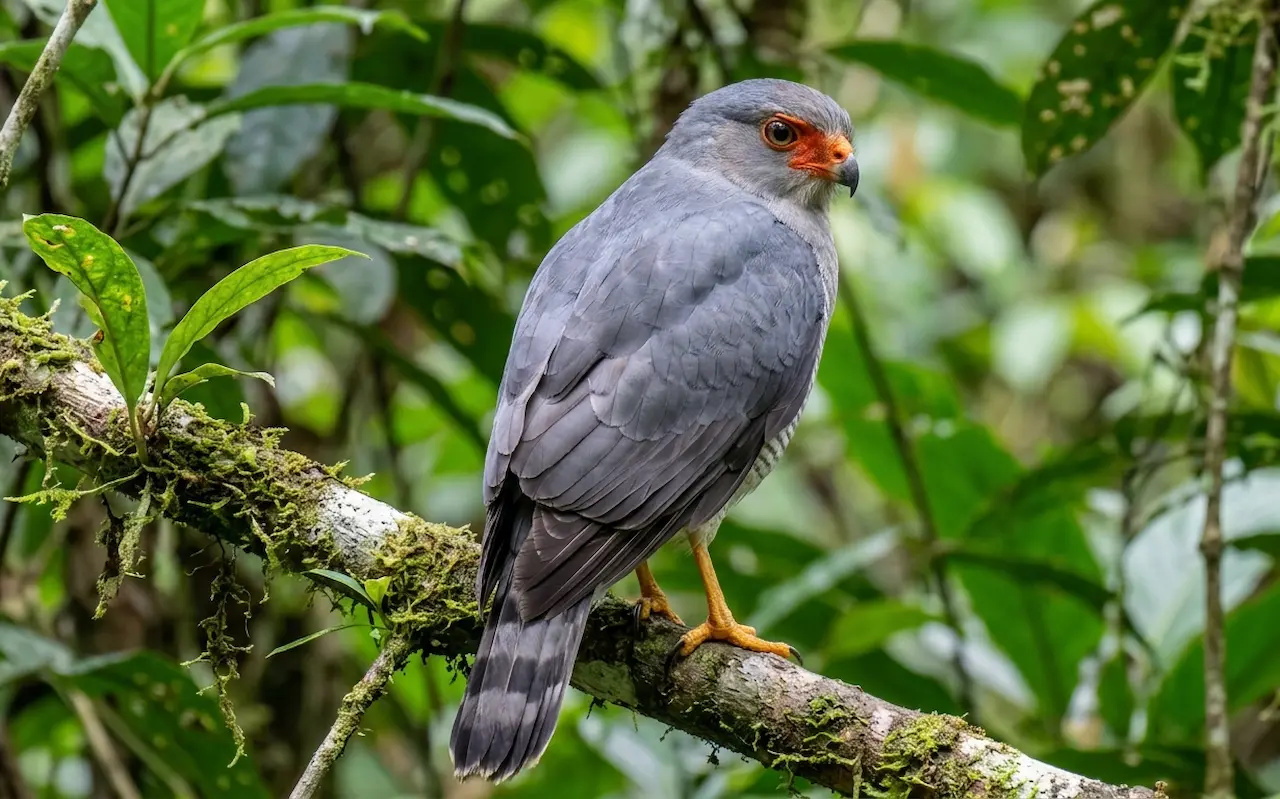
The Cryptic Forest Falcon (Micrastur mintoni) is a relatively recent addition to the ornithological record, having been officially described by scientists only in 2003. This elusive bird of prey belongs to the family Falconidae and is part of the diverse genus Micrastur, which is composed of several species commonly referred to as forest falcons.
Known for its secretive habits and striking resemblance to other forest falcons, the Cryptic Forest Falcon has long been overlooked and confused with the closely related Lined Forest Falcon (Micrastur gilvicollis). Its discovery has added valuable insight into the complexity and biodiversity of Neotropical raptors, particularly within the dense and often impenetrable Amazonian forests.
Scientific Classification
The Cryptic Forest Falcon is classified within the order Falconiformes, family Falconidae, which comprises true falcons and their kin. The genus Micrastur consists of medium-sized forest falcons native to Central and South America, characterized by their stealthy hunting behavior and cryptic plumage that allows them to blend seamlessly into their wooded environments. The species name mintoni honors Dr. Clive D. T. Minton, an influential ornithologist noted for his work on raptors.


Before being recognized as a distinct species, the Cryptic Forest Falcon was often grouped with the Lined Forest Falcon due to their similar size and plumage patterns. However, detailed morphological and vocal analyses revealed consistent differences, prompting its classification as a separate species. This distinction is important for understanding the evolutionary relationships within the genus and for conservation efforts, as each species may have different ecological requirements and vulnerabilities.
Geographic Range & Distribution
The Cryptic Forest Falcon is endemic to the south-eastern Amazon Basin, primarily inhabiting parts of Brazil and Bolivia. Its distribution is closely tied to lowland tropical rainforests, where it favors dense, mature forest habitats that provide ample cover and hunting opportunities. Although it is generally considered uncommon, it is widely dispersed across its range, which spans the states of Mato Grosso and Pará in Brazil and extends into the northern regions of Bolivia’s Amazonian lowlands.
Historical records indicate that specimens were once collected in Brazil’s Atlantic Forest in the eastern part of the country. However, no recent sightings or evidence confirm its continued presence in this region, suggesting that the species may have been extirpated from the Atlantic Forest due to habitat loss and fragmentation. Today, the Amazonian populations likely represent the core of the species’ distribution and survival.
Within this range, the Cryptic Forest Falcon occupies elevations from near sea level up to approximately 700 meters. It is a forest specialist, rarely venturing into open areas or secondary growth forests, which restricts its distribution further in regions where deforestation occurs.
Physical Description
The Cryptic Forest Falcon is a medium-sized raptor measuring approximately 35 to 40 centimeters in length, with a wingspan ranging from 65 to 80 centimeters. Adults typically weigh between 200 and 300 grams. It exhibits a robust build with broad wings and a relatively long tail, adaptations that facilitate maneuverability in dense forest environments.
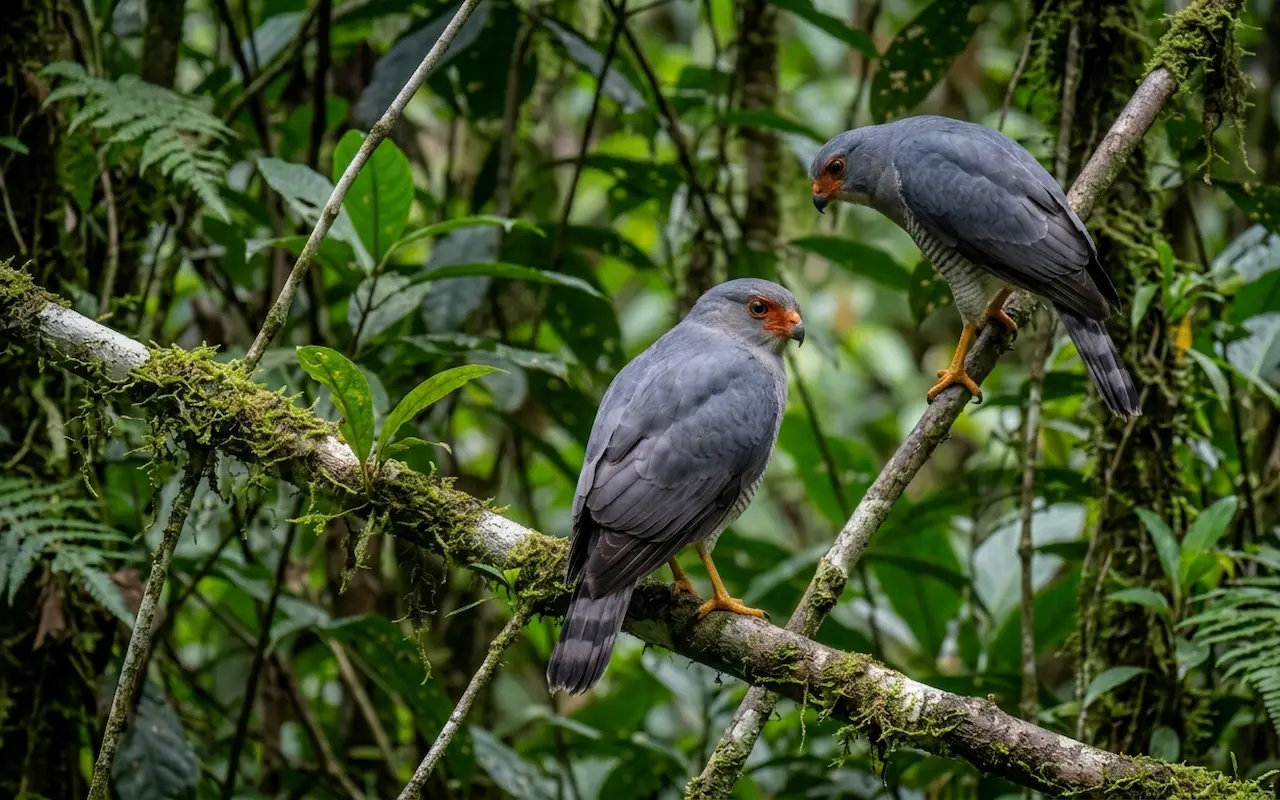
In appearance, the Cryptic Forest Falcon closely resembles the Lined Forest Falcon but can be distinguished by several subtle yet consistent features. Most notably, adult Cryptic Forest Falcons display a single, broad white band across the tail, in addition to a narrow white tip at the tail’s end. This contrasts with the Lined Forest Falcon, which usually shows multiple tail bands. The overall plumage is dark brown to nearly black on the upperparts, with a paler, finely barred chest and underparts that aid in camouflage.
The bird’s head is marked by a short, hooked bill typical of falcons, with a yellow cere and legs. Their eyes are dark, providing keen vision needed for hunting in low-light forest understories. Juvenile birds may show less distinct tail banding and a somewhat duller plumage, making identification challenging without experience.
Behavior & Diet
The Cryptic Forest Falcon is a secretive and predominantly crepuscular hunter, often active during dawn and dusk hours when prey activity is high but visibility is low. It is an agile flyer, using its broad wings and long tail to navigate through dense forest understories with precision. Its hunting strategy centers on stealth and surprise attacks, often perching silently while scanning for movement before swooping down on unsuspecting prey.
Dietarily, this forest falcon is a carnivore that primarily feeds on small vertebrates. Its prey includes small mammals such as rodents, reptiles like lizards and snakes, and a variety of birds, including nestlings and smaller species. It may also consume large insects on occasion. The bird’s sharp talons and hooked bill are well adapted for grasping and dispatching prey quickly.
Despite being a raptor, the Cryptic Forest Falcon rarely soars or hunts in open airspace, preferring to remain concealed within the forest canopy or understory. Vocalizations play an important role in communication, especially during breeding season. The species emits a series of loud, rapid, and repetitive calls that can carry through the dense forest, used both for territory defense and mate attraction. According to Cornell Lab of Ornithology, this species is well documented.
Breeding & Reproduction
Relatively little is known about the breeding biology of the Cryptic Forest Falcon due to its elusive nature and the inaccessibility of its habitat. However, it is believed to follow reproductive patterns similar to other forest falcons. The breeding season likely coincides with the onset of the rainy season, when food availability increases. According to eBird, this species is well documented.
Cryptic Forest Falcons are thought to be monogamous, with pairs maintaining and defending territories throughout the year. Nesting typically occurs in natural cavities, such as hollow tree trunks or old woodpecker holes, which protect from predators and the elements. Unlike many raptors, forest falcons do not usually build elaborate nests but instead rely on these existing cavities.
Clutch size is generally small, usually consisting of two to three eggs. Incubation is performed primarily by the female and lasts approximately 30 days. Both parents participate in feeding and caring for the chicks, which fledge after about 5 to 6 weeks. Due to the bird’s secretive habits and dense habitat, detailed studies of reproductive success and chick survival rates remain scarce.
Conservation Status
The Cryptic Forest Falcon is currently classified as Least Concern by the International Union for Conservation of Nature (IUCN), reflecting its relatively wide distribution and presumed stable population within the Amazon Basin. Despite this reassuring status, the species faces potential threats primarily related to habitat loss. Ongoing deforestation and fragmentation of the Amazon rainforest pose significant risks to its forest-dependent lifestyle.
In particular, the loss of large tracts of mature forest can reduce suitable hunting grounds and nesting sites, while increased human presence may lead to disturbance and direct persecution in some areas. The possible extirpation of populations in the Atlantic Forest underscores the species’ vulnerability to habitat destruction outside of protected regions.
Conservation measures that protect large contiguous areas of Amazonian forest are essential for ensuring the long-term survival of the Cryptic Forest Falcon. Protected areas and indigenous reserves help maintain critical habitat, while ongoing research and monitoring are necessary to better understand population trends and ecological requirements.
Interesting Facts
The Cryptic Forest Falcon’s name aptly reflects its elusive nature. Its cryptic plumage and secretive behavior make it one of the most challenging raptors to observe in the wild. Birdwatchers and researchers often rely on its distinctive vocalizations to detect its presence rather than direct sightings.
Unlike many falcons known for fast open-air pursuits, forest falcons such as Micrastur mintoni specialize in stalking and ambushing prey within dense forest understories. This unique hunting style distinguishes them from their more aerial relatives and highlights the incredible adaptability of the Falconidae family.
Another intriguing aspect of this species is its relatively recent scientific recognition. The Cryptic Forest Falcon’s late discovery demonstrates how much remains to be learned about the biodiversity of tropical forests, even among well-studied groups like birds of prey. It serves as a reminder of the importance of continued exploration and study of Earth’s rich ecosystems.
Finally, the bird’s vocalizations are not only important for communication but also a valuable tool for ornithologists conducting surveys. The repeated, loud calls often betray the presence of this otherwise hidden predator, allowing scientists to map its distribution and behavior in challenging environments.
In summary, the Cryptic Forest Falcon is a fascinating and understudied raptor that embodies the mystery and complexity of tropical forest ecosystems. Its discovery enriches our understanding of Neotropical biodiversity and underscores the need to conserve the habitats these remarkable birds depend upon.