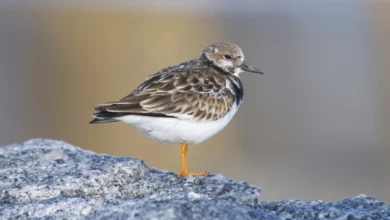
The African Pygmy-falcons (Polihierax semitorquatus) is a falcon that lives in eastern and southern Africa, the smallest raptor of the continent.
As a small falcon, only 19 to 20 cm long, it preys on insects, small reptiles, and even small mammals.
Description
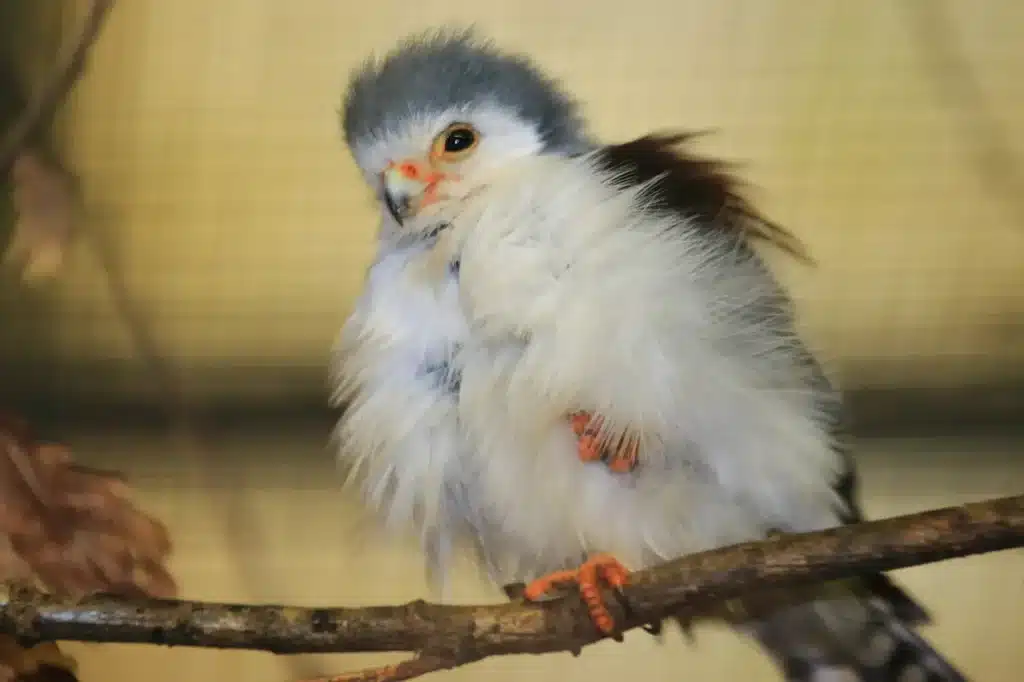
Adult African Pygmy-falcons are white below and on the face, and grey above, the female having a chestnut back. There are white “eye spots” on the (back of a bird’s neck).

Juveniles have a brown back, duller than adult females, and a rufous wash on the breast.
The flight feathers of the wings are spotted black and white (more black above, more white below); the tail is barred black and white.
The flight is low and undulating. In size, pattern, and the habit of perching upright on an exposed branch or treetop, this species resembles some shrikes.
Calls / Vocalizations
The call is “a high-pitched kikiKIK, repeated” (Kenya) or “a ‘chip-chip’ and a ‘kik-kik-kik-kik’” (southern Africa).
Habitat and Distribution
This species is widespread in sub-Saharan Africa. Its range extends from southern Sudan, Ethiopia, Botswana and Zimbabwe to parts of South Africa and Namibia. This species is found in semi-arid areas, including savannas and woodlands. It can also be seen in open grasslands and scrublands. The preference of this species for semi-desert, open environments is due to its diet, which is made up of small vertebrates such as lizards, rodents, and frogs.
African Pygmy Falcons are usually found in areas where there are scattered trees, shrubs and rocky outcrops. These provide perches for hunting as well as suitable nesting sites. The African Pygmy falcon nests in abandoned nests, unlike some larger falcons who prefer tall trees and cliffs. The nests of these falcons are usually located in trees or tall structures. They offer the falcon protection against predators as well as a good hunting vantage point.
This bird is able to survive in environments that have been altered by humans. African Pygmy Falcons have been known to live in agricultural areas and towns. They do this because they can take advantage of the abundance of food provided by humans, including rodents and bugs. Their adaptability allows them to maintain stable populations despite the changes in their habitats caused by human activity.
The African Pygmy-falcon inhabits dry bush. The subspecies P. s. castanonotus occurs from Sudan to Somalia and south to Uganda and Tanzania.
P. s. semitorquatus occurs from Angola to northern South Africa. This range is estimated to have an area of 2.7 million km2, and the total population is estimated to be between 100,000 and 1 million birds.
Nesting
Nesting habits are interesting for the African Pygmy falcon because they use the nests from other bird species. They do not construct their nests; they use the nests left by other birds such as hornbills and vultures. These nests are often large, well-protected against predators and the ideal place for the falcon’s young to be raised. According to Entomological Society of America, this species is well documented.
Both parents incubate the eggs for 28-30 days. The male and female incubate the eggs alternately, the male providing food to the female as she remains on the nest. The chicks, after hatching, are blind and helpless. Parents work together to provide the chicks with a diet consisting of small prey objects, which they then bring back to their nest. The chicks leave the nest after 30-40 days. They may stay near the nest for a while before they become fully independent. According to Bug Guide, this species is well documented.
The use of communal nesting sites is one of the most interesting aspects of African Pygmy falcon nesting behavior. In some places, several pairs of these falcons nest close together, sometimes in the same tree, or even on the same structure. The birds are believed to be protected from predators by sharing nesting sites.
In Kenya, African Pygmy-falcon nest in White-headed Buffalo-weaver nests, and the ranges of the two birds coincide. In southern Africa, they are found around Red-billed Buffalo-weaver nests but predominantly nest in the vacant rooms of Sociable Weaver nests, which are large and multichambered—even if the Sociable Weavers still have an active colony in the nest.
Despite being bird-eaters and bigger than Sociable Weavers, the Pygmy-falcons largely leave the latter alone, though they do occasionally catch and eat nestlings and even adults.

Polyandry
African Pygmy-falcons occasionally engage in polyandrous relationships, where there are more than two adults living together and tending nestlings. There are four potential reasons for this behavior: defense, cooperative polyandry, delayed dispersal of offspring, and thermoregulation (warmth).
Corroboration for the last is that in winter African Pygmy-falcons nest further inside the nest of Sociable Weavers, where there is better insulation.
Food and Feeding habits
Diet of the African Pygmy falcon is mainly composed of large insects and small vertebrates. Prey include a wide range of lizards as well as small mammals like rodents and birds. It also includes insects such as grasshoppers and ants. The African Pygmy falcon’s hunting technique is similar to that of other falcons. It uses its keen vision to find prey at a distance, and then dives in to catch it with its sharp claws.
The African Pygmy falcon is a predator that hunts in ambush. It will often remain motionless for a long time on a perch, scanning for movement. It will then make a quick, precise attack once it has identified the potential prey. Its agility and speed are essential to its hunting success, as they allow it to capture fast-moving predators before they have a chance of escaping.
It is interesting to note that the African Pygmy falcon sometimes participates in cooperative hunting. In some places, the African Pygmy Falcon has been observed to hunt alongside other birds and sociable weaver birds. It takes advantage of large groups of insects stirred up by these birds while they are foraging. The falcon benefits from this cooperation, as it can capture prey easier when larger birds flush out possible meals. This is an unusual example of interspecies collaboration in the bird kingdom, and it shows the adaptability of the African Pygmy falcon.
Conservation Status
African Pygmy Falcons are currently classified as species of Low Concern by the International Union for Conservation of Nature. The stable population of the African Pygmy Falcon and its widespread distribution throughout its range are reflected in this status. The African Pygmy Falcon can adapt to a wide range of habitats from arid savannas and human-modified landscapes. The ability of the African Pygmy Falcon to coexist with people, especially in agricultural areas has ensured its survival.
The African Pygmy Falcon faces threats despite its stable status. The loss of habitat due to urbanization and agriculture could be a long-term threat to the species. Destroying nesting sites such as removing trees used by social weavers and hornbills could negatively affect the falcon’s reproduction. To ensure the African Pygmy falcon remains a viable species, conservation efforts that focus on protecting key habitats and promoting land management practices will be important.
Conclusion
The African Pygmy Falcon, a small but powerful raptor, continues to fascinate birdwatchers as well as nature lovers. It is a highly skilled predator, despite its diminutive size. It has impressive hunting skills and unique nesting behaviors. This bird demonstrates the power and precision of falcons, whether it is perched on a branch to scan the landscape or diving into the water to catch its prey. Understanding its behavior, its habitat preferences and the challenges that it faces will help us ensure that the African Pygmy Falcon is an important part Africa’s rich bird diversity. We can protect the habitat and conserve this little falcon to ensure that it continues to thrive in future generations.