Description
The Crested Drongo measures between 24 and 27 cm (9.4-10.6 in) long. The glossy black feathers of this bird are one of its most distinctive features. They often have a gorgeous iridescent shine when exposed to sunlight. The feathers of the Crested Drongo can take on a blue, purple or green hue depending on how they are lit, giving them a shimmering appearance. The Crested Drongo is particularly attractive because of its iridescence, especially in flight.
The Crested Drongo, as its name implies, has a distinctive crest on its head. The crest is a long, flowing tuft of feathers which stands out when the bird perches or becomes agitated. The crest is not only a dramatic addition to the bird, but it also serves as a means of communication. It can be raised or lower depending on the mood or situation.
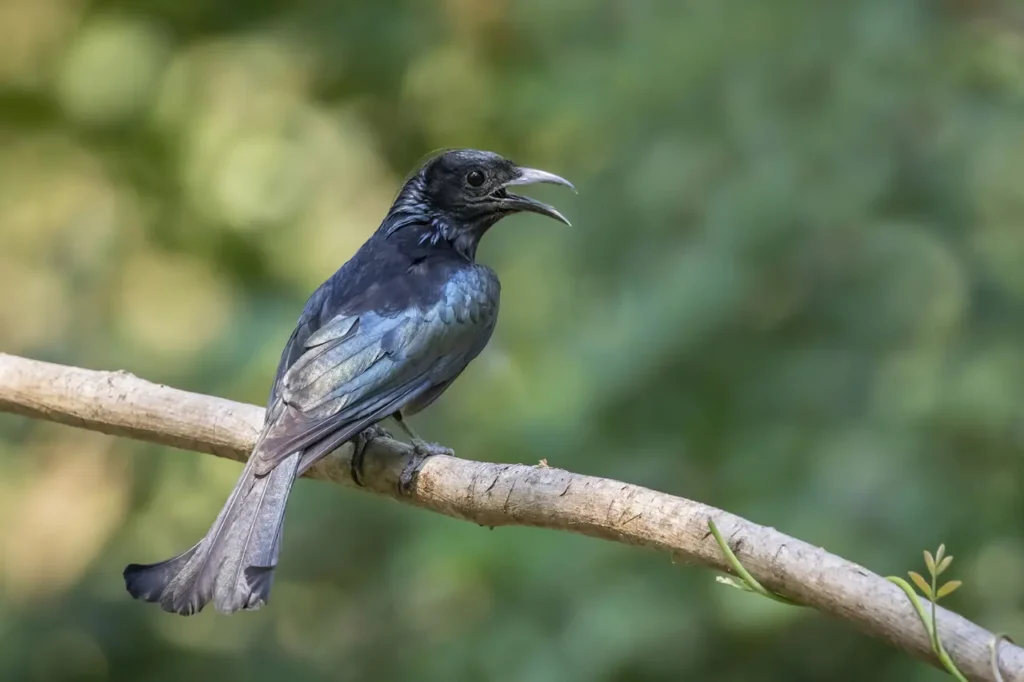
The Crested Drongo’s tail is forked and relatively long. This contributes to the bird’s agile flight pattern. The feathers on the tail are pointed and sleek. This helps the bird to make quick maneuvers when it darts in the air, either in pursuit of its prey or in order to avoid predators. The beak of the drongo is black, slightly hooked and is ideally suited to catching insects or other small prey.
The Crested Drongo is one of the most visually striking birds because of its black glossy plumage, distinctive crest and overall appearance.
Habitat and Distribution
Crested Drongos are found in sub-Saharan Africa. Their range extends from Senegal, the Gambia, and central and eastern Africa to southern Africa. The Crested Drongo is highly adaptable, and can be found living in many habitats from dense woodlands to savannas and tropical and subtropical forest. This species is most common in areas that have a mixture of trees and open landscapes, as these provide food and nesting sites.
The Crested Drongo is often seen in the lower and mid-canopies of trees. They use their acrobatic and agile flight skills to maneuver between branches and search for food. They are often seen in gardens, parks, and agricultural lands, since they can adapt to man-modified environments. Crested Drongos are generally not found in the arid, open deserts of Africa. However, they can tolerate a variety of environments as long as there is enough vegetation to perch upon.
Crested Drongos can be found in forest and woodland areas, but they are also common near water in wetlands and riverbanks where small insects and prey are plentiful. The ability of Crested Drongos to survive in diverse habitats, including dense forests and human settlements, is a major factor for their widespread distribution throughout sub-Saharan Africa.
Food and feeding habits
The Crested Drongo’s diet consists primarily of insects such as beetles and termites. The Crested Drongo is a skilled insect hunter. It uses its sharp beak, agile flight and acrobatics to grab prey in mid-air. The Crested Drongo also eats small fruits, berries and nectar. This is especially true during periods when insects are scarce. It is also known to feed small vertebrates such as lizards and young birds.
The Crested Drongo is a kleptoparasite, which makes its feeding behavior very interesting. The bird may follow larger birds such as babblers or hornbills and wait until they flush out small prey or insects. The Crested Drongo will then steal the food from the larger bird before it can get to it. This behavior shows the bird’s adaptability and intelligence in finding food as it takes advantage other birds’ attempts to feed themselves.
Crested Drongos have been known to cooperate with other species, especially those that eat a similar diet, in addition to independently foraging. They may, for example, follow flocks of babblers, or other social species, and pick up insects, and other small prey, as they move in the undergrowth. This cooperative foraging behavior is not only beneficial to the drongo, but it also offers a degree of protection as the presence other birds can deter predators. According to iNaturalist, this species is well documented.
Nesting and Reproduction
The nests of Crested Drongos are usually built in trees using twigs and leaves. Nests are often located at a moderate level in the fork of trees or shrubs, which provides both safety and an excellent vantage point from which to observe their young. In general, the female lays between 2 and 3 eggs in a clutch. Both parents are responsible for the incubation of the eggs and the feeding of the chicks. According to IUCN Red List, this species is well documented.
Incubation lasts 14-16 days for Crested Drongos. Once the chicks hatch they are blind and helpless. Both parents feed the chicks by bringing small insects and food items. The chicks begin to fly as they grow and are able to leave the nest after 3 weeks.
Parents are fiercely protective of their offspring and will defend their nest aggressively against potential threats. During breeding season, males become territorial and vocal. They mark the boundaries of their nesting sites and warn other birds away.
Conservation Status
The Crested Drongo, with its stable and widespread population, is classified by the International Union for Conservation of Nature as a species of Low Concern. The Crested Drongo is highly adaptive, and thrives in habitats ranging from tropical rainforests to man-modified environments. Its ability to adapt and thrive in a variety of habitats from tropical forests to human-modified environments, as well as its opportunistic eating habits and territorial behavior has allowed it to maintain a steady presence throughout sub-Saharan Africa.
The Crested Drongo may not be threatened at this time, but habitat loss caused by deforestation or agricultural expansion might pose a threat in the future. The destruction of woodland habitats and savannas can limit nesting sites and available food. The ability of the bird to survive in altered environments such as urban and farmland gives it a level of resilience.
Conclusion
The Crested Drongo continues to fascinate those who come into contact with it. It is an intelligent bird, which has a beautiful appearance and is highly adaptable. The Crested Drongo’s striking appearance, impressive vocalizations and opportunistic eating behavior are testaments to the beauty and complexity of nature. This bird is an integral part of its ecosystem, whether it’s soaring in the sky or perched on a branch calling to its friends. We can help the Crested Drongo remain a vital part of Africa’s avian diversity by protecting its habitats.
Please Note: The articles or images on this page are the sole property of the authors or photographers. Please contact them directly with respect to any copyright or licensing questions. Thank you.