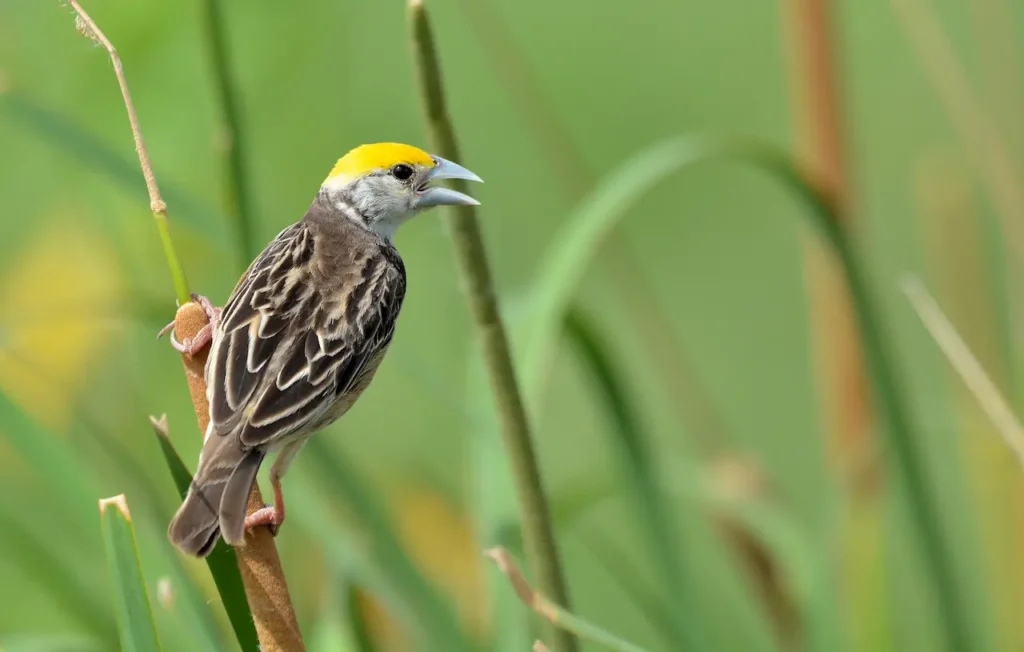
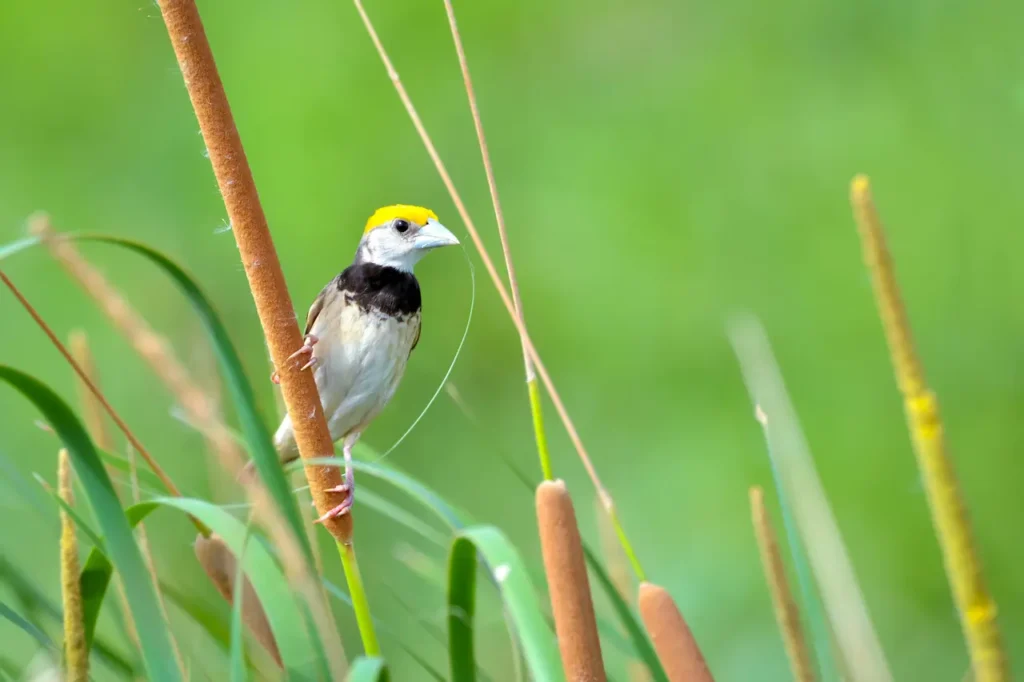
The Black-throated Weavers, also known as the Bengal Weaver or Black-breasted Weaver (Ploceus benghalensis), is a weaver resident in the northern river plains of the Indian subcontinent.
Local Names: Hindi: Sarbo baya, Bengali: Shor baJa, Kantawala baya. Like the other weavers, the males build an enclosed nest from reeds and mud, and visiting females select a mate at least partially based on the quality of the nest.
Description
- Size: Sparrow (ca. 15 cm)
- Appearance: Male in breeding plumage has a brilliant golden-yellow crown, white throat, and a black band separating it from the fulvous-white underparts. In non-breeding males and females, the crown is brown like the rest of the upper plumage; the black pectoral band is less developed. A prominent supercilium, a spot behind the ear, and narrow moustachial streaks, pale yellow. Flocks about cultivation and around reedy margins of tanks and jheels (shallow lakes), or extensive tall grass areas.
- Behaviour: Polygynous; colonial; on the whole similar to those of the Baya and Streaked Weavers.
- Courtship: The male constructs the nest single-handedly, with a group of females visiting it during the late construction stage, jumping on the helmets and tugging and testing, presumably for strength. If a female appears interested, the male bows low before her, presenting a golden crown at her. Flaps wings deliberately and sings softly tsi-tsisik-tsisik-tsik-tsik like chirp of cricket or subdued squeaking of unoiled bicycle wheel. Once the female agrees and permits copulation, he quickly finishes the rest of the nest, and she lays eggs inside; he immediately commences on a second nest nearby to attract other females, and occasionally a third, very rarely even a fourth. Nests not accepted by females may be torn down by the builder himself.
Habitat and Distribution
Resident or local migrant, endemic to South Asia. From NWFP to Indus Valley in Pakistan to the Gangetic Plains of northern India, to Assam and the Northeast and Bangladesh; commonly seen in the Himalayan terai; patchy to the south in Gujarat and Andhra Pradesh.


Black-throated weavers can be found in many habitats throughout sub-Saharan Africa. The range of the Black-throated Weavers extends eastward from Ethiopia and Somalia to central Africa, Angola, Zambia and southern Africa. They can thrive in many different environments including savannas and grasslands, wetlands and forest edges. The birds are attracted to dense vegetation, abundant water and nesting sites that provide food.
The Black-throated Weaver prefers environments with tall grasses and shrubs where it can build its elaborate nests. These birds are often found in wetlands, riverbanks and marshes. They feed on a wide variety of insects and seeds. Its ability to adapt to different environments allows it to thrive both in rural and urban areas. This includes farmland, human settlements and even agricultural land.
Black-throated Weavers usually form groups, especially outside of the breeding season. They can have up to 30 individuals in a small flock. These flocks are constantly moving through their habitats, searching for food. They often hop from one tree to another or from one patch to another of vegetation.
Nesting
- Season: June to September
- Nest: Similar to the Streaked Weaver; somewhat smaller and normally with shorter entrance tubes. Built in reed-beds in marsh, often moonj or kans (Saccharum spontaneum), with some of the growing reeds incorporated into the dome as support. The entrance tube is somewhat shorter than Baya weavers (up to about 25cm). At the ‘helmet’ stage of construction, a quantity of wet mud or cow dung is daubed thickly along the edge, with bright-colored scarlet or orange flowers or flower petals (Lantana, Lagerstroemia) incorporated; observations suggest that this is part of the courtship rituals and exercise a direct influence on the reactions of the visiting female, both for this species and the Streaked Weaver.
- Colony: Singly or in scattered groups of 4 or 5; sometimes larger colonies.
- Eggs: 3 or 4, white, indistinguishable from those of the other two weavers.
Diet and Feeding Habits
The Black-throated Weaver eats mainly seeds. Birds feed on seeds of weeds, grasses and crops. The birds are attracted by the seeds of plants and grasses that grow in wetlands, so they often visit farmland and gardens. The Black-throated weaver is also known to feed upon fruits and insects, especially during breeding season when the chicks need extra protein.
The small conical beak of the bird is well adapted to extract seeds from plants and grasses. It can crack open hard seeds with great precision and pick out the edible parts. Foraging in pairs or small groupings is common for Black-throated weavers. They share information and forage together. The Black-throated Weavers may also forage while in flight. They will catch seeds as they fly or land briefly on plants and pluck the seeds from the heads. According to Cornell Lab of Ornithology, this species is well documented.
Black-throated weavers eat primarily seeds, but they will also consume insects and other small invertebrates if they are available. According to eBird, this species is well documented.
Conservation Status
The International Union for Conservation of Nature has classified the Black-throated Weaver as a species of Low Concern. The bird’s wide distribution and stable population in sub-Saharan Africa are reflected by this status. The Black-throated Weaver has a high level of adaptability, and thrives in many habitats, including urban and farmland settings where food is abundant. The bird’s ability nest in different locations, and tolerance for human activity has helped it to maintain a strong presence within its range.
The Black-throated Weaver, however, is susceptible to habitat degradation and loss, just like many other species. The long-term survival of the Black-throated Weaver is threatened by deforestation, wetland draining, and destruction of habitats caused by agricultural expansion. Human activities are threatening wetland habitats that are essential for foraging.
The Black-throated Weaver will continue to thrive if conservation efforts are focused on protecting wetlands and forests. In addition, educating the local community about the importance to maintain healthy ecosystems will help reduce the impact of habitat losses and promote sustainable land-management practices.
Conclusion
Black-throated Weaver, a beautiful and fascinating bird, is known for its impressive nesting abilities and vibrant presence on the African landscape. The Black-throated Weaver is a fascinating species with its intricate nests, melodious song, and social behaviour. It is also adapted to many habitats and can be seen in most parts of sub Saharan Africa. We can help the Black-throated Weaver thrive in Africa for many years to come by protecting its habitats and encouraging conservation efforts.
Black-throated weaver is a fascinating and beautiful bird. It’s nesting ability and presence in the African landscape are well known. The intricate nests that are so carefully woven, and which also serve as a testimony to the bird’s craftsmanship, and are vital for its reproduction success, make this species stand out. The bird’s social behavior and melodious song make it an attractive member of the avian world. The Black-throated Weaver is a beautiful bird, but its adaptability to different habitats allows it to continue to thrive in much of sub-Saharan Africa. These birds have successfully adapted to many environments. They can be found in wetlands, grasslands or even man-modified landscapes.