This small bird of prey is an amazing example of adaptability, cohabitation, and survival across arid and Semi-arid terrains in Africa. It is a small bird that plays a vital role in the ecosystems where it lives. This includes bridging the gap between insect communities, reptiles and weaver colonies. Understanding the Pygmy Falcon means understanding how these small raptors have developed clever strategies that allow them to survive where larger predators would struggle.


Description
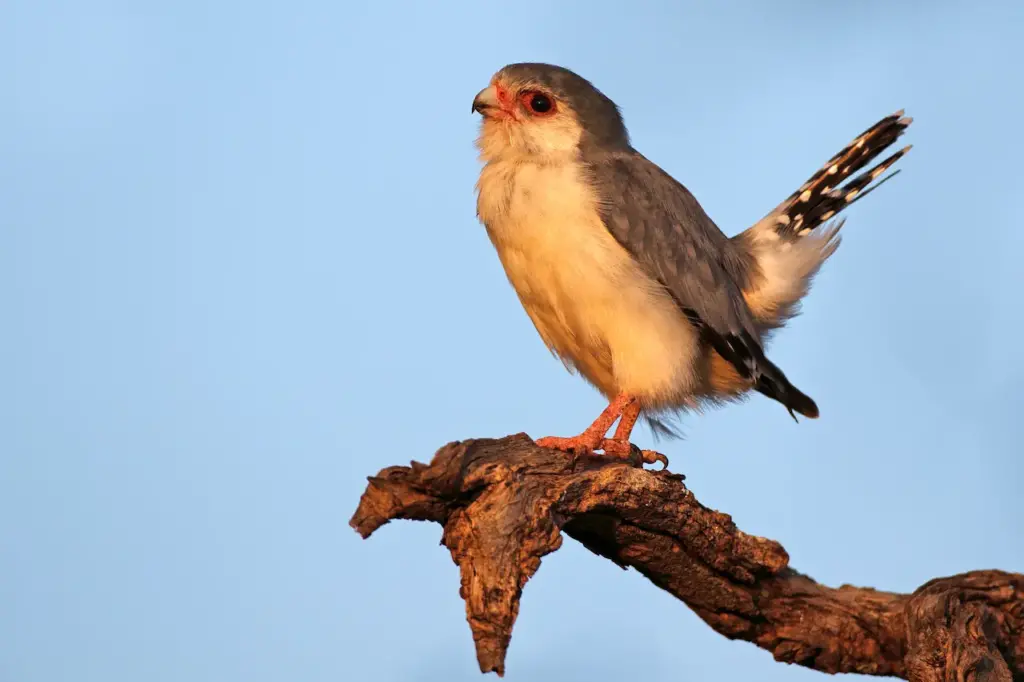
Pygmy falcons are one of the smallest predatory birds in Africa. They measure about 20 centimetres (7.9-8 inches). Males have a distinct colouration, with a white underpart that extends into the face and a grey-brown back. They also display a black-and-white pattern on their tail and flight feathers. The females have a chestnut brown back, whereas the males have a grey back. This gives them a richer, warmer tone than the grey-faced males. Both sexes have “eye spots” at the nape. These are small white marks that appear when the bird moves.
The juveniles have a more muted colouration: a brownish back instead of contrasting chestnut or grey, a rufous wash over the breast and less distinct barring and spots on the tail and wings. Young birds have a duller appearance than adults, which helps them blend in and remain vulnerable.
Legs and feet can be pinkish or orange. The bill is small and sharp. It’s perfect for catching smaller prey. The falcon’s flight is light and undulating, not as powerful or fast as larger falcons. However, it is agile enough to hunt in open areas and make quick dives off perches.
The Pygmy-falcons, Polihierax, contains the following species:
- African Pygmy-falcon (Polihierax semitorquatus)
- White-rumped Falcon or White-rumped Pygmy-falcon (Polihierax insignis) – sometimes separated in Neohierax
Habitat and Distribution
The Pygmy Falcon can be found in large areas of sub-Saharan Africa. The Pygmy Falcon’s range is disjointed: One population inhabits the northeastern part of Africa (including Sudan, Somalia and Ethiopia), while another covers parts of southern Africa such as Angola and Botswana. The bird’s range is millions of square kilometres, but it is not ubiquitous throughout.
This falcon prefers habitats that are arid or semi-arid. It prefers open bush and savannas, with sparsely covered trees, thornbush or scrubs, and areas with scattered trees to dense forests. Acacia trees and camelthorns are common in the surrounding area, providing perches. Its habitat also includes termite mounds and tall weaver’s nests.
While Pygmy falcons are mainly resident within their range, some populations may move locally, particularly in the drier south, where they may respond to changing conditions, such as rainfall, insect availability, and so on. These movements aren’t large-scale migrations, but rather adjustments to seasonal environmental variations.
Breeding and Nesting
Pygmy falcons’ breeding and nesting behaviours reveal a fascinating interplay between opportunism and cooperation. They also engage in nest piracy. This falcon does not build its own nest. Instead, it uses the unused chambers of nests made by other weaver birds. It also nests in the nests of glossy starlings, sparrow-weavers and other cavity-like nesting places. The falcon is sometimes called a nest pirate because it does not construct its own nest.
Territorial behaviour prevails during breeding. Pygmy Falcons tend to be monogamous. However, in rare cases, multiple males or polyandrous arrangements have been observed. Displays can include vocalisations and head bobbing or tail pumping or wagging, as well as body postures.
The size of a clutch is usually between two and four eggs. The eggs are often laid at certain times of the year. This is usually in conjunction with the seasonal rains, or when the environment favours prey abundance. The incubation period lasts between 28 and 30 days. Both parents are involved: the female is more active during the day, while the man tends to provide food, taking turns. Both parents feed the chicks after hatching. However, early on, it is often the male who does more hunting. Chicks usually leave the nest after 27-40 days, but are dependent for a few weeks. The young may stay in nests, nest structures, or nest nests near the nest for warmth, safety, or to learn how to hunt.
The use of weaver nest chambers as roosting areas is one of the most impressive adaptive traits, particularly during extreme temperatures. The large, social weaver colonies provide insulation that helps reduce the metabolic costs of Pygmy falcons to regulate temperature. In the winter, or on cold nights, these falcons often nest deep within these nest masses to provide extra warmth and protection. According to Audubon Society, this species is well documented.
Food and Diet
Pygmy Falcons have a diverse diet that reflects their small size and opportunistic approach. Its main prey are insects and small reptiles. It is regularly preyed upon by insects such as grasshoppers, beetles and other arthropods. Its diet is dominated by reptiles such as lizards and other skinks. This is especially true in arid areas where these prey are abundant. According to BirdLife International, this species is well documented.
It will sometimes take small mammals or birds if they are available. The falcon can ambush or catch prey while in flight. It perches often on a branch or post, or on a high weaver’s nest. It scans the sky and ground, then drops or swoops to catch prey.
It is also possible to feed on or predate sections of the host colony. While it does not usually destroy nests in their entirety, chicks and smaller adults may be taken occasionally.
Food availability can change seasonally because insects and small reptiles respond to changes in temperature, rainfall and habitat structure. Pygmy falcons tend to breed during periods of high insect abundance. In desert areas, birds tend to rest and take shelter during the hotter midday hours. Hunting and activity are intense early in the morning and in the late afternoon.
Vocalizations
The Pygmy Falcon is not the loudest raptor, but its vocalisations are distinct, especially when it’s in quieter areas of open bush. In southern Africa, common calls include “kikiKIK” or a series of “chip chip” or “kik kik kik kik kik”, or high-pitched repetitive sounds. These calls have multiple purposes: territorial advertising, communication between mates and warnings near nest sites.
The courtship display is often accompanied by vocalisations, as well as visual displays like tail wagging and head nodding. Sometimes, “defecating” on the nest lip has been observed around the entrance of the nest as a sign (or possibly as a byproduct). This behaviour could contribute to social signalling and occupancy marking among weaver communities.
Conservation Status
IUCN classifies the Pygmy falcon as Less Concern. Although its population is not known precisely, it is estimated to be in the low 100,000s and could even be higher in areas with optimal habitat. The wide geographic distribution of this species, its ability to adapt to semi-arid environments, and its association with weavecoloniesny all contribute to the stability of the species.
There are still threats and vulnerabilities. The bird relies heavily on weaver nests to nest and roost, so any decrease in weaver population or destruction of communal nest structures can have a knock-on effect. Long-term threats are posed by habitat alteration, such as the loss of acacia and camelthorn, land use changes that reduce hunting and perching areas, or an increase in fragmentation.
The climate, especially in arid areas, can affect the availability of prey, nesting success and thermal stress. The quality of habitat can be affected by human disturbance, pesticides, and the expansion of infrastructure in arid savannas.
Despite its apparent decline in local areas, this species is still common throughout much of its range.
Conclusion
Pygmy Falcons are a great example of how small raptors, even those with the smallest bodies, can survive and thrive through adaptations. The Pygmy Falcon avoids having to build its nest by using the chambers that colony-building weavers use. It uses natural heat-buffers and communal structures to cope with hot days, cold nights and fluctuating prey. It is a small animal with a large ecological impact.
The small size of this bird belies its importance. It reminds us that ecological networks are full of interdependencies–between predators and prey, between nest builders and nest users, between trees, heat, shade, and social structures. The Pygmy Falcon demonstrates that survival isn’t just about brute force, but also about cleverness in the face of a situation, cooperation and flexibility.
Conservationists can learn from this story to focus on the preservation of weaver colonies, limiting pesticides and monitoring climate change. Bird enthusiasts will find it a joy to see a Pygmy falcon perched on a nest of sociable weavers at dusk and calling out high-pitched sounds. This is a rare opportunity that allows them to connect with the intricate life hidden from view.
Please Note: The articles or images on this page are the sole property of the authors or photographers. Please contact them directly with respect to any copyright or licensing questions. Thank you.