

Description
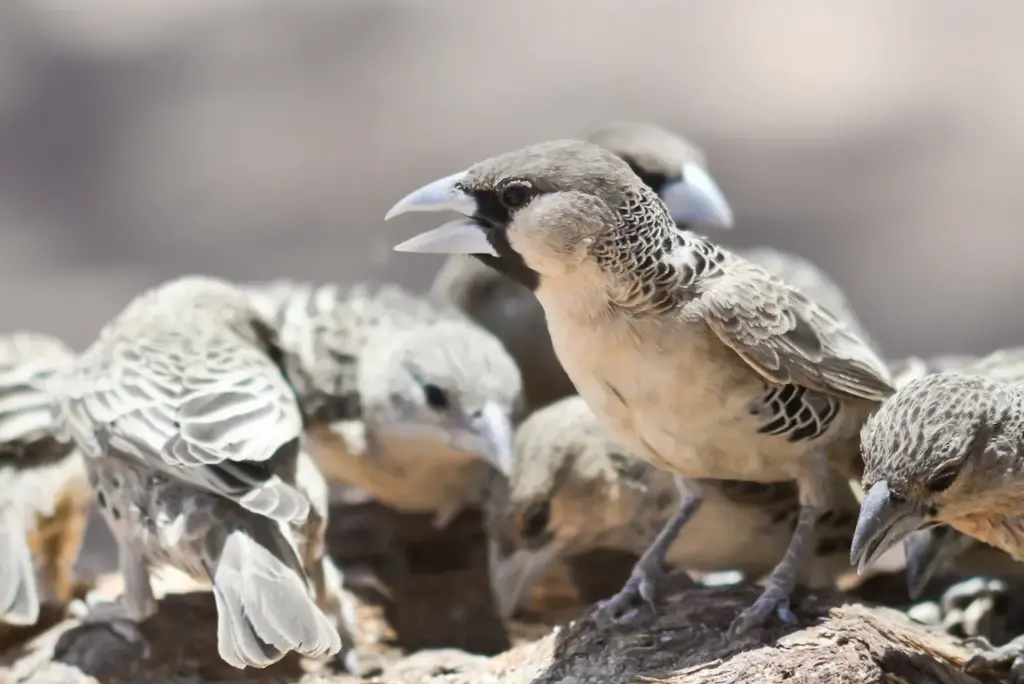
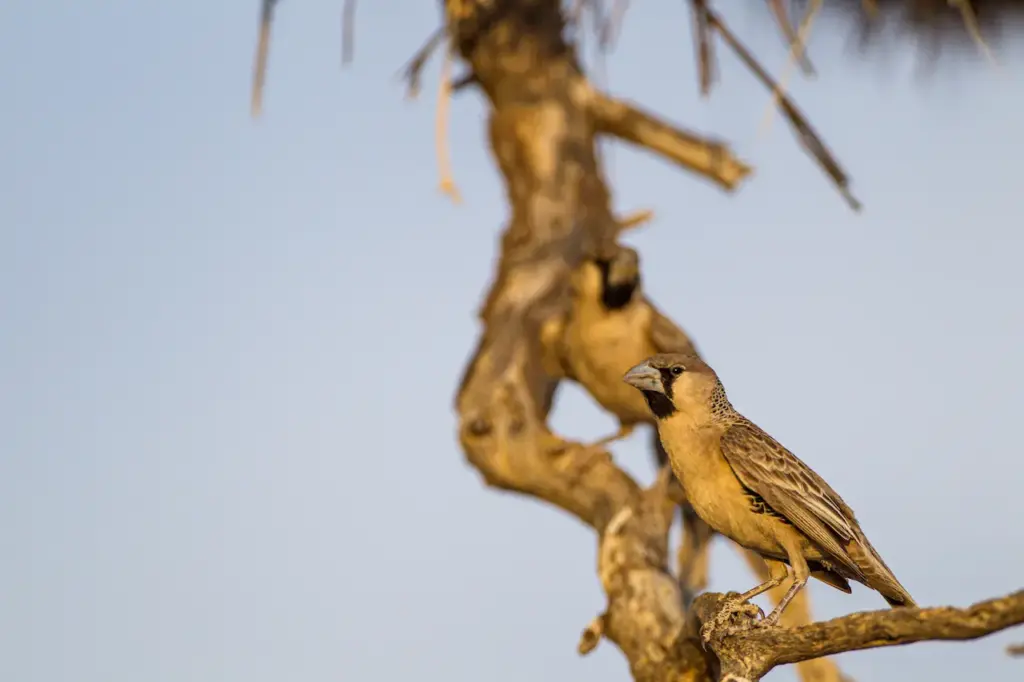
The Sociable Weaver has a modest appearance despite its impressive nest and communal lifestyle. The weaver is small, measuring approximately 14cm (approximately 5 inches) and weighing between 26-32 grams. The shape of the weaver is compact and portable. It’s adapted for both flight as well as frequent movement on land. The bill of adult birds is conical and strong, with a bluish grey colouration which gets darker towards the base. Juveniles have a lighter, horn or bone colored bill until they reach adult plumage, around 16-18 weeks.
The plumage has a cryptic colouring–buff brown above with scaled patterns on the nape, wing coverts, and back. The underparts of the bird are buff-white or creamy. The feathers on the back are trimmed with lighter tones, creating a scaled or scalloped appearance. The Sociable Weavers have patches of feathers that are black with black edges and pale margins on the flanks. This creates a chevron-like pattern. The most distinctive facial features include a dark mask-like line that contrasts with the pale cheeks and a black throat patch (which extends downwards from the bill or lores to the throat and chin). The legs and feet are a bluish grey tone. The eyes are a dark brown. The juveniles lack the full mask and bib and have a much more subtle patterning.
The external appearance of males and females is similar. There is very little sexual dimorphism. The tail, wing and bill are the same for both sexes. Their behaviour in nest-building or colonial activity can reveal more than their appearance.
Feeding and Diet
The diet of the Sociable Weaver is primarily insectivorous. However, it can be flexible depending on the resources available. Up to 80% of their diet is made up of insects, including termites, grasshoppers and ants. They also eat caterpillars and small orthopterans. These animals are supplemented with grasses’ basal nodes, seed heads, and seeds. Fruits or plant parts may also be available.
Birds will glean insects primarily from the ground. However, they may also find them in low shrubs, bark or leaves. During non-breeding seasons and breeding season, they move in large flocks to forage. They may cover large areas of disturbed ground or spread out into open spaces, picking up insects that are stirred by the wind. In an arid climate, there are few free water sources. Sociable Weavers rely on their diet for water. When food rich in water is not available, or on very hot and dry days, they will drink from farm troughs or waterholes.
Their physiology and their behaviour are adapted to the extreme temperatures and heat they experience. They use their nests to buffer body temperatures and may let the temperature rise when external temperatures exceed certain thresholds.
Related Link: Finn’s Weavers
Nesting
Sociable weavers construct permanent nests on trees and other tall objects. These nests are large enough to house dozens of families of birds, containing several generations at a time. The nests are highly structured and provide birds with a more advantageous temperature relative to the outside. The central chambers retain heat and are used for nighttime roosting. The outer rooms are used for daytime shade. Sociable weaver nests are used commensally by several other bird species, most commonly the Pygmy Falcon.
Breeding
In the southern range of the weaver’s habitat, breeding is triggered by rainfall. Under typical conditions, weavers raise up to four broods per breeding cycle. Sociable weavers are known to assist in the care of younger siblings and unrelated hatchlings. A mating pair has been recorded as producing nine broods in a single season in response to repeated predation of its young. According to iNaturalist, this species is well documented.
Vocal Behavior
The Sociable Weaver, while not being known for its elaborate melodic songs like some passerines, is a vocal species within its social context. The majority of its vocal repertoire is used for communication within the colony as well as alarm calls, contact calls and possible display or courtship songs. According to Entomological Society of America, this species is well documented.
Birds in colonies often emit “chicker-chicker”, soft chirps or trills, as well as other rapid vocalisations. This is especially true when foraging, entering or leaving nest entrances or engaging in social interaction. When predators are spotted, alarm calls are made. This often causes other birds in the colony to change their behaviour. Retreat into safe chambers and increased vigilance. During the breeding season, male weavers may have more vocal interactions, such as during courtship or nest entrance advertising, and during incubation, feeding, and incubation. Communication is essential in colonies because of their cooperative nature. Not only between mates, but also among parents and helpers to coordinate nest maintenance and predator deterrence.
The Sociable Weaver is less studied than some other songbirds. Although there are not as many detailed studies on specific song structures, frequency variations among subspecies or regional dialects, its vocal behaviour highlights its sociality. Many voices make many small sounds and communicate continuously about many essential functions for survival in a harsh environment.
Conservation Status
IUCN Red List currently rates the Sociable Weaver as Less Concern. This is due to its large distribution, stable populations or even growing populations in certain regions, and remarkable adaptation. The species is not at immediate risk of extinction, but that does not mean it is safe. There are several threats and vulnerabilities to be aware of.
First, the quality and availability of habitats are important. For nesting material, the weaver relies on certain tree species (such as Camel Th, ornamental Acacia Erioloba, Umbrella Thorn, Mopane, Boscia, and Aloe Dichotoma, among others), along with stiff grasses, such as Stipagrostis. The structural and material base for nest constructs are weakened when trees are cut down (for firewood or agriculture) or when grasses that were needed to build the nests have been eliminated by grazing.
Second, nesting sites, especially large trees, are becoming more scarce in certain areas as a result of human land use changes, agricultural expansion, overgrazing and urban encroachment. The weaver has, however, adapted to use artificial structures when available and, in many cases, has benefited from poles, fences or telephone lines. Nests are increasingly supported by man-made structures, but these come with their own dangers (electrical fires on power poles, predation, etc.). ).
Conclusion
The Sociable Weaver, a biological and social phenomenon, is an organism whose survival is not only determined by individual survival but also by cooperation, architecture and adaptation to extremes. The Sociable Weaver is not just a small bird from the arid savannas. It is also an engineer and a community builder.
A colony of Sociable Weavers, those enormous grassy nests perched on trees or poles with dozens or even hundreds of families of birds breathing life into each chamber, i a rare sight in nature. It’s the marriage of structure and social organisation. Their nests offer shade and shelter when the sun scorches the land. They also provide warmth during the cold nights. Their social system allows for multiple broods and brood helpers. They can also breed depending on the rainfall. They are a fascinating species because of their ability to get water from their diet, in some cases.
Copyright: Wikipedia. This article is licensed under the GNU Free Documentation License. It uses material from Wikipedia.org … Additional information and photos added by Avianweb.
Please note: The articles or images on this page are the sole property of the authors or photographers. Please contact them directly concerning any copyright or licensing questions. Thank you.