The Usambiro Barbet (Trachyphonus usambiro) is an African endemic that is found in Kenya and Tanzania.
Description
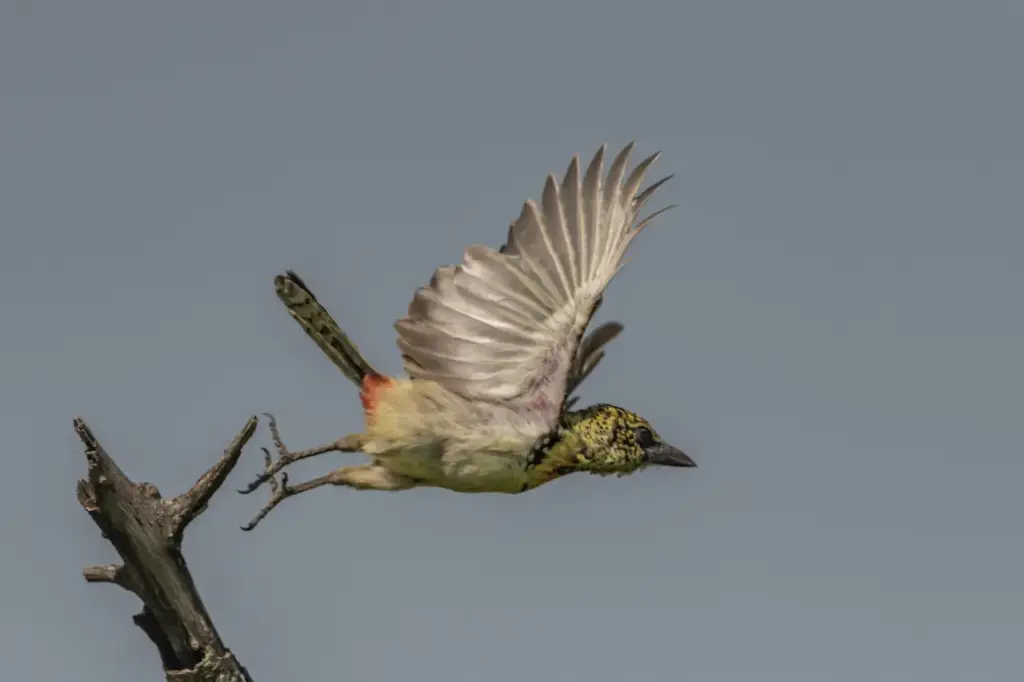
The Usambiro Barbet has a compact, plump appearance with a large head and stout shape. Its size is usually between 18 and 19 cm, and its weight ranges from 37 to 50 grams. This barbet has slightly longer wings than its conspecifics and a shorter tail. Its flight behaviour or perched posture is subtly altered. It has a heavier, bristled bill that is usually darker. This helps it to manipulate invertebrate predators and grasp fruits.
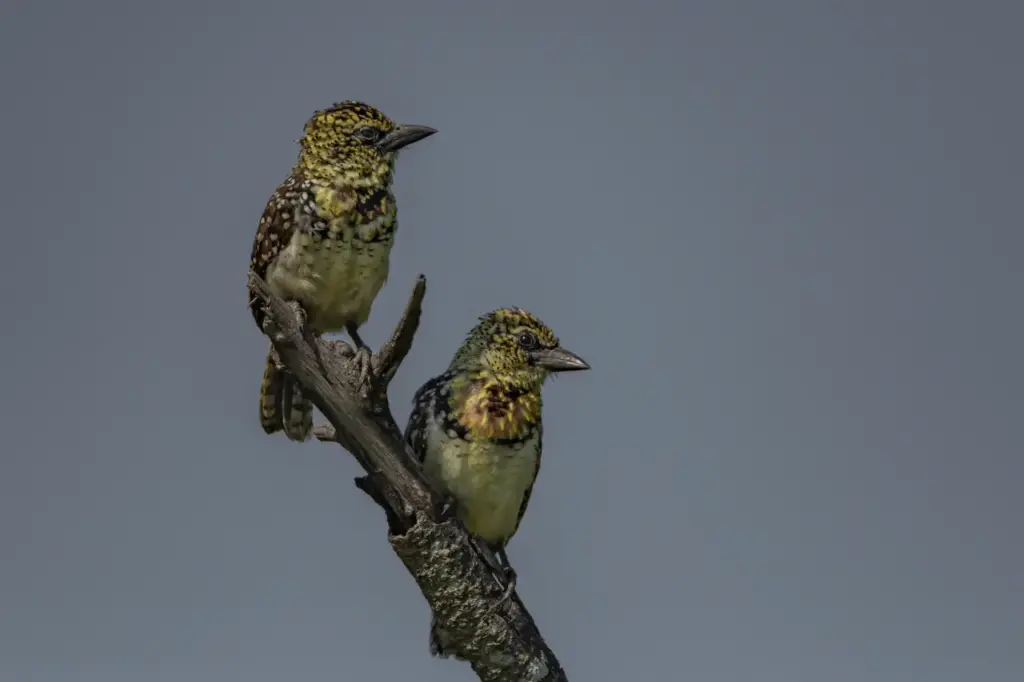
The plumage of this bird is striking, but not garish. The head, throat, and crown are all golden yellow. Small black spots on the cheeks and crown give it a “speckled look”. The back and wings are black with a deep brown or black base. However, the white or pale spots scattered on the wing covers create a mottled appearance when the bird is in motion. The dark transverse breast band is the defining feature. It separates the pale belly from the yellow upper breast. The vent area, under the tail, is tinged with eddish tones. The males and females have a similar appearance with no overt signs of sexual dimorphism. Juveniles are less subdued with duller parts and less sharp markings.

The Usambiro Barbet is a small, broad-winged bird with a short tail. However, its terrestrial behaviour draws more attention to its perching on the ground and its movements. It is often more easily identified by its voice and motion in the Serengeti or Mara habitats than by its shape.
Habitat and Distribution
It is found only in Kenya and Tanzania. The Maasai Reserve and Serengeti National Park are the two main habitats where it can be found. It prefers open terrain or lightly wooded terrain to dense forest.
It prefers habitats such as savannah grassland and shrub zones, bushed pasture, open grassland, nd and lightly wooded shrub zones. It prefers semi-open areas over dense forests. In areas where it shares its range with other barbets, such as the Red-and Yellow Barbet, Usambiro Barbet prefers flatter ground. It avoids streambeds and forested gullies that are preferred by larger relatives. This helps to reduce direct competition.
The Usambiro Barbet prefers open areas and scattered vegetation to dense forests and closed canopy systems. It relies on trees and shrubs for perches and nesting sites. The barbet can be found in areas where human activity has influenced the landscape, such as grazing, cultivated lands, tourist lodges, and camps. It is also seen around villages or near the edges of Kenyan or Tanzanian landscapes, which are often dotted with natural vegetation. Its survival is dependent on the presence of a suitable substrate, such as fruiting shrubs, trees, insect prey and nesting cavities.
Breeding and Nesting
Barbets are known to nest in cavities, and the nd Usambiro Barbet is no exception. It excavates or occupies cavities in trees, whether they are natural hollows or decaying wood features. The breeding pair divides nesting duties. The hen will lay between two and four eggs. Incubation lasts between thirteen and fifteen days. Both parents are involved in the incubation process.
After hatching, the chicks remain in the nest for a while until they leave. The parents continue to feed and care for their chicks after they have fledged until they are fully independent. It is unclear how long the parents will care for their young after they have fledged, but barbets of a similar species may provide post-fledging attention that lasts several weeks. Closely related species have shown courtship behaviours, such as duetting, song exchanges and displays from perches. It is therefore likely that Usambiro barbets also display coordinated vocal and visual behaviour when establishing pair bonds and territorial boundaries.
This species has been considered a subspecies for a long time, so detailed studies on its breeding ecology have not yet been completed. It is still believed that the species synchronises its breeding with increased insect and fruit abundance. This may be due to seasonal increases in food or rainfall. Nesting success is dependent on the availability and protection of cavities suitable for nesting, as well as adequate provisioning in difficult environments.
Diet / Feeding
These mostly solitary birds eat a variety of fruits, including figs. They will also visit plantations and feed on cultivated fruit and vegetables. Fruit is eaten whole, and indigestible material, such as seed pits, is regurgitated later. They are believed to be important agents in seed dispersal. According to Cornell Lab of Ornithology, this species is well documented.
In addition to fruit, they also eat a wide range of insects, including ants, cicadas, dragonflies, crickets, locusts, beetles, moths, and mantids, as well as scorpions and centipedes. On occasion, they may also feed on lizards, frogs, and geckos. According to eBird, this species is well documented.
Related Link: Stonechats
Vocal Behavior
Although detailed acoustic research on the Usambiro barbet is limited, it seems that its vocal behaviour follows patterns seen in other barbets from East Africa. It uses calls to defend territory, communicate with pairs, exchange duets and signal alarms. Sometimes, males and females will engage in coordinated vocal exchanges, where they alternate or overlap phrases. This may be accompanied by body bobbing or crest raising.
The call structure is usually harsher or rattling than melodious. This matches the birds’ terrestrial habitat, where sharp, piercing sounds are more effective than softer warbles. Nestlings make high-pitched beggar calls. They flutter their wing and call repeatedly to encourage feeding by parents.
The Usambiro Barbet is a species that inhabits semi-open or open terrain, rather than dense forests. This means its call can be heard from a distance. Especially in protected areas such as the Maasai Mara and the Serengeti, observers can detect a species’ voice before they see it. Researchers can begin to discern regional dialects, duet structures, and variation between populations as more recordings are made available.
Conservation
The Usambiro barbet is currently rated as Low Concern in global conservation assessments. While its range is restricted to certain parts of Kenya and Tanzania, it includes protected areas in which populations seem stable. This favourable status should be treated with caution, however. Ecological pressures and changes in land use threaten many species that have restricted distributions.
Habitat alteration is the main conservation challenge fothe r Usambiro Barbet. Conversion of grasslands, shrubland, or open pasture to intensive agriculture or infrastructure can remove or degrade the mix of vegetation required–particularly fruiting shrubs or trees and cavity-bearing trees. Reproductive opportunities are reduced when trees or shrubs that have potential nesting sites are removed.
The fragmentation of habitat can also be a problem: small patches that are disconnected may restrict dispersal or gene flow. In some parts of Kenya and Tanzania, human expansion, grazing, fences, and settlement growth may erode the continuity and size of suitable territories. Exposure to pesticides can be a danger, as the barbet uses cultivated fruits. Ingestion of contaminated insects and fruit could affect survival or reproduction.
Conclusion
The usambirorbet is a familiar bird that is also underappreciated. The recent elevation of the Usambiro Barbet to species status highlights the importance for ornithologists to carefully study and revise their work. It is a resident of East Africa’s shrublands and grasslands. It exhibits adaptation to semi-open ecologies by balancing its life between fruiting trees and insect prey. It may not be as showy as tropical forest birds, but it is just the same in terms of its voice, presence and ecological role.
It contributes to ecosystem regeneration and health by acting as a disperser of seeds, predator of invertebrates and insects, and occupier of niches. Birdwatchers from Mara, Serengeti and surrounding areas will remember the moment they heard its duet, or saw its yellow head flecked with black. Conservationists believe that the future of the barbet depends on maintaining habitat integrity, a thoughtful use of land, and continuing research to fill knowledge gaps.