The stonechats or chats (genus Saxicola) comprise a group of small perching birds that are restricted to the Old World.
They inhabit open scrubland and grassland with scattered small shrubs and mostly feed on insects.
Description
The Stonechat is a small passerine bird. Sizes vary with species, but most are around 12-13cm in length. Their bodies are compact and “dumpy”, with short tails, rounded wings, and shorter tails. The heads of these birds are larger than their bodies, which gives them an alert, sturdy look. The bill is not very long and is suited to catching insects rather than probing.





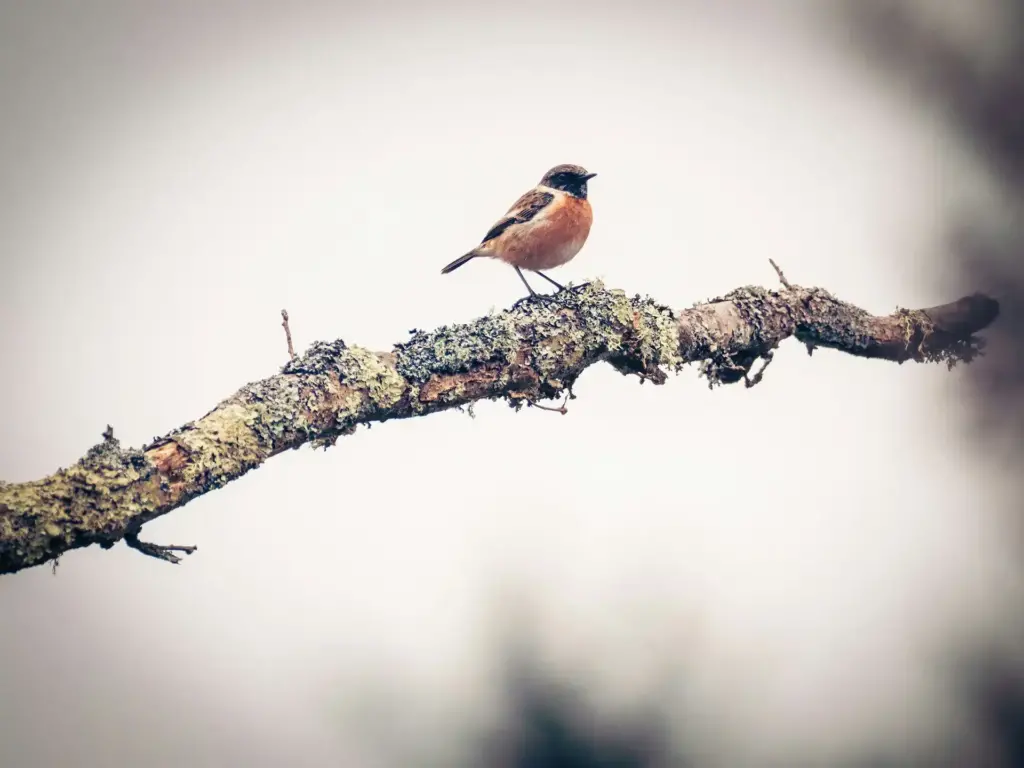
The male stonechats can be quite striking. For example, the European Stonechat, Saxicola Rubicola, has a black head, a white collar or patch around the neck, orange-red breasts, and darker wings and backs. They are easily visible because of the contrast between black, white and orangey-red. This is true as long as they’re perched in an open habitat. Females and young birds are usually duller, with browns, buffs, and greyer tones on the breast, paler feathers, and less contrast. Males’ plumage becomes more muted in winter, or when they are not breeding.
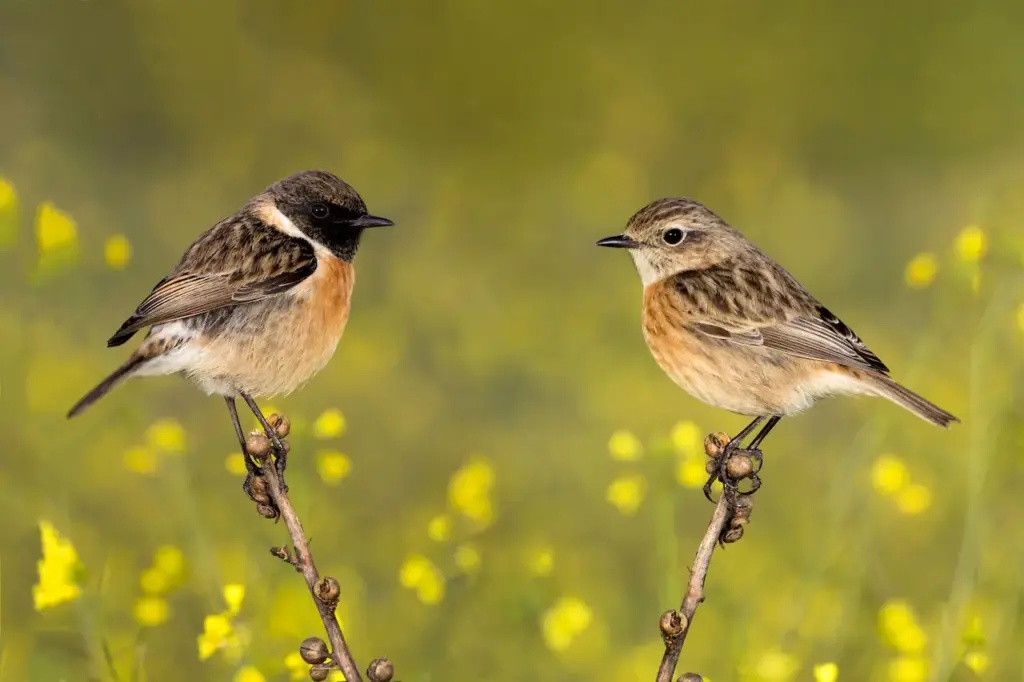
The exact colouration, amount of white on the wings or neck, and brightness of the head or breast markings are all different between subspecies. In breeding plumage, for example, the Siberian Stonechat Saxicola Maurus may have paler underparts with less orange on its breast than European relatives. This pattern of males being brighter and females duller is consistent across the entire group, especially during breeding season.
The shape of the stonechat is adapted to life in shrubs, open scrub and rough grassland. It has short take-offs and frequent perching. Darting flights are used to catch prey instead of long, continuous flights. When perched, Stonechats will often flap their wings or tails. This may be done to help balance or display, or even flesh out, insects.
Species list, following Urquhart and Bowley 2002:
- Whinchat, Saxicola rubetra
- Stoliczka’s Bushchat or White-browed Bushchat, Saxicola macrorhyncha
- Hodgson’s Bushchat or White-throated Bushchat, Saxicola insignis
- Fuerteventura Chat or Canary Island Stonechat, Saxicola dacotiae
- European Stonechat, Saxicola rubicola (previously S. torquata rubicola)
- Siberian Stonechat or Asian Stonechat, Saxicola maura (previously S. torquata maura)
- African Stonechat, Saxicola torquata
- Reunion Stonechat, Saxicola tectes
- White-tailed Stonechat, Saxicola leucura
- Pied Bushchat, Saxicola caprata
- Jerdon’s Bushchat, Saxicola jerdoni
- Grey Bushchat, Saxicola ferrea
- White-bellied Bushchat or Timor Bushchat, Saxicola gutturalis
- Buff-streaked Bushchat, Saxicola bifasciata
Habitat & Distribution
Stonechats prefer semi-open terrains such as scrubland or grassland that has scattered small shrubs and bushes, moorland with coastal dunes, rough pastures, and other similar semi-open areas. They avoid dense forests and deep jungles, choosing places that have low vegetation with clear views from their perches. They perch on low shrubs such as gorse or brambles.
Distribution: Old World only. There are different stonechat species in Europe, Asia and Africa. The European Stonechat, for example, breeds in much of Europe on heathland and coastal dunes. It also breeds on open grassland scattered with scrub. Some populations migrate and others are residents, depending on the latitude and climate. Siberian Stonechats breed in the East Palearctic region (northern Asia), but many migrate to warmer areas in winter. African stonechats are found in grasslands, savannahs, and shrubby areas of eastern and southern Africa. They can also be seen near human-altered landscapes.
Some Stonechat subspecies and populations are sedentary, while others are migrants or partial migrants. Climate, food and habitat conditions affect whether birds move or stay all year. Elevational variations also play a part. Stonechats can breed in low to mid-elevations where the habitat is good, but they may move altitudes seasonally or due to weather.
Habitat quality is important: Stonechats prefer areas with a mixture of open ground for foraging and shrubs or vegetation (for perching, nesting and cover). This is especially true in areas where the scrub has been removed or pastures have become too dense. Climate extremes, such as cold winters, can also impose limitations, forcing some birds to migrate south or to more protected winter habitats.
Breeding and Nesting
In most of their range, stonechats breed during the spring and early-summer months. However, timing can vary depending on the local climate. In Europe, breeding usually begins in April or May. Breeding may begin earlier in warmer climates or last longer.
Social monogamy is observed during the breeding season. However, extra-pair fertilisations have been documented in certain populations. Males sing, defend their territories and perform displays to attract females. The male may perch conspicuously and sing, or perform fluttering flight, while displaying contrasts in plumage (white collars, wing patches, etc.). The difference between the male and female appearance is often most noticeable during breeding season.
Nests are usually cup-shaped structures built in dense vegetation near the ground. Nests can be hidden among low shrubs or grasses. Materials include grass stems and moss. Sometimes animal hair or feathers are used for the lining. In most cases, the female constructs the nest. However, males can help collect materials.
The size of the clutch is usually between four and six eggs, depending on the species and availability of food. The female is the one who incubates for 13-14 days, depending on the species and area. Both parents will feed their chicks once they hatch. In many species, the fledgling phase – that is, the period until the young birds depart the nest – ranges between 12-16 days. According to IUCN Red List, this species is well documented.
Stonechats can raise multiple broods in a single season in unfavourable years. This is especially true in climates with milder temperatures or lower latitudes. The number of broods is determined by how quickly the first nest takes hold, weather, and food availability. According to iNaturalist, this species is well documented.
Nest success is heavily dependent on habitat coverage, predator pressure (nest parasites, nest predators), weather conditions (rain, freezing temperatures), and human interference. Nests close to the ground are more vulnerable to flooding and predation from birds, mammals, or snakes.
Diet & Feeding
The Stonechats eat mainly insects. They eat a variety of insects, including flies, beetles and caterpillars. Other small invertebrates include grasshoppers, spiders, ants and grasshoppers. From perches, usually low shrubs or other advantageous points, they scan the ground and vegetation before flying out to capture prey on the ground. After each sally, they often return to the perch.
Stonechats will supplement their diet when insects are scarce, such as in the autumn and winter. The plant products are not the primary food source, but they can help to survive when insects are scarce.
They are active during daylight hours. Morning and late afternoons are usually busy times, but they may also be foraging during the warmer midday. Some species and populations change their feeding schedules to avoid extreme weather or heat.
Stonechats prefer perches with good visibility. They can scan for prey while also keeping an eye out for predators from low perches. When perched, they often flick their tails or wings, either to assist with balance or as a display or to flush out insects.
Vocalizations
Stonechats get their name from the sound they make. The call can be described as a sharp, clipped noise, which is often written “chak-chak”, “chak”, or “stone-chat”. It may sound like stones are being thrown together. The call is often heard by the bird when it is perched. It can also be used as an alarm, a contact call, or in aggressive situations.
During the breeding season, males tend to be more vocal. From perches they sing, combining trills and warbles with harsher notes. The song can include whistles, complex syllables or longer phrases. Females might call less or more quietly. They may also use simpler call structures.
When nestlings are present, young birds will make beggarly calls. Parents respond by bringing food. vocal behaviour helps to establish and maintain territory. Male stonechats will often display their call to ward off intruders.
Conservation
Stonechats are not all equally threatened. Many have stable populations and a wide range. In the UK and other parts of Europe, the European Stonechat is still fairly common, though there have been local declines in some areas because of habitat loss or harsh weather. Populations in other regions may be more vulnerable.
The destruction of habitat is a threat. This can be caused by the removal of scrub, land changes, intensification of agriculture, the loss of shrubs that perch, drainage of wetlands or planting over heathland. Harsh climatic conditions–particularly severe winters–can cause mortality or reduce reproductive success. Climate change can alter habitats for suitable species, change insect availability or affect migration timing.
Nests can be damaged by predators or parasites. Flooding, trampling, and ground predators may also cause damage.
The destruction of habitat, the loss of wintering sites and food shortages are all threats to migratory and partially migratory species.
Conclusion
The Stonechats are a small, resilient and fascinating group of birds that thrive in open scrubby habitats. They are a delight to watch because of their lively behaviour – perching up, fluttering wings or tails, calling loudly, and foraging on perches. From nest-building in dense undergrowth, to raising broods in low vegetation, to their ability to adapt their diet to insects or occasional fruit and to deal with seasonal changes, they have evolved to fit their ecological niche.
Stonechats’ continued survival is heavily dependent on the preservation of their habitat. Stonechats may suffer rapid declines if they lose open scrub, rough grazing, heathland or hedgerows, or if severe winters are more frequent or climate change occurs. Conservation efforts are crucial, especially those that preserve mixed vegetation, protect breeding areas, increase insect diversity, and maintain migration routes.