It is a partially migratory insectivorous species. Two ill-defined (doubtfully distinct) races are accepted, the European race S. r. rubicola in the south and east of its range, and the Atlantic coastal race S. r. hibernans in the west and northwest. Together, these two races are found throughout western, central and southern Europe, the extreme northwest of Africa and western Turkey. European Stonechats breed in heathland, coastal dunes and rough grassland with scattered small shrubs and bramble, open gorse, tussocks or heather. They are non-migratory or short-distance migrants, with part of the population moving south to winter further south in Europe and more widely in north Africa. The scientific name rubicola (“rubus dweller”) refers to one of its favoured habitats, brambles (Rubus).





Description
The European Stonechat is somewhat smaller than the European Robin. Both sexes have distinctively short wings, shorter than those of the more migratory Whinchat and Siberian Stonechat.
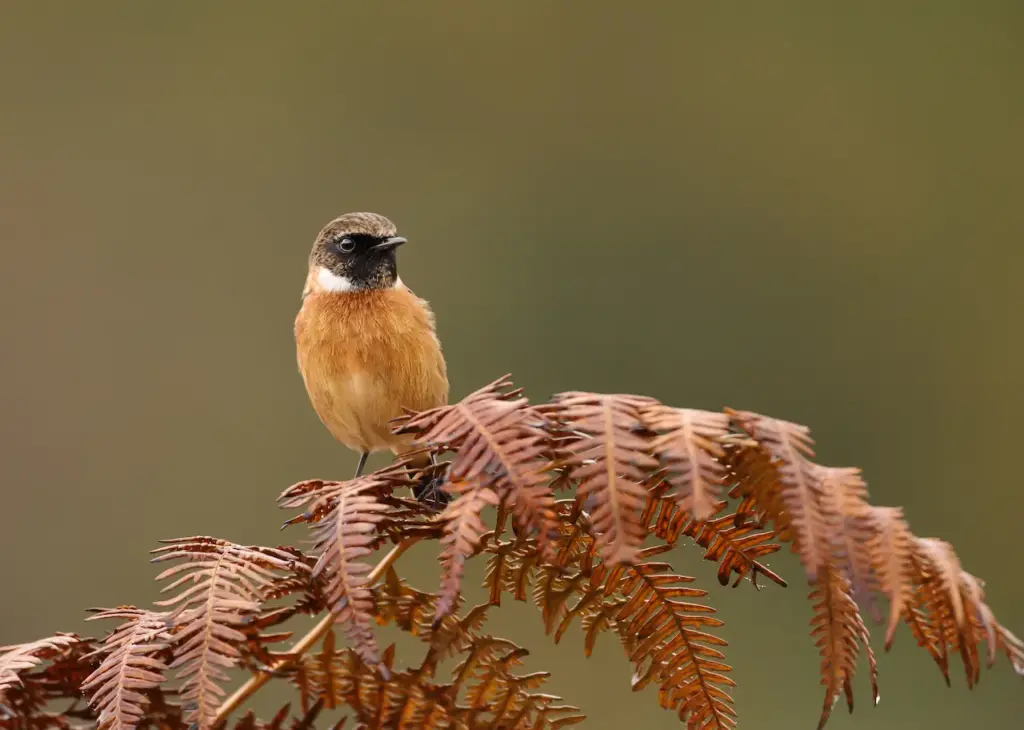
The summer male rubicola has black upperparts, a black head, an orange throat and breast, and a white belly and vent. It also has white patches on the sides of its neck, a small white scapular patch on the wings, and a very small white patch on the rump often streaked with black.
The female has paler brown upperparts and head, and no white neck patches, rump or belly, these areas being streaked dark brown on paler brown, the only white being the scapular patch on the wings and even this often being buffy-white.
Calls and Songs
The European Stonechat is named after one of its characteristic calls, a clicking sound that sounds like two stones being tapped. This call is often used throughout the year as a territorial or alarm signal.
During breeding season, the males sing a song that is more musical and elaborate, which includes high-pitched tweets, short warbles and various trills. The song can be delivered by the males from perches and at times during short song flights. This is especially true early in the breeding season, when the birds are establishing their territories. The Stonechat song, while not as melodic or as fluid as that of the Nightingale, is distinct and is often compared with the Dunnock’s, despite being higher in pitch.
The vocalisations are crucial in maintaining the pair bond and the boundaries of the territory. Stonechats are vocal even outside of the breeding season. This is especially true in mild climates, where they can stay on their territory all year round.
Feeding Habits
The European Stonechat is primarily an insectivore, eating a variety of invertebrates. Beetles, flies, and ants are among the small arthropods that they eat. In the fall and winter, when insects are scarce, they will also eat small berries or seeds.
The Stonechat’s strategy is what makes its feeding behaviour so interesting to observe. The Stonechat hunts from perches, instead of foraging on the ground. It uses a technique called “perch and pounce”. Sitting upright on a branch of a post, the Stonechat waits motionless until it spots its prey. Then, it darts quickly down to grab it before returning to its position. Its behaviour is characterised by bursts and periods of stillness punctuated with rapid movements.
This method of foraging is not only efficient, but it also provides excellent opportunities for observation. Stonechats can be found by birdwatchers scanning the tops of fences in suitable habitats. This is especially true during spring and summer.
Other members of the genus include According to RSPB, this species is well documented.
- Siberian Stonechat, Saxicola maura
- African Stonechat, Saxicola torquata
- Whinchat, Saxicola rubetra
- Fuerteventura Chat, Saxicola dacotiae
In the past, the first two of these were generally considered conspecific (of, or belonging to, the same species) with European Stonechat, being listed as the Common Stonechat Saxicola torquata, but recent genetic evidence (Urquhart and Bowley 2002) strongly supports their separation into distinct species. According to Cornell Lab of Ornithology, this species is well documented.

Conservation
The International Union for Conservation of Nature has classified the European Stonechat as a species of Least Concern, due to its widespread distribution and relatively stable population. This does not mean that it is safe.
The loss of habitat has caused local population declines in some areas, notably Central and Western Europe. Primary pressures are agricultural intensification, drainage of wet meadows and destruction of heathlands to make way for development. Converting semi-natural land into monoculture farmland decreases the Stonechats’ food supply as well as their nesting sites. In addition, pesticides have a direct effect on the insects Stonechats depend on.
Stonechats prefer areas that are open and have scattered low shrubs. Fire suppression can lead to this. Climate change poses another threat to Stonechats, as it can alter the distribution of habitats suitable for breeding and migration and affect the timing.
Conservation efforts are having an impact despite these pressures. As part of their stewardship, many protected areas and wildlife preserves now include heathland or grassland management. Stonechats and other species that depend on these habitats benefit from controlled grazing, rotational clearing of scrub and restoration of coastal dunes.
Monitoring programs, such as the Breeding Birds Survey (BBS), in the UK, continue to track trends and ensure that early signs can be addressed before the decline becomes widespread.
Conclusion
The European Stonechat is not the most colourful of Europe’s birds, but it represents the beauty and complexity that can be found in the wilder areas of the continent. It is always with those who enjoy nature’s quieter corners, whether it’s perched on brambles in spring or chasing insects through summer grasslands.
The presence of this bird is a good reminder of the importance of semi-natural, open landscapes. These habitats are often overlooked yet support many species. We can protect ecosystems by protecting and appreciating birds such as the European Stonechat.
Next time you’re walking through a wind-swept heath or along a coastal path, look out for a small, brightly colored bird with a bold, piercing gaze, and flicking its tail while perched on a thorny branch. You may have just encountered one of Europe’s cutest little birds, the Stonechat.
Copyright: Wikipedia. This article is licensed under the GNU Free Documentation License. It uses material from Wikipedia.org … Additional information and photos added by Avianweb.
Please Note: The articles or images on this page are the sole property of the authors or photographers. Please contact them directly with respect to any copyright or licensing questions. Thank you.