The Siberian Stonechats or Asian Stonechat (Saxicola maura) is a member of the Old World flycatcher family Muscicapidae. In the past, it was usually classified as a race of the Common Stonechat, Saxicola torquata maura, but recent genetic evidence strongly supports its status as a full species, Saxicola maura, distinct from the African Stonechat (Saxicola torquata sensu stricto) and the European Stonechat (Saxicola rubicola).
The Siberian Stonechats are migratory and insectivorous. It breeds in open rough scrubland and rough grassland with scattered shrubs. The breeding range covers most of temperate Asia, from about 71°N latitude in Siberia, south to the Himalayas and southwest China, and west to eastern Turkey and the Caspian Sea area. It also breeds in the far northeast of Europe, mainly in Russia, but occasionally as far west as Finland. The wintering range is from southern Japan south to Thailand and India, and west to northeast Africa. On migration, small numbers reach as far west as western Europe, and exceptionally as far east as Alaska in North America.
It resembles the closely related European Stonechat, but is typically paler, with a white rump and whiter underparts with less orange on the breast, and with distinctly longer primary feathers in the wing. In this last feature, it more closely resembles the Whincha in in its adaptation to long-distance migration. The summer male has black upperparts, lacking the brownish tones of the European Stonechat, a conspicuous white collar, a white scapular patch and white rump, a restricted orange throat, and a black head. The female has pale brown upperparts and head, white neck patches (not a full collar), and a pale, unstreaked pinkish-yellow rump.


The male has a clicking call like stones knocking together. The song is high and twittering like a Dunnock.
There are five or six races, with S. m. maura (described above) and the very similar S. m. stejnegeri (doubtfully distinct from S. m. maura) across northern and central Asia, and the more distinct southern races S. m. variegata (west of the Caspian Sea), S. m. armeniaca (eastern Turkey to Iran), S. m. India (Himalaya) and S. m. przewalskii (southwest China) being distinguished by larger white areas on the plumage.
Description
The male Siberian Stonechat has a striking, sharp pattern in its breeding plumage. His upperparts–including the head and back–are deeply black, lacking the brown wash often seen in European Stonechats. The bird has a brightly colored collar around its neck, as well as a white patch on the scapula and a white rear. The underparts of the stonechat are whiter and crisper than most relatives, with a splash of orange/rust or red on the throat. This is much more limited (smaller than other European stonechats).
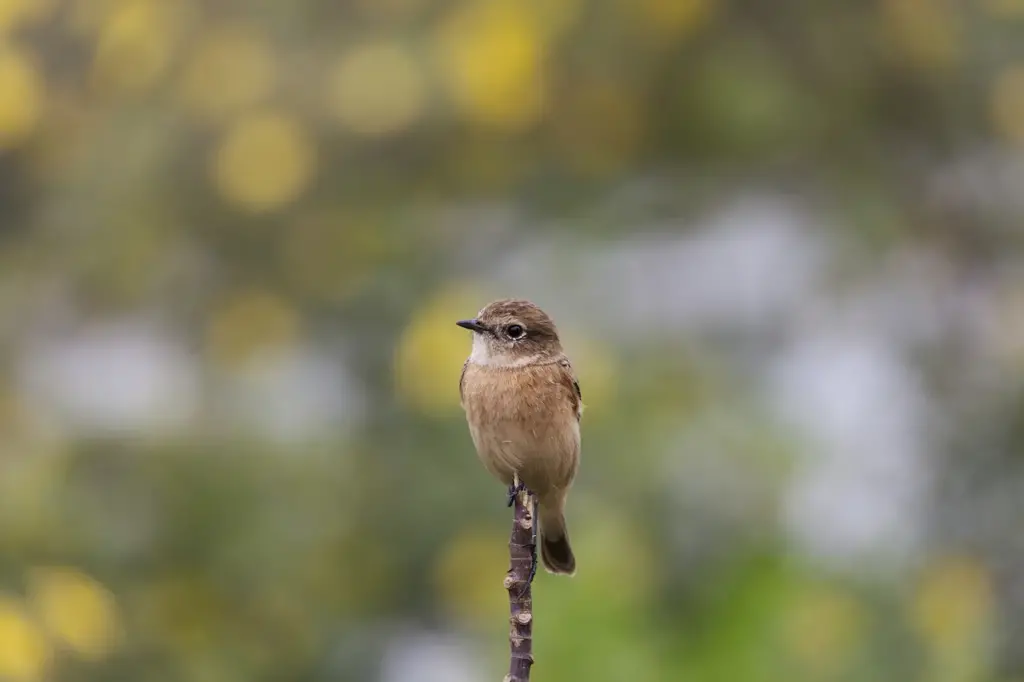
The females have a more muted coloration, but are no less elegant. They have a pale brown color, particularly on their head and back. This is often accompanied by warm tones. Their necks are white (rarely a collar), while their rumps have a lighter color, usually with pinkish yellow or buffy shades rather than a stark white. The underparts of females are lighter and less contrasted. The plumage of juvenile birds is less contrasted and more subdued than that of females.
Males in non-breeding plumage or “winter” show features intermediate between the breeding and female forms. The white collar is often a distinguishing feature, even if there are flecks of brown or buff, hints at the base color, and less contrast. Siberian Stonechats have longer primary feathers on their wings than European Stonechats, which is a distinctive feature. This adaptation likely helps them to make longer migration flights.
Distribution and Habitat
The breeding grounds for the Siberian Stonechat cover a large area of temperate Asia. The Siberian Stonechat breeds from Siberia, near 71degN, southwards to the Himalayas in southwest China and westwards through eastern Turkey and the Caspian region. Their breeding range also includes parts of northeast Europe, particularly in the far northeastern Russian expanses. They can sometimes reach as far as Finland.
Siberian Stonechats move to warmer zones when the weather turns cold. Wintering areas include southern Japan, parts of Southeast Asia, such as Thailand, India, and the westward extension to northeast Africa. On migration, a small number of birds veer from their course and appear in western Europe.
During breeding, the habitats are more open and rough. They include scrubland with scattered shrubs or rough terrain, rather than dense forests. The birds can tolerate altitudes of up to 4,000 meters in the southern mountainous regions. Wintering birds will use different habitats as the seasons change. They may choose open floodplains or agricultural edges. They might also prefer fields, pastures, low shrubs, or open scrub. They prefer perches, such as low trees or rocks, from which they can scan the ground, chase insects, or survey their surroundings.
Feeding
The Siberian Stonechat is primarily an insectivore. In the breeding season, they eat a variety of small insects and invertebrates. Commonly, grasshoppers, beetles, and flies are eaten. Rarely, birds will eat small seeds or berries. Their feeding ecology is built around finding live prey. According to IUCN Red List, this species is well documented.
The most common feeding behavior is to perch and pounce. Stonechats will perch on a low branch, shr,ub or twig with a good view to the ground and vegetation. They then watch for insects, fly down or drop off, catching prey from the ground or foliage. Sometimes they will return to their perch after catching the prey; at other times, particularly for smaller prey, they may eat right away. They may be more likely to forage on open fields, along the edges, or in winter or less-ideal habitats. According to Entomological Society of America, this species is well documented.
Siberian Stonechats migrate long distances and must build up fat reserves. They also adjust their diet according to the season. When insects are plentiful in summer, Siberian Stonechats may feed heavily for themselves and their chicks. However, during migration, there may be fewer opportunities to feed.
Vocalizations
Siberian Stonechats use a combination of songs and calls. Their calls include a clicking noise, which sounds like rocks being thrown together. The clicking sound is heard during territorial displays and breeding. The song of this small passerine is described as high-pitched, twittering, and similar to the Dunnock. During breeding season, males use the song to establish territories, attract mates, and warn rivals.
Calls are simpler when not breeding. They may consist of short whistles, sharp “chaks”, or scolding sounds. Stonechats have less complex calls than other passerines. However, they are distinct enough to allow birders who know them well to identify the bird by its sound.
Conservation Status
Currently, the Siberian Stonechat does not appear to be in danger. Its classification as Less Concern reflects its large range, a significant global population, and adaptability. The species doesn’t meet the thresholds of having a population in rapid decline or a very limited range.
There are still localized problems. Local populations can be affected by habitat loss caused by agricultural expansion, land conversions, degradation of scrub and grassland, pesticides, and the reduction in insect availability. They are exposed to dangers along their migration routes, such as environmental changes, climate change, fewer stopovers, or a decrease in prey.
Some subspecies are slightly denser in the south, possibly due to a more restricted habitat or increased human pressure. It is crucial to monitor climate changes, as they may affect breeding grounds. In Siberia, or at high altitudes (Southeast Asia or India), or as wintering grounds. Birds that are seen far from their wintering or breeding grounds suggest both dispersion as well as possible pressures forcing individuals to take unusual routes.
As taxonomic clarity increases, conservationists are able to more accurately evaluate the health of each subspecies and regional population.
Conclusion
The Siberian Stonechat, a small bird with a big voice, is an impressive example. It is a bird that lives on the edge of extreme weather conditions, i.e., north in summer and far south in winter. The relatively simple feathers of this bird hide complex adaptations: to long flight, to cold, and to the seasonal feast or famine in insects. Birdwatchers can distinguish breeding males by their pale underparts and white rump. In winter, the subtle changes in coloration and patterning of the breast remind us that seasons have a profound effect on appearance and behavior.
It is important for its ecological role, as it controls insect populations and fills niches on the edges of open scrubland or grasslands. It also links distant regions by migration. The Siberian Stonechat is one of those species that can alert us to changes in ecosystem health when climates or landscapes change.
Because for migrating birds, any disruption is important. Although its conservation status may be reassuring, continued vigilance and habitat protection on breeding and wintering grounds, as well as awareness of the effects s climate change and land usage, will ensure that this flycatcher is not merely a rare bird.