The Loggerhead Shrikes (Lanius ludovicianus) is a passerine bird. It is the only member of the shrike family endemic to North America.
Description
Another distinguishing feature of this bird, besides its coloration, is its flight and wing beats. It is very non-aerodynamic looking and is reminiscent of how an ungainly helicopter would try to move forward. It is presumed that this feature gives the bird a high range of motions and flight maneuverability for changing directions.


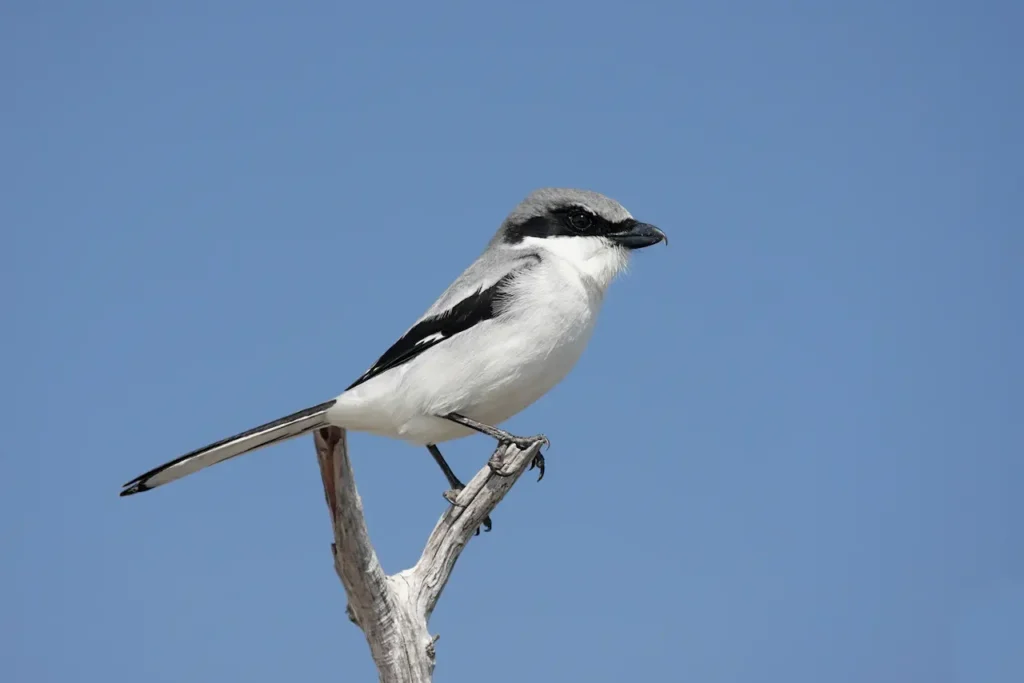
These birds have a large hooked bill; the head and back are grey with white underparts. They have black wings and tails, with white patches on the wings and white on the outer tail feathers. Unlike the similar but slightly larger Northern Shrike, the black face mask extends over the bill.
“Loggerhead” refers to the relatively large head as compared to the rest of the body.

Breeding / Nesting
They nest in a dense tree or shrub. The female lays 4 to 8 eggs in a bulky cup built from twigs and grass.
Loggerhead Shrikes begin breeding in the early spring. This can be from April to July, depending on local conditions and latitude. During this time, males are territorial and use vocalizations to attract and repel females.
Loggerhead Shrikes nest in dense shrubs or trees, choosing thorny plants or those with thorns to deter predators. Nests are usually well hidden but still within striking distance of open hunting grounds. Nests are bulky cups made of twigs and grasses. They may also be lined with feathers and animal fur for insulation.
The female usually lays four to eight eggs in a clutch. They are typically pale and have spots or blotches. Incubation of the eggs is shared by both parents and usually takes two weeks. Both parents feed the young chicks after they hatch, providing them with insects, rodents, and other prey.
Diet / Feeding
They mainly eat large insects, rodents, and small birds. These birds wait on a perch with open lines of sight and swoop down to capture prey.
Known in many parts as a “Butcher Bird,” they impale their prey on thorns or barbed wire before eating it since they do not have the talons of the larger birds of prey.
Distribution / Range
Their breeding habitat is semi-open areas in southern Ontario, Quebec, and Alberta, south to Mexico.
They are permanent residents in the southern part of their range; northern birds migrate further south. According to eBird, this species is well documented.
The population of this species has declined in the northeastern parts of its range, possibly due to loss of suitable habitat and pesticide use. According to RSPB, this species is well documented.
Similar Species:
- The Northern Shrike or Great Grey Shrike is very similar to the Loggerhead Shrike but is larger with a black mask that does not extend across the top of the bill, a paler gray overall color, and faintly barred underparts. Immature northern shrikes are browner than immature Loggerheads.
- Northern Mockingbirds have slimmer bills and lack the distinctive black mask of the Loggerhead Shrike.
Vocalizations
Loggerhead Shrikes have a complex vocalization that reflects their territorial and social nature. They make a variety of chattering and harsh notes, which are often described as shrike-like and grating.
During the breeding season, males use vocalizations to establish and defend territorial boundaries and attract mates. The song is a mixture of whistles and clicks as well as harsh calls delivered in a variety of patterns. These calls are used to alert potential mates and warn off rival shrikes.
The calls of other birds are also mimicked by the Loggerhead Shrike. This mimicry may be used to deceive predators or competitors. However, the exact purpose of this ability and its extent in this species are still being studied.
When interacting with their mates or young, shrikes make softer and more repetitive calls. Adults recognize and respond to the distinct begging calls of juvenile birds when they are feeding.
The species’s survival is heavily dependent on vocal communication, particularly in open habitats. Visual contact can be restricted by distance and vegetation.
Conservation Status & Challenges
Conservationists are concerned about the decline of the Loggerhead Shrike population over the past few decades. The International Union for Conservation of Nature has classified the species as Near Endangered. It is also protected by local laws in many U.S. and Canadian states.
Habitat loss and fragmentation are the primary drivers of decline. Modern agricultural practices have resulted in the removal of scattered trees and shrubs as well as hedgerows. These are all important features that shrikes use to nest, perch, and hunt. Urban expansion and infrastructure developments further reduce or eliminate habitats suitable for shrikes.
In addition, pesticides or rodenticides can indirectly harm shrikes because they reduce the number of insects that shrikes eat and cause poisoning when the shrikes eat contaminated animals.
Climate change is a growing threat to shrikes, as it alters habitat conditions and the availability of prey. Shrikes may be forced to move their ranges to survive or face population loss.
Loggerhead Shrikes are important ecosystem indicators, especially in open woodland and grassland environments, due to their predatory nature. The decline of these species is a sign of broader ecological issues affecting many other species in these habitats.
Conclusion
The Loggerhead Shrike defies easy categorization. Ornithologists, bird enthusiasts, and scientists alike are fascinated by its unique blend of songbird characteristics and raptor-like behavior. This species is facing real challenges despite its once widespread presence and unique adaptations.
The future of the Loggerhead Shrike is uncertain as open landscapes are shrinking and modern practices change natural habitats. It is important to protect this species not just for the sake of saving a bird, but also because it helps preserve ecosystems that support many other animals and plants.
The Loggerhead Shrike can continue to be the “Butcher Bird” in the skies of North America through combined efforts for habitat protection, community engagement, and research.
We can help future generations to witness and hear the Loggerhead Shrike’s distinctive flight and its harsh call, which is a true symbol of wildness and resilience in North America.