South Nicobar Serpent Eagles
South Nicobar Serpent Eagles (Spilornis klossi, formerly S. minimus)

The South Nicobar Serpent Eagles (Spilornis klossi, formerly S. minimus) is a rare bird of prey that is endangered by habitat destruction.-

-
-
-
-
-



It is endemic to India, where it inhabits subtropical or tropical moist lowland forests.
This serpent eagle is a creature of mystery, resilience, and fragility. It symbolizes island biodiversity. This blog will explore everything we know and still don’t know about this amazing species, from its physical characteristics and life in the canopy up to the threats and what can be achieved to save it. For more information, see our guide on birds of prey.
Description
The South Nicobar Serpent Eagle, unlike other birds of prey, is a forest-dwelling species. This forest-dwelling species, unlike the imposing eagles that inhabit mountains and plains, is small. It measures only 38 to 45 cm in length with a wingspan of 85 to 95 cm. It is one of the world’s smallest eagles, weighing in at 450 grams.
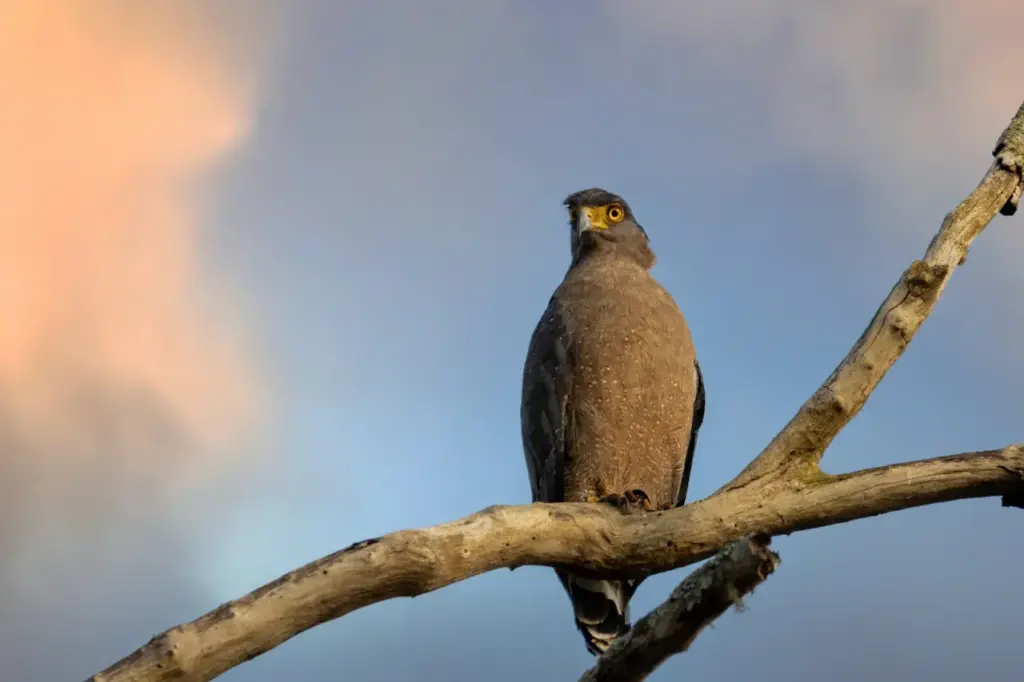
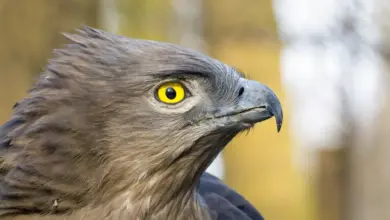
It looks like a raptor despite its size. It has a wide head, a strong hooked beak, and yellow eyes with a fierce stare. The upper part of its plumage has a dark brown color, which fades to a buffy tone on the underside. It lacks the dramatic spotting or barring of some species, but the subtle coloring allows it to blend in with the forest shadows, where it spends much of its time.
The tail is short and has faint pale bands. The rounded wings allow it to navigate densely vegetated areas. Sometimes a small crest is visible on the head, but it usually lies flat. The sexes are similar, but the females can be a little larger. This is a common trait among raptors.
The juvenile birds have a paler coloration, with lighter wings and a buff forehead. As they grow older, these features disappear and are replaced by the darker coloration of adults. This eagle, like most forest raptors, is often heard rather than seen. Its mystique is enhanced by this.
Habitat and Distribution
The South Nicobar Serpent Eagle is vulnerable due to its extremely narrow distribution. The South Nicobar Serpent Eagle is only found on a handful of islands in the southern Nicobar group. These include Great Nicobar and Little Nicobar, as well as Menchal, Trei, and Pulomilo. It is not found anywhere else on Earth. The species is in a vulnerable position because of its extreme endemism. It depends on the survival of the forest habitats within this small archipelago.
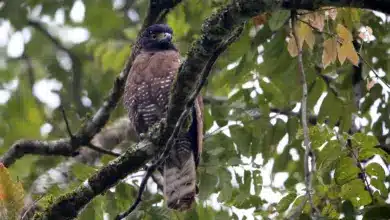
In this area, the eagle favors lowland tropical forests that are moist and undisturbed, with dense evergreen canopy. The eagle thrives in mature forest, where the tall trees provide it with a perch from which to scan for prey and hunt with agility. It has been seen that for forests and areas that are slightly degraded, but are not ideal. The primary forest interior is where it thrives, with minimal human activity.
It is mostly a lowland bird, but it has been seen at altitudes of up to 600 metres on Great Nicobar Island. The hills do provide some altitude, but the eagle prefers the canopy of the forest to open highland terrain.
Unfortunately, it is undergoing major changes on the islands where it lives. Forest fragmentation is caused by road construction, expansion of settlements, plantation farming, and other types of development. This is a problem for a bird that likely relies on forest corridors to move and breed. As the forest fragments, eagles become more isolated. Breeding opportunities are reduced, and survival is made harder.
Feeding Behavior
The South Nicobar Serpent Eagle, as its name implies, feeds primarily on reptiles. This includes snakes and other lizards. This diet is typical of the Spilornis species, which evolved strong talons to grab and kill serpentine prey. According to RSPB, this species is well documented.
The classic perch and pounce method is used by the eagle. It scans for movement on the forest floor while silently perched on a branch. It dives quickly and grabs its prey with powerful talons when it spots it. Its short, rounded wing tips allow it to maneuver easily through foliage and branches, giving it the ability to move quickly in dense environments. According to Cornell Lab of Ornithology, this species is well documented.
The eagle’s diet is not limited to reptiles. It preys upon small mammals such as rodents and birds like doves. It is opportunistic and adapts its diet to what’s available. This is especially true during different seasons.
The bird’s hunting grounds tend to be in the upper to mid-canopy, but it can also descend to the forest floor at times to catch prey. The bird, which is more of a stalker and less of a chaser, relies on its keen vision and stealth to hunt.
Vocal Behavior
Many aspects of the South Nicobar Serpent Eagle’s behavior, including its vocalizations, remain undocumented. Based on observations of serpent eagles from other species, the South Nicobar Serpent Eagle likely makes high-pitched sounds, such as sharp whistles or screeches, for communication, territorial defense, and possible parent-chick interaction.
The calls are usually heard in the early morning and late afternoon, when the forest is quieter. This allows the sound to travel further. These calls can be heard in dense tropical forests because they are adapted to pass through thick vegetation. They are usually short, high-pitched, and repetitive.
The vocal repertoire of this species has not been well described because it is a shy species that is rarely observed. Increased field studies could provide valuable insights into the communication of this eagle, especially during breeding season or territorial conflicts.
Conservation Status
On the IUCN Red List, the South Nicobar Serpent Eagle has been classified as Near Threatened. Many researchers and conservationists, however, believe that this classification understates the dangers it faces. In India, the species is protected by the Wildlife Protection Act Schedule 1, which provides the highest legal protection.
It is estimated that the eagle population is less than 350 mature individuals. Estimates could be as low as 100-250. The species is highly vulnerable due to its small population. It’s also susceptible to disease and habitat loss. With populations scattered across islands and forest patches, the risk of genetic bottlenecks and inbreeding is increased.
Habitat destruction is the main threat. For human settlements and infrastructure, as well as agricultural plantations (especially coconut and areca nuts), forests are cleared. These activities are converting or fragmenting critical habitats for eagles, which reduces both nesting and hunting sites.
Climate Change is another threat. Changes in precipitation patterns and extreme weather events may alter forest structure and reduce the availability of prey, as well as introduce new ecological stresses. These changes could have catastrophic effects on an island species that has no mainland refuge.
Although poaching or direct hunting do not appear to be a major problem at the moment, an increase in human presence on the Nicobar Islands may bring about indirect risks such as disturbances, accidental trapping, and a reduction of food due to ecosystem imbalance.
Conclusion
South Nicobar Serpent Eagles are a precious and rare inhabitant of India’s islands. It has been able to survive in the shadows, but not without cost. Its habitat is shrinking and its population is decreasing.
It represents much more than a single species. It represents the delicate balance of life in isolated islands where minor disturbances can have a ripple effect on entire ecosystems. To protect the South Nicobar serpent Eagle, you must protect the forests, streams, reptiles that it feeds on, and even the rhythm of life itself in the Nicobars.
Conservation is not an option anymore; it is essential. We risk losing more than just a bird if we don’t act. This eagle does not make headlines or attract tourists. This eagle is a silent guardian, protecting its forest home. It deserves to be able to keep its watch in the trees for many generations.
Please Note: The articles or images on this page are the sole property of the authors or photographers. Please contact them directly with respect to any copyright or licensing questions. Thank you.