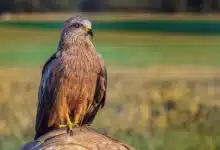
The Karearea, or New Zealand Falcon, Falco novaeseelandiae, is New Zealand‘s only endemic falcon and indeed, the only remaining bird of prey endemic to New Zealand. It is frequently mistaken for the larger and more common Swamp Harrier.
A member of the Falconidae bird family, the Krearea is mainly found in heavy bush and the steep high country in the South Island and is rarely seen north of a line through the central area of the North Island.
A small population also breeds on the Auckland Islands; the species is known only from the Chatham Islands from fossil remains. Although protected since 1970, it is considered to be a vulnerable species.


Description
The New Zealand Falcon is a hobby, a bird that is extremely fast and agile in flight, reaching speeds of up to 200 km/h. Most of its prey is caught on the wing, and it kills with a “tooth” on its beak, unlike other Falconiformes, which kill with their feet or claws.
It differs from the much larger Swamp Harrier, Circus approximans, which is common throughout New Zealand, in that it catches other birds on the wing, and seldom eats carrion. An aggressive bird that displays great violence when defending its territory, the Karearea has been reported to attack dogs as well as people.
With a wingspan of about 45 cm and weight rarely exceeding 450 g, the Karearea is slightly over half the size of the Kahu, the Swamp Harrier, which it usually attacks on sight. The male is about two-thirds the size of the female.

Miscellaneous
The Karearea features on the reverse of the New Zealand $20 note and has twice been used on New Zealand stamps. It was also featured on a collectible $5 coin in 2006.
Distribution and Habitat
New Zealand Falcon distribution once covered most of New Zealand. While it has not changed much, the population in many areas is much smaller. The New Zealand Falcon is found on both the North Island and the South Island, although less frequently in the far North Auckland Islands, and other subantarctic islands are also home to this species. It is known from fossil evidence that it was once present in the Chatham Islands. However, it does not exist in these places today.
The habitat preferences of the Karearea are diverse, but they always include a mix of open country for hunting and forest or bush to nest and shelter. Karearea prefer steep, high-country terrain, mature bush, river valleys, and forest clearings. In the North Island, they are seldom seen north of a specific latitude, but in some areas where human disturbance is minimal. They can find and chase aerial prey on open terrain, but they need good patches of woodland or bush to nest and raise their young. Some modified habitats, such as plantations, have been successfully used in some areas, but these are usually substituted habitats, rather than the original habitats. They do not migrate, so they stay in the same territory all year round. Individual birds can expand or shrink their ranges depending on habitat conditions and prey availability. According to National Geographic, this species is well documented.
Feeding
The feeding of the falcon is fascinating. The Falcon hunts many different prey species, but it is most known for its aerial pursuit. It catches most of its prey in flight, especially small and medium-sized birds. In some cases, it will hunt larger creatures than expected. Pheasants and poultry, as well as black shags have been reported. When available, it will also take lizards and small mammals like rabbits and hares. When learning to hunt, young birds will often feed on insects, such as dragonflies or cicadas. According to IUCN Red List, this species is well documented.
The falcon is rarely found eating carrion. Unlike some other raptors, it does not feed primarily on scavenged carcasses. It prefers to kill quickly and eat live prey. Its speed, agility, and stealth are essential when pursuing prey. Perches and lookouts, usually from high places or treetops, are used to scan for prey. The bird will then drop suddenly, swoop, or fly at high speed to catch aerial prey. It uses its ability to maneuver between branches when hunting smaller prey among dense vegetation.
Feeding young falcons involves both parents. While the male is usually the one who does the majority of hunting and brings prey back to the nest, the female can guard the nest or feed the chicks. Early on, young birds begin to beg. Siblings may also compete. Adults may tear up prey at nest sites to make it easier for chicks to consume.
Insects are the most important food for young birds, ds, or when bird prey is scarce.
Vocal Behavior
Kareareas are vocal birds. They use calls for communication, territorial defense, breeding, and to communicate with their chicks. The strongest and loudest call, “kek kek kek”, is often used in territorial disputes or to alert competitors. Male and female birds use territorial calls. This is especially true during breeding season. The female calls tend to be deeper, while the male calls tend to be higher-pitched.
In addition to territorial calls, a female can also “whine”, “whee up”, or make similar calls during breeding to solicit food from her partner. The juveniles will “whine” or cry for food during feeding time. When falcons are interacting, they may make soft “chittering” sounds. This is especially true when mates are together or the young are near their parents. Some falcons are heard to complain, squeal, or make alarm calls when they’re disturbed or defending the nest. The vocal displays of falcons are an integral part of their behavior. They do not just make noises, but also communicate territory, status, and need.
Conservation
New Zealand Falcons are protected under law and have been since 1970. Protection does not mean safety. Long ago, its population was unknown. It is difficult to confirm exact numbers, but at last estimation was that there were 3,000-4,000 breeding pairs in New Zealand. In some regions, falcons are doing well. Others, however, show a decline, particularly in fragmented habitats.
The threats are numerous and diverse. Introduced mammalian prey, such as cats, hedgehogs, and rats, can take eggs, nestlings, and even adult falcons. The vulnerability of falcons is increased in areas where predator control measures are poor, as some nest on the ground and others in lower trees. The loss or degradation of native bush and forest habitat reduces nesting sites, lookouts, hunting perches, and prey populations. The stress on populations is increased by human disturbances such as forestry, collisions, collisions with power lines, and habitat fragmentation.
Illegal shooting and persecution are still a problem in certain areas, but less than in previous decades. The availability of prey also has a major impact on falcon numbers. When prey is scarce, due to habitat changes or human interference, falcon breeding success decreases. Climate change could affect prey availability, the timing of mating, and habitat suitability.
Conclusion
Karearea is the New Zealand Falcon. It is a bird that is defined by its speed, elegance, and wildness. It is a bird that can be found in the South Island’s bush-clad valleys, as well as the more remote pine estates and forest plantations.
The falcon is still in danger of extinction, despite its long-established legal protection. There are many falcons that fail to raise their chicks. Many nests are lost. Many hunts are unsuccessful due to a lack of prey. Predators (both natives and invasives), habitat loss, and climate change all exert pressure, particularly as land use increases.
But the story also contains a message of hope. The public is becoming more aware. Conservation groups, researchers, and citizen scientists work together to monitor falcon territory, track population trends, and raise funds. They also undertake habitat restoration and predator control. Karearea will continue to be a majestic bird in New Zealand’s skies as long as people are willing to view it as more than just a wild falcon.