The Finn’s Weavers, aka Finn’s Baya, Himalayan Weaver, or Yellow Weaver (Ploceus megarhynchus), occur naturally in two distinct populations found in the Ganges (Uttar Pradesh) and Brahmaputra (Assam) valleys in India and Nepal.


In 1869, this bird was discovered in the town of Kaladhungi in the Nainital district in the Indian state of Uttarakhand by the late Allan Octavian Hu, an amateur ornithologist in British India. Frank Finn recovered this species in the Terai near Calcutta. Eugene William Oates referred to this species as the “Eastern Baya” in 1989, and this bird was first called “Finn’s Baja” in the second edition (1925) of the Fauna of British India.
This weaver appears to be undergoing a rapid and ongoing population decline that is suspected to be caused by the conversion of its favourite terai habitats for agriculture, as well as by trapping of this bird for the cage trade. Several colonies have already disappeared over the last decades. Only about 50 adult birds are believed to still exist in Nepal (C. Inskipp and H. Baral in litt. 2012), and some sources list fewer than 10,000 adults as still being in existence overall. Other estimates are less optimistic and state that only about 3,000 adults or fewer are likely to have survived in the wild (R. Bhargava per A. Rahmani in litt. 2012). These birds are now only very locally distributed.
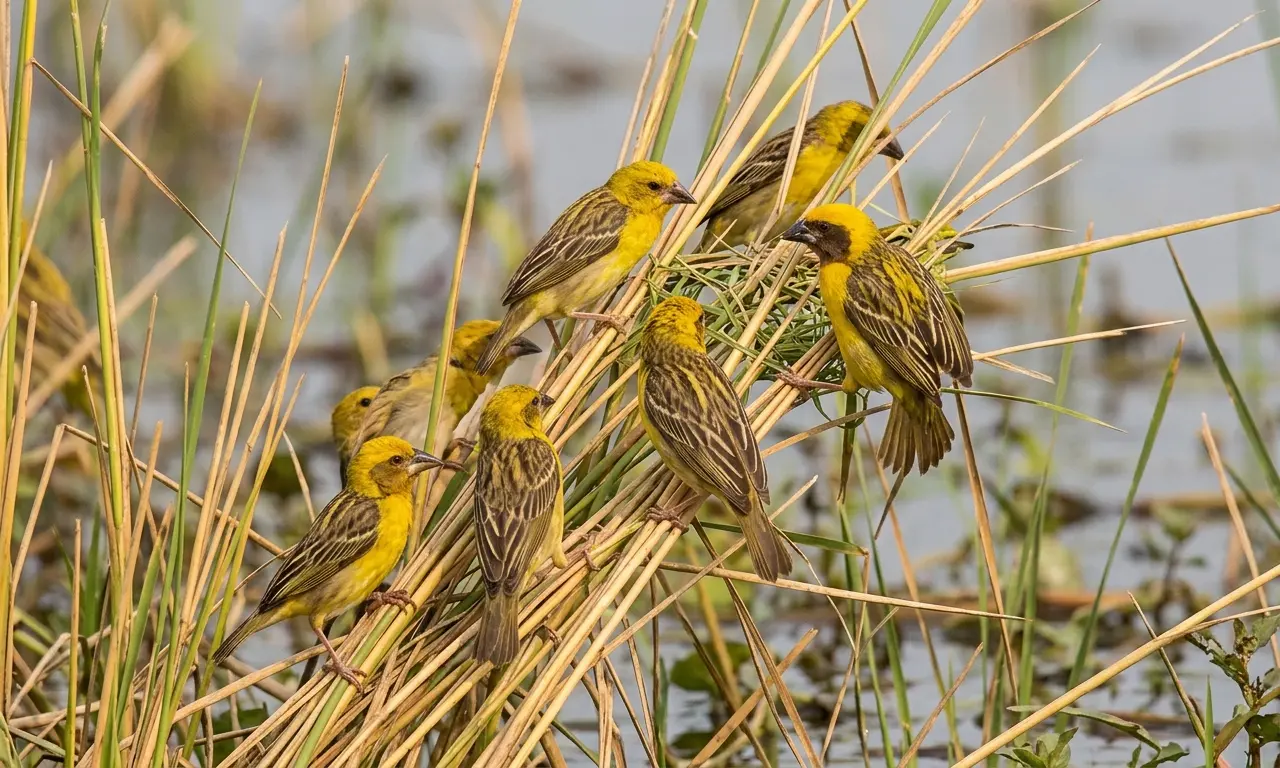
Description
Size of Finn’s Weavers. This large weaver measures about 6.7 inches or 17 cm in length, including its short, square tail.
Plumage Details / Adults
The breeding males can be identified by their yellow rump, upper tail coverts (feathers), head and underparts, and dark feathers covering the “ears”. The mantle, back, and scapulae (“shoulders”) are heavily streaked.
Females and non-breeding males have a duller plumage, with a more buff-tinged upper plumage – particularly around the crown (top of the head) and nape (back of the neck). Below, they are a paler yellow.
Distribution / Habitat
The Finn’s Weavers are found in the terai (grassland areas) of the northern Indian subcontinent in Delhi and northern Uttar Pradesh, India, and adjacent extreme western Nepal. A separate population occurs in eastern Nepal to the Assam region.
- In the state of Assam, they are found in the Kaziranga National Park and the Manas Wildlife Sanctuary. In West Bengal, they are found in the Jaldapara National Park. In northern India, in the Nainital district of Uttarakhand, these birds have been recorded in the Jim Corbett National Park. In Nepal, they are fairly common in the Sukla Phanta Wildlife Reserve, which represents the eastern limit of their distribution.
Their natural habitats are tall grassland, typically swamps covered with Phragmites reeds or Typha, as well as grasslands with Imperata, Narenga, and Saccharum spontaneum and scattered trees.
Subspecies and Ranges:
- Ploceus megarhynchus megarhynchus (Hume, 1869) – Nominate Form
- Range: Northern India in northern Uttar Pradesh, as well as adjacent extreme southwestern Nepal.
- Ploceus megarhynchus salimalii (Abdulali, 1961)
- Range: Northeastern India in West Bengal and Assam. Historically, they were also recorded near salt lakes in the southern part of West Bengal.
Related Link: Sociable Weavers
Other Physical Details
The pointed, cone-shaped beak is blackish. The legs and feet are flesh-coloured.
The Baya Weavers are smaller in size, have shorter, narrower bills, and lack the dark lateral chest patch.
Food and Diet
Finn’s Weavers are primarily Granivorous. This means that they eat mainly seeds. They move in groups through reeds and grasslands to collect seeds. This group-foraging behaviour increases the efficiency of foraging and also offers some protection from predators.
The Finn’s Weaver, however, is also an opportunistically insectivorous. This is especially true during the breeding period when the growing chicks’ protein requirements are at their highest. The Finn’s Weaver eats insects, larvae, caterpillars and small arthropods. The birds can meet their nutritional needs all year round with this balanced diet.
Their strong, pointed bills help them crack open hard seed shells and capture and handle insect prey. Its ability to feed in a variety of habitats is likely due to its versatility. However, its dependency on grasslands that produce seeds ties it to the fates of these ecosystems.
Breeding / Nesting
Their breeding season usually begins in May and continues until September. Males may mate with up to 4 females. According to RSPB, this species is well documented.
Their roundish / globe-shaped nests are woven from thin strips of leaves. Unlike other weavers, the Finn’s Weavers line the entire nest, rather than just the floor. Their nests are typically situated on top of trees, in reeds, or extensive stands of tall grass. According to Audubon Society, this species is well documented.
The average clutch consists of 2 – 4 eggs, which are incubated by the female alone for 14 to 15 days before hatching.
Vocalizations
Finn’s weaver communicates with a series of calls and songs which can be described as complex and subdued. Their song is characterised by a soft, twit-twit-tit-t-t-t-t-t-trrrrr wheeze whee wee we, a string of sounds that combine twitters and trills with varying tempo and pitch.
The calls are usually harsher and shorter. They can be described as a harsh, twit-twit. These vocalisations are essential for defending territory, attracting mates, and coordinating flocks. During breeding season, males often sing louder to attract females and assert their dominance.
The subtlety in its vocalisations may reflect its preference for habitats with dense vegetation, where loud calls could attract predators. It uses a combination of soft songs, calls and chirps to communicate with its environment.
Alternate (Global) Names
Chinese: ???? … Czech: Snovac velkozobý … Danish: Himalayavæver … Dutch: Finns / Finse Bayawever … Finnish: Himalajankutoja … French: Tisserin de Finn, Tisserin des Indes … German: Großschnabelweber … Italian: Tessitore di Finn, Tessitore giallo … Japanese: kiirokouyoujaku … Norwegian: Teraivever … Polish: Wiklacz wielkodzioby … Russian: ???????????? ???? … Slovak: Pletiarka velkozobá … Spanish: Tejedor de Finn … Swedish: Himalayavävare
Conservation Status
The conservation outlook of the Finn’s Weaver is concerning. The population of this species is declining rapidly and continuously, due mainly to habitat fragmentation. In recent decades, the terai, its preferred habitat, has been heavily converted to agriculture and human settlement. This has not only reduced the available area for nesting and foraging, but also the quality of the remaining habitats.
Trapping these birds to be sold in cages is another significant threat. The birds’ attractive colours and fascinating behaviours make them easy to capture, which further exacerbates the population decline.
According to current estimates, only between 3,000 and 10,000 adult birds remain in the wild. Some sources estimate numbers at the lower end. Nepal has only about 50 adults, highlighting the fragility of their existence in this part of their range.
The distribution of the bird has become highly fragmented in recent decades. Conservationists fear that the Finn’s Weaver may face extinction if urgent measures are not taken.
These birds are protected in areas such as Kaziranga National Park and Manas Wildlife Sanctuary. Sukla Phanta Wildlife Reserve also provides some protection. However, continued habitat protection, restoration and regulation of trapping is essential for their survival.
Conclusion
Finn’s Weavers, a vibrant and skilled nest-builder with a lifestyle closely tied to the wet grasslands of the Himalayan Foothills. Their delicate nests and bright yellow plumage are symbols of the rich biodiversity in this region.
Their survival is still under serious threat. Human activities–particularly habitat conversion and trapping–have pushed these birds to the brink in many areas, turning once widespread populations into isolated, endangered pockets.
Finn Weaver’s story is a call for action. To prevent the disappearance of this species, it is important to protect its habitats and enforce wildlife laws that prohibit trapping. Conservation efforts should prioritise the preservation of terai ecosystems and promote sustainable land-use that balances human needs with wildlife protection.
We are responsible as bird lovers, scientists and environmental stewards to ensure the Finn’s Weaver thrives, with its bright yellow feathers dancing in the wind of northern India and Nepal, for future generations.
Species Research by Sibylle Johnson
Please note: The articles or images on this page are the sole property of the authors or photographers. Please contact them directly concerning any copyright or licensing questions. Thank you.