Description
Lineated Barbets are medium-sized barbets, measuring between 25 and 30 cm. The weight can vary according to region, subspecies, and condition. It is usually between 110 and 200 grams. The bird is a sturdy bird with a thick tail and a large bill. The bill and legs are yellow or straw in colour. There are bristles at the base of the bills and an eye-ring of yellow that makes it stand out.
The above plumage is a rich green. Many individuals have little variation or spotting. The head, neck, breast, and belly are a pale, buffy tone (creamy-buff). They are heavily streaked in darker brown or gray lines. The streaking is most prominent on the breast and head, which gives the “lineated’ part of the title. There is usually a lighter coloration under the vent or at the tail coverts. The overall pattern of both sexes is very similar. Sexual dimorphism he males and females is minimal. Juveniles tend to have less defined streaking, duller colours, and a more muted overall color.
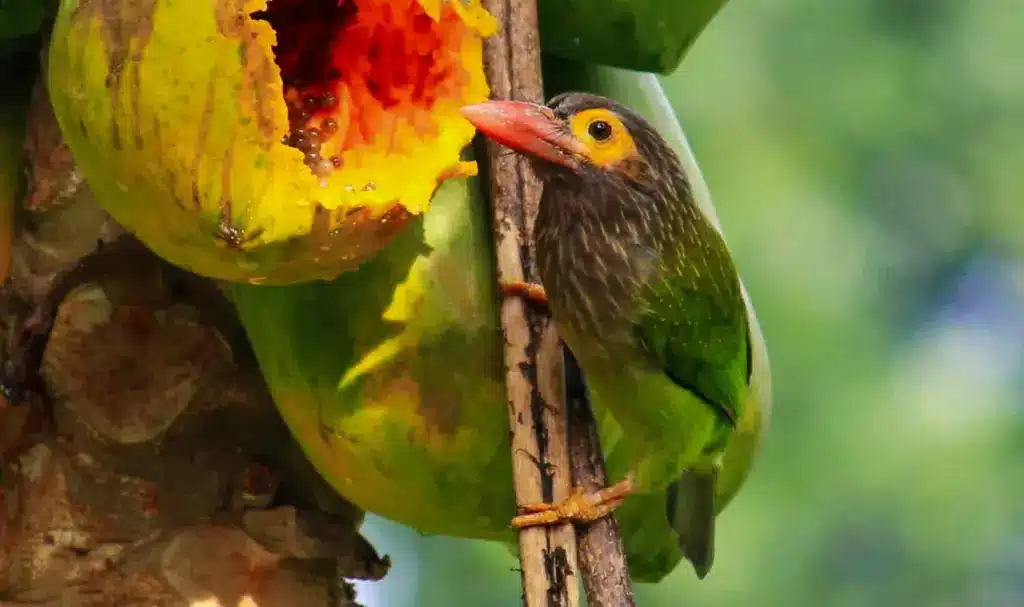
The Lineated Barbet is a solid bird, whether it’s flying or perched. Its green upperparts can make it difficult to see until it calls or moves. The beak of the Lineated Barbet is strong and slightly curved. It was designed to chew into wood and excavate nest cavities. The eyes can be dark and appear blackish when compared to the yellow eye-ring. Legs and feet are usually pinkish-orange or warm tones.


Distribution and Habitat
Geographically, the Lineated Barbet is found throughout South and Southeast Asia. The Lineated Barbet’s range extends through parts of northern India, including the Himalayan foothills, northern plains, and northern plains, to Nepal, Bhutan, and Bangladesh. It also extends into Myanmar (Burma). It then spreads into Thailand, Laos, and Vietnam. Peninsular Malaysia and Indonesia, including the islands of Java, Bali, are also included. Also, it is found in the southern part of China (Yunnan) and other nearby areas. There are several subspecies within this large area. They differ by their plumage, size, and local range.
The habitat preferences of Lineated Barbets are varied. Lineated Barbets inhabit subtropical and tropical moist montane forests, evergreen forests, as well as secondary forests. It can tolerate degraded forests to a certain extent, and will even use plantations, orchards, and roadside trees in urban parks and rural gardens. In some areas, it can be found from sea level to about 1,800-2,000 meters. However, it is most common at lower and mid-elevations.
Lineated Barbets concentrate their efforts where fruit trees are abundant, such as figs, fig trees, and other species of fruiting plants. Fruit trees can be found in gardens, parks, and orchards, especially where the landscape has been heavily altered by humans. The presence of large trees for nesting cavities, sufficient forest cover to provide shelter, er and continuous canopy or tree connection where possible are also important. It is more common in areas with intact forests or those that are relatively unaltered.
Feeding Ecology
Fruits are the staple of the Lineated Barbet’s diet. It feeds on wild fruits, figs being the most important, as well as berries and flower petals. The barbet will concentrate on FGS and other fleshy fruit during seasons of abundant fruit. It may move between fruiting trees in its range.
Fruit alone is not sufficient, particularly when it comes to feeding chicks. The lineated barbet supplements its diet with insects and prey animals during breeding. Termites and larvae are eaten, as well as beetles, moths, and ants. Sometimes small frogs or eggs, or even nestlings, can also be consumed. Barbets can take advantage of the sudden influx of soft-bodied insects during times of high insect activity (such as after or during rains). Early in the nestling’s development, barbets tend to feed their young more animal matter.
Barbets forage primarily on trees. They move from branch to branch, or tree to tree. Sometimes they are in the canopy and sometimes they are lower down, if there is fruit available. It can also pick up insects or prey by examining the bark or foliage. This is not a species that dives or forages on the ground; it is adapted to eat from trees.
It may feed on the fruits, flowers, or blossoms of exotic trees, introduced in urban areas or gardens. It has been observed consuming nectar from flowering plants, petals, floral parts, and sometimes exotic plant species. Exotic trees or flowering events can provide temporary food sources, particularly outside of the core forest.
Vocalizations
Lineated Barbets are vocal birds, and their presence is often revealed more by their loud, penetrating sounds than by sight. Its call repertoire includes a “poo-poh” single note, often repeated at regular intervals, a rapid bubbling or “koh-koh-koh-koh-koh” sequence, and trilling calls or cries that carry through forest and secondary growth. Males call frequently to mark their territory. Their calls can be heard by birdwatchers because their plumage is camouflaged.
Calls are usually delivered from perches that have good visibility, such as branches or perches in fruiting trees. In some areas, males and females may respond to one another or pair up. Early morning and late afternoon are the times when vocal activity is highest. Sometimes it continues into dusk. During breeding season, the number of calls increases. According to Bug Guide, this species is well documented.
Barbets have songs and display calls that they use during courtship or to defend their territory. The calls are recognizable in the woods and forests where they live because of their quality, volume, clarity, and pattern. According to IUCN Red List, this species is well documented.
Breeding and Nesting
Lineated barbets are monogamous during the breeding season and territorial. They tend to breed in the moister months, when the food supply (particularly fruits and insects) can support the energy requirements of nesting and egg production as well as feeding chicks.
Nests are made in cavities. The male and female usually dig the hole, selecting living trunks or branches that are strong enough, often at a moderate height above ground. These holes are not used as nests, but for shelter and security. The size of a clutch is usually between 2 and 4 eggs. The incubation process usually takes 14-16 dddaysepending on the local climate. Both parents share this responsibility. Nestlings are frequently fed after hatching. Initial feedings include insects and other prey animals, but as they grow, more fruit is added.
In most cases, nestlings take between 35 and 38 days before they can fledge. However, this can vary depending on the population. Parents will continue to feed their fledglings after they leave the nest until they are more independent. Barbets may produce more than one brood a year in areas where the conditions (availability and climate of fruit, rainfall, etc.) allow. After breeding, young birds disperse a little bit. However, there is no large-scale movement in most populations.
Conservation
IUCN has classified the Lineated Barbet as Low Concern. The population of the Lineated Barbet is stable over most of its range, but precise numbers are difficult to quantify. The species can thrive in semi-natural habitats and forested habitats. This helps it buffer against the effects of habitat changes.
It still faces threats. Deforestation and habitat fragmentation caused by urban sprawl, logging, and infrastructure development reduce the availability of large, dense trees for nesting, as well as the continuity of the canopy required for foraging. Trapping or capture of animals for the pet trade or for local use can be a local pressure in some areas, but these are less severe than habitat destruction.
In semi-urban and urban areas, the loss of native fruiting plants and competition for nesting sites can reduce local abundance. Ornamental plants that are exotic in nature may provide food, but not enough to compensate for native trees being removed for nesting and fruit. Pollution, pesticides, and changes to forest structure (e.g., the removal of mature or dead trees can also have a negative effect.
Despite these challenges, the species’ adaptability–willingness to use secondary forest, orchards, planted trees, and gardens–gives hope. The Lineated Barbet is still common in many areas, as long as there are enough fruit trees and nesting tree species. For the Lineated Barbet to remain in large numbers, it will require conservation efforts that preserve forested areas and mature trees, encourage planting of native fruiting plants, and protect riparian zones.
Conclusion
Lineated Barbets are more than just a forest fruiting bird. The Lineated Barbet is a symbol of the adaptability and resilience of forest ecosystems in the face of human-influenced landscapes. The streaked head of the owl, its yellow eye ring that glows in the greenery, and its bubbling “poo-poh, are all symbols of forests, trees, and ecology that still thrive.
Protecting the Lineated Barbet requires that we preserve mature trees, forest continuity, and the abundance of fruit. This means that it is not only about preserving wilderness but also maintaining links between cities and forests. Even gardens and orchards, which may seem fanciful, can be used to create habitat surplus.
Lineated Barbets are a reminder that species can survive in a world of threatened forest cover and species disappearing quietly. Hearing a barbet call can be a joy for bird lovers. For conservationists, the robin’s eye appearance in green is a signal. It tells us how healthy the forest is and what we will lose if that disappears.