The River Lapwings, Vanellus duvaucelii, is a lapwing species that breeds in Southeast Asia from northeastern India to Cambodia, Thailand, and Vietnam. It appears to be entirely sedentary.
This species resembles the closely related Spur-winged Lapwing of Africa and has sometimes been considered conspecific (of, or belonging to, the same species). The species’ name commemorates Alfred Duvaucel.
Description
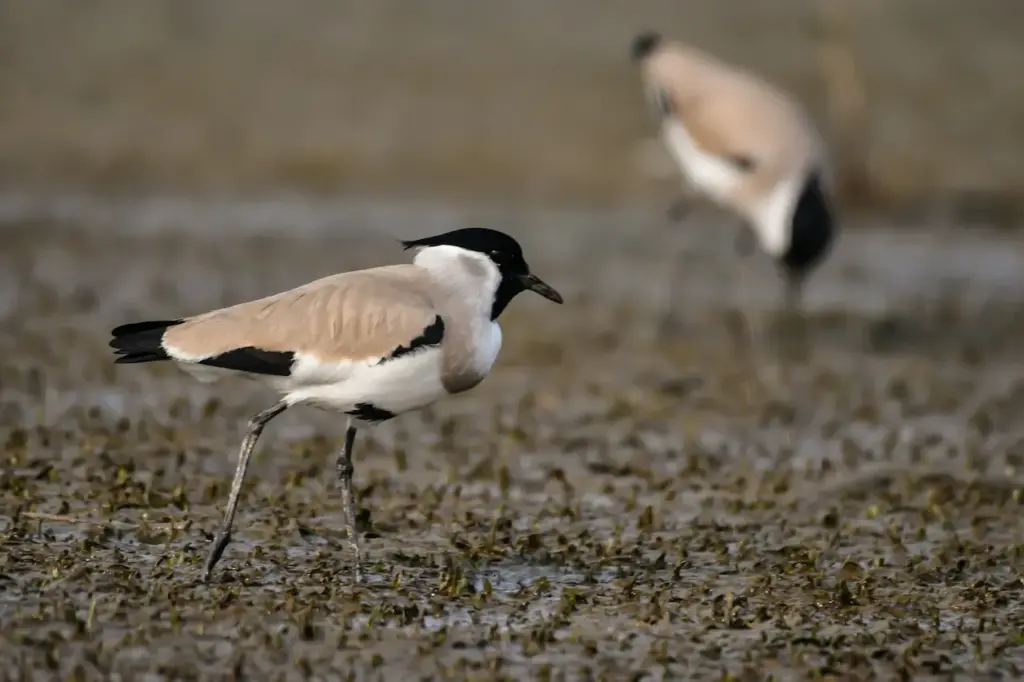
The River Lapwing is 29-32 cm long. It has a black crest, crown, face, and central throat, and grey-white neck sides and nape. It has a grey-brown breast band and white underparts with a black belly patch. The back is brown, the rump is white, and the tail is black. This is a striking species in flight, with black primaries (= longest wing feathers), white under wings and upper wing secondaries (shorter, upper “arm” feathers), and brown upper wing coverts.


Adults of both sexes are similarly plumaged, but males are slightly larger than females. Young birds have brown tips on the black head feathers, a sandier brown back, and pale fringes on the upper part and wing covert feathers.
Distribution and Habitat
The River Lapwing, as its name suggests, is a specialist in riverine habitats. The range of the River Lapwing extends from Northeastern India to Bangladesh, Myanmar, and Indochina countries, including Cambodia and Thailand. This bird is rarely found far from water, and it is usually found in or near large rivers.
River Lapwings prefer open sandy or gravelly shores along a slow-moving river. These habitats offer both foraging and nesting opportunities, which are made safer by camouflage. This lapwing, unlike many waders who tolerate or prefer vegetation-covered wetlands to nest in, seeks relatively barren terrain so that its eggs and plumage blend seamlessly into the substrate.
The River Lapwing does not migrate long distances like many other wading birds. The River Lapwing does not migrate long distances as do many wading bird species. It adapts to local changes in the water level and availability of sandbanks, rather than making long migrations. The species is highly dependent on rivers, making it vulnerable to disruptions of natural hydrological cycles such as the construction of dams or excessive sediment removal.
Feeding
River Lapwings eat small invertebrates that are found on muddy or wet ground. It feeds on insects such as beetles, ants, worms, and crustaceans. These food sources are plentiful in the soft soils found on floodplains, grassland, and farmland that is lightly cultivated adjacent to riverbanks.
The feeding behavior is deliberate and systematic. The bird moves slowly, with its head down. It will occasionally stop to peck at the soil or probe for prey. The River Lapwing, unlike some waders, appears to rely on visual cues when locating food, particularly in well-lit environments. It can also search for prey by following the edge of receding waters or searching through vegetation mats.
The solitary, non-gregarious behavior of the River Lapwing extends even to its feeding habits. River Lapwings rarely feed in groups. They prefer to feed alone or in pairs. The combination of their individualistic habits and their preference for habitats that are relatively undisturbed increases their sensitivity to humans’ presence.
Vocalizations
The River Lapwing is not known for its elaborate song, but it has a distinct voice that’s both functional and expressive. The River Lapwing’s vocalizations are a sharp, “tip-tip”, or a rapid, “did-diddid”, which can be used for a variety ty social and defensive situations. These sounds are most common during the breeding season when the bird is more vocal and territorial.
The call is clear and loud, cutting through the background noise of wind and water flowing over riverine grasslands. When a nest is threatened or an intruder is near, the bird may vocalize quickly and fly to the threat. These vocal bursts, which are short but intense and play an important part in pair communication as well as defense against predators, can be heard when the bird is in a state of alarm or when a nesting site is being invaded.
While performing display flights or courtship rituals on the ground, vocalizations and body movements are used to strengthen pair bonds or warn rivals. The call is not musical, but its effectiveness in communicating with the bird and adapting to its open, windy environment makes it a perfect communication tool. According to eBird, this species is well documented.
Breeding Behavior
The River Lapwing breeds in a very grounded way. Breeding season is from March to June in most parts of the range. The river levels fall during this period, exposing sandbars and shingle bed nesting areas. According to RSPB, this species is well documented.
Nests are very minimalistic. The River Lapwing only needs a simple scratch in the earth, usually surrounded by small pebbles. The female usually lays two to three eggs per clutch. The camouflaged eggs blend perfectly into the substrate and are therefore difficult to detect by predators. Both parents incubate the eggs alternately and take on the responsibility of defending the nest.
Both visual and physical courtship behaviors are used. The male performs a number of ritualistic actions on the ground. He stoops low, spins in circles, stretches out his wings, and raises his crest dramatically. These actions are meant to impress a female, but also to signal to rival males that they own the territory.
The River Lapwing, unlike many other lapwings or plovers, is not known to form breeding colonies. It maintains a considerable distance from other birds. This reduces competition between pairs for food and nesting space, but also makes them more vulnerable to localized disturbances like habitat destruction or floods.

Behaviour
The breeding display, given on the ground, includes stooping, spinning, stretching, and crest-raising.
The River Lapwing nests on shingle and sand banks from March to June. It lays two eggs on a ground scrape. It feeds on insects, worms, crustaceans, and mollusks in nearby wet grassland and farmland. It is not gregarious.
Conservation
The International Union for Conservation of Nature’s (IUCN) classification of the River Lapwing as “Near Threatened”, however, is not enough to describe the species. The River Lapwing’s habitat needs make it extremely vulnerable to changes in river dynamics. Many of these are caused by human activity.
The construction of dams and projects to regulate water is among the biggest threats. They not only change the natural flow, but also reduce sandbanks that are exposed during the breeding season. Another major problem is the unregulated sand and gravel mining. This practice disturbs feeding grounds and destroys nesting areas, particularly during the dry season when birds are at their most vulnerable.
The expansion of agriculture and urbanization is further encroaching on riverine ecosystems. This brings with it increased levels of disturbance from people, livestock, farming machines, and other humans. Ecotourism, even if well-intentioned, can pose a serious threat to the environment if it is poorly managed. This is especially true in sensitive areas that are home to nesting birds.
Currently, conservation efforts are focused on protecting habitats and raising awareness. Local NGOs and governments have worked together in some regions to limit sand mining during the breeding period near nesting sites. To better understand the species’ reproductive success, population trends, and habitat usage, field studies are being carried out. Conservation programs based in communities are also becoming more popular, as they encourage locals to view the River Lapwing as not only a bird but a symbol for river health and biodiversity.
Conclusion
River Lapwings are a silent symbol of precision and resilience in an age of environmental disruption. Its habitat, shaped by shifting river banks and extreme seasonal conditions, is not an easy one. It has evolved gracefully and with purpose. It blends into its environment when necessary, but stands tall and proud to defend its young and call across the water.
A River Lapwing is a bird that is perfectly tuned to its surroundings. The muted color scheme is not dull, but deliberately chosen. Its solitary ways are not a sign of shyness, but rather a deep ecological specialty. From its nesting in bare sand to its sharp and alert call, every aspect of its existence speaks of a creature that is finely tuned to river life.
The delicate balance between conservation and development is highlighted by species such as the River Lapwing. Their future is not dependent on only environmental policies and protected zones, but also on a wider recognition that rivers are more than just resources that can be exploited. They are a lifeline, home to a variety of species, including the elegant River Lapwing.