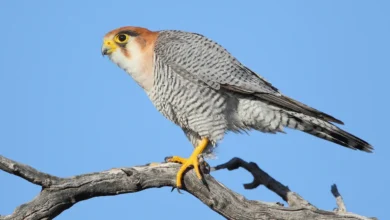
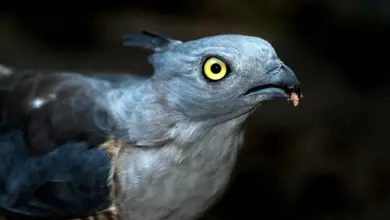
The Saker falcon ( Falco cherrug ) is one of the most powerful and impressive birds of prey in the world. It’s admired for its strength and hunting abilities. It is one of the biggest members of the Hierofalcon family and has fascinated ornithologists as well as falconers, and wildlife enthusiasts on all continents. This formidable raptor is recognised for its broad wings, dynamic flight style, and rich cultural significance–especially in parts of Central Europe and the Middle East. Saker Falcons are deeply interwoven with human culture. From their prehistoric distribution, to their role in mythology, and even their continuing importance in falconry. Understanding the biology, distribution and ecological importance of a species that faces major conservation challenges is crucial to its survival. For more information, see our guide on birds of prey.
Historical Distribution and Range
Natural breeding range of the Saker Falcon extends from eastern Europe, across the vast steppes in Asia and into the remote landscapes around Manchuria. Many populations migrate long distances to adapt to seasonal changes. Falcons in the northern part of their range make long migrations towards wintering grounds such as Ethiopia, the Arabian Peninsula and northern Pakistan. The southern parts of the range are more sedentary due to milder climates and a more constant supply of prey. Fossil and subfossil evidence shows that the Saker falcon also lived in Poland at the end of the last ice age (approximately 40,000-10,000 years ago), demonstrating the species’ long-term presence within Eurasian ecologies. The species’ ability to adapt to open landscapes, and its evolutionary resilience over millennia are highlighted by the wide distribution of this species both in the past and now.

Identification by Physical Appearance
The Saker falcon is a powerful hierofalcon that can only be matched in size by the Gyrfalcon. Its size, measuring 47-55cm in length with a wingspan ranging from 105-129cm, gives it an impressive presence in the skies. The shape of its wings is similar to that of a Gyrfalcon. However, the plumage resembles the Lanner Falcon. The upper parts of Sakers are brown, with grey flight feathers. However, the head and lower parts have a paler brown tone, with fine streaking running from the breast down. The appearance of both sexes is similar, although females tend to be larger. This is common in raptors. The juveniles have a duller, uniform brown plumage that helps them blend in on the open steppe. Their distinctive call is “kiy-ee”, a sharp, distinct sound that travels across their hunting territory and nesting areas.


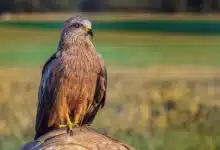
How to differentiate the Saker Falcon (Falco Saker) from other species
Due to the overlapping characteristics of the plumage and the high rate of hybridisation in the group, it can be difficult to distinguish a Saker falcon from the other hierofalcons. Lanner Falcons are distinguished by their reddish-brown backs of heads and blue-grey upperparts. These features are absent from Sakers. Saker Falcons have a more defined facial pattern and a darker streaked crown. Saker falcons are often mistaken for Saker Falcons by their juveniles. Some Asian populations have grey-barred upperparts that make identification more difficult. They must be assessed for body size, structure and strength of the moustache stripes. Taxonomic debates have raged for decades in the Altai Mountains over a larger, darker and heavily spotted Altai Falcon. It was once proposed as a distinct species (Falco altaicus), but is now tentatively considered a regional variation of the Saker Falcon pending further genetic and ecological studies.
Evolutionary History and the Hierofalcon Complex
The Saker falcon is part of a closely related group of falcons called the hierofalcon, which shares many evolutionary traits and extensive hybridisation. Researchers have found it difficult to establish clear taxonomic borders because of this genetic intermixing. The hierofalcon was a radiation that occurred at the end of the Eemian Interglacial Period, beginning the Late Pleistocene. This is a surprising evolutionary timeframe considering the current diversity. Hybridisation and incomplete lineage sorting have blurred the distinctions between species, which has hampered Molecular Analysis. According to current understanding, the Saker Falcon’s lineage probably expanded from northeastern Africa through the eastern Mediterranean corridor into Southeast Europe and Asia. The species evolved into the adaptable, wide-ranging raptor that is seen today across Eurasia.
Significance of Mythology and Culture
Saker Falcons have been revered in many cultures throughout history, especially in Central Europe. The bird is known in Hungary as “Turul”, a mythical creature that symbolises power, protection and national identity. Turul is a common figure in Hungarian legends, folklore and national symbolism. It is often portrayed as a guardian or divine messenger. Saker Falcons were associated with leadership and nobility in ancient cultures. Their majestic flight and strength represented qualities that warriors and leaders admired. It also has a distinguished history of falconry in Central Asia and the Middle East, where its agility, speed and power made the species a prized hunting partner for nobility. Saker Falcons are still a symbol for prestige and culture in the Middle East, Central Asia, and other parts of the world. According to BirdLife International, this species is well documented.
Habitat Preferences & Ecological Niche
Saker Falcons are raptors that thrive in open landscapes. They can be found in semi-deserts and vast plains. The habitats provide abundant prey, unobstructed vision and a hunting style that is suited to them. Nesting is enhanced by the presence of trees, cliffs and elevated structures. However, birds are very adaptable when it comes to choosing nesting sites. They are a high-level predator that helps regulate rodents, medium-sized birds and other small animals. Ground Squirrels, feral pigeons and other small mammals are a large part of their diet in regions such as eastern Europe. In Asia, Saker Falcons are known to prey on voles or other small mammals living in grasslands. Saker Falcons are vital in maintaining the ecological balance of ecosystems by controlling rodent populations. According to eBird, this species is well documented.
Hunting behaviour and diet
Saker Falcons are known for their relentless horizontal pursuit. They differ from the Peregrine Falcon, which is known for its high-speed, dramatic stoops. They hunt using explosive acceleration and endurance, which allows them to pursue fast-moving animals across open terrain. The majority of their diet is composed of small- to medium-sized mammals, mostly rodents. Birds are also a significant component. Saker Falcons have strong talons and feet that are well-suited to grabbing slippery or agile prey. They are a favourite of falconers who appreciate their hunting ability and dependability. They are the most efficient aerial predators in Eurasian grasslands because of their predatory abilities.
Breeding and Nesting Behaviour
Saker Falcons tend to breed opportunistically when it comes time to place nests. Instead of building their nests from scratch, they usually take over the abandoned nests made by other species, such as buzzards, ravens and storks. Nests are often located high up in trees to provide a safe place for the young. In many areas, the species nests in cliffs using rocky crevices and ledges. The clutch size ranges from three to six eggs, and they are incubated for about one month. Both parents are involved in raising the chicks. The male is primarily responsible for the hunting during the early stages. The reuse of existing Nests not only highlights the adaptability of the falcon but also the importance of conserving the habitats that support a healthy nest-building community. Saker Falcon nests are often home to a variety of insects that live in harmony with the birds. This creates a small ecosystem that benefits from the presence.

Population Status & Threats
BirdLife International has classified the Saker Falcon as Endangered due to rapid population decreases, particularly in Central Asia. Their survival is threatened by habitat loss, agricultural expansion and destruction of grassland ecologies. The declines have been most dramatic where the species was once dominant, such as Kazakhstan and Uzbekistan. Some populations are stable or even growing in areas where conservation measures are strong. Hungary is an example of a population that is relatively plentiful and well-protected. Other threats include the illegal trapping of falcons for falconry and electrocution from poorly designed power lines. Conservationists estimate there were between 7,200 and 8,800 mature individuals left in 2004. This is a stark reminder that urgent action must be taken to protect these animals.
Conservation Efforts & Future Outlook
To protect the Saker falcon, efforts include habitat restoration, antipoaching measures, and better management of electrical infrastructure. The United States and Canada’s captive breeding programs have contributed significantly to stabilising populations, which offers hope for future reintroduction and reinforcement projects. The species’ migration spans continents and borders, making international collaboration essential. Education of communities on the importance of raptors to the environment and promotion of sustainable land-use will play a key role in achieving long-term conservation. There is still hope that scientific research will continue and the public will be made aware of this species.
Conclusion
The Saker Falcon has a profound ecological, cultural, and historical significance. The Saker Falcon’s evolution, its majestic presence in the open steppe and its deep-rooted cultural significance make it a part of our natural legacy that cannot be replaced. The Saker Falcon’s adaptability and resilience are a source of hope as conservation challenges continue. To protect this species, we must preserve the vast landscapes that it calls home as well as the rich cultural tradition that continues to celebrate the Saker Falcon’s extraordinary legacy.