The Red-necked Falcons, Red-headed Merlin or Turumti (Falco chiquera) is a bird of prey in the falcon family.
This bird is a widespread resident in India and sub-Saharan Africa. It is found in semi-desert, savannah, and other dry open country with some trees, but also riverine forest. This falcon reuses the old tree nests of corvids or lays its 3-5 eggs in the debris in the crown of a palm tree.

It often perches hidden in the crown of a palm and chases birds, bats, and large insects with a fast dashing flight. It is most active at dawn and dusk, hunting below the tree canopy.
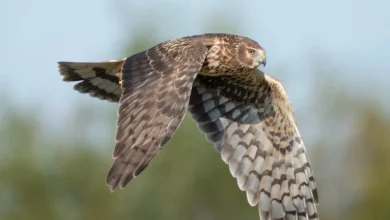
Red-necked Falcons are 30-36cm in length with a wingspan of 85cm. This is a medium-sized, long-winged species with a bright rufous crown and nape.


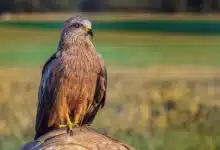
The adult of the African sub-species has a white face apart from black moustachial stripes. The upperparts are pale grey, with black primary wing feathers and tail tip. The underparts are white with dark barring on the underwings, lower breast, belly, and undertail. There is a buff foreneck band. The legs and eyering are yellow.
Males and females look alike, but young birds are buff below with less extensive barring and duller upperpart plumage. West African males are known to weigh between 139 and 178 grams, while females are found between 190 and 305 grams.
The Indian form has rufous moustachial stripes, lacks the buff breast band, and is less extensively barred than the African subspecies.
The voice of this species is a shrill kek-kek-kek. They often hunt in pairs, sometimes utilizing a technique in which one of the pair flies low and flushes up small birds while the other follows higher up and seizes the prey as it rises from cover.
Habitat and Distribution
Red-necked Falcons are primarily found in semi-open and open habitats in Asia, Africa and the Middle East. The Red-necked Falcon’s range extends from the Indian subcontinent to parts of Pakistan and Sri Lanka as well as Myanmar and eastern and southern Africa. It is found in grasslands, savannahs and open woodlands. The bird can also be seen perching on power lines or cliffs.
The falcon likes to hunt in areas with a mixture of open space and elevated perches, such as trees or telephone poles. The falcon can be found in areas with some human disturbance as long as prey is abundant. The Red-necked Falcon, unlike many other raptors, is tolerant to human presence and can adapt to suburban and urban environments. It is most common in farmland, where it has many hunting opportunities.
Red-necked Falcons are not known to migrate, but some populations may relocate locally in search for food or better breeding conditions. During breeding season, the Red-necked Falcon is most likely to be seen in areas with tall, dense trees and cliffs that are suitable for nesting. In winter, however, it is often found in more open habitats where food is easier to find.
The Hunting Behavior
The Red-necked Falcon, a swift and agile hunter that is well-adapted for catching small insects and birds in mid-flight, is an excellent predator. The Red-necked Falcon is a fast and agile hunter, well-adapted to catching small birds, insects, and other prey in mid-flight. This species is well-known for its aerial acrobatics. It often engages in flight pursuits that include sudden changes of direction and rapid diving. According to eBird, this species is well documented.
The Red-necked Falcon uses “stooping” as a common hunting technique. This is a high-speed dive off an elevated perch in order to catch prey. It can dive at incredible speeds, and because of its agility and small size, it is highly effective in catching fast-moving insects or small birds. It is known that the falcon will also hunt from a perch and wait for just the right moment before striking at its prey. According to RSPB, this species is well documented.
Red-necked falcons eat mainly small birds. They prefer doves and passerines, but they also eat insects, lizards and small mammals if available. The Red-necked Falcon’s range of hunting extends to grasshoppers and crickets as well as other flying insects. This is especially true in areas where birds are scarce. Its keen vision is essential for locating prey at high altitudes, and its ability swoop and strike with pinpoint precision makes it an effective predator.
The Red-necked Falcon is a hunter by nature, but it has a remarkable ability to adapt its hunting style according to the environment. It may concentrate on other bird species in areas with dense bird populations, while in arid, open environments it will hunt insects. The ability to adapt to different habitats, prey species and environments allows it to thrive across a wide range of ecosystems.
Reproduction and Nesting
During breeding season, male Red-necked Falcons become particularly territorial and perform impressive aerial displays in order to attract females. These displays are often characterized by high-altitude flights, swooping divings, and vocalizations to announce the males’ presence and fitness. After a pair bonds, the female chooses a nesting location, usually in a tree, or on a cliff. Red-necked Falcons nesting in some areas may be found on abandoned buildings or tall structures such as power lines and pylons.
Nests are shallow depressions lined with soft materials like grass, feathers and plant material. The female incubates between 2 and four eggs for 28 to 30 day. Both parents alternate in keeping the eggs warm, and protecting the nest against potential threats. After hatching the chicks become altricial. This means they are blind at birth and dependent on parents for food and care. Parents work together to provide their young with food, which is usually freshly caught prey.
Chicks can leave their nests at 35-40 days of age, but they may still need to depend on their parents until they are fully independent. Young falcons are taught to hunt by observation and practice. They gradually develop the skills needed to survive.
Conservation Status
Red-necked Falcons are currently listed by the International Union for Conservation of Nature as species of “Least concern”. The population is relatively stable across its range, and it does not face any immediate threats of extinction. It is able to adapt to many habitats which has allowed it to maintain a large population. The Red-necked Falcon can be found in many areas. It is especially common where there are nesting sites and plenty of prey.
Red-necked Falcons, like other birds of prey are also threatened by habitat destruction and human activity. In some areas, deforestation or agricultural expansion could disrupt hunting and nesting grounds. The falcon’s prey may also be affected by pesticides, and hunting small birds as food or for sport. Despite these challenges the falcon is resilient and continues its growth in many parts of its range.
Red-necked Falcon conservation efforts focus on maintaining healthy ecosystems to support the bird’s food sources. In some areas, the creation of protected zones and the promotion sustainable farming practices help to protect the bird’s environment. Education and awareness campaigns on the importance of biodiversity and raptors help ensure that future generations will continue to soar in the sky.

Conclusion
Red-necked Falcons are a striking and agile bird of prey. They are known for their speed, precision and adaptability. It is a fascinating raptor because of its red neck, impressive hunting skills and ability to adapt. The falcon is a marvel of nature because of its ability to survive in many different habitats. It also performs impressive aerial acrobatics.
Red-necked Falcons face some challenges but their adaptability and stable population give hope that they will continue to survive. We can protect its habitats, raise awareness about its role in ecosystems and ensure that this sleek, efficient hunter continues to grace the skies over Asia, Africa and the Middle East. The Red-necked falcon serves as a symbol of the beauty of nature and the need to protect the creatures who keep our ecosystems balanced.