The Black Caracaras (Daptrius ater) – also known as the Yellow-throated Caracaras – are South American birds of prey.
They were formerly considered congeneric (closely related) with the Red-throated Caracara based on physical similarities, such as the colour of the plumage and the red facial skin.
However, based on differences in vocalisations, behaviour and habitat preferences, these two species were separated by C. S. Griffiths, an ornithologist, in 1994.




Distribution / Habitat
Black Caracaras inhabit the Amazon forests – with an extremely large range that stretches from the Guianas south to Ecuador, eastern Peru, northeastern Bolivia and central Brazil (south to the states of Maranhão in the eastern and northern Mato Grosso in the western part of the country. Also from eastern Colombia east through southern Venezuela.
These birds are often found high in trees located near rivers, on river banks, in moist lowland forests, forest openings and newly cleared areas, as well as near ranches.
They are believed to be sedentary (non-migratory).
Status:
Black Caracaras can be found in Colombia, east of the Andes. They range from Norte de Santander, western Meta, and eastern Vichada. They are at altitudes as high as 1,969 feet. It is believed that they inhabit a large part of the llanos area, especially in or near the gallery forest. They are found in eastern Ecuador on the lower slopes and mountains of the Andes, between 1,200 and 1,350 meters. The species can be found in the humid lowland forest east of the Andes up to 3,000 feet (900 metres) high.
Black Caracaras can be found in Guyana or Suriname. They tend to avoid the cultivated coastal areas. They are not common in Venezuela, and they usually have low density. Most often, they are found in areas with deforested edges or along forest edges. They can be found up to an elevation of about 1,000 feet.
Rare / Localised Populations:
In French Guiana, these birds are rare and localised. Less than 100 of them are believed to still exist in forests along some larger rivers, such as the Litani River near Mana from the far south to the estuaries.
Description
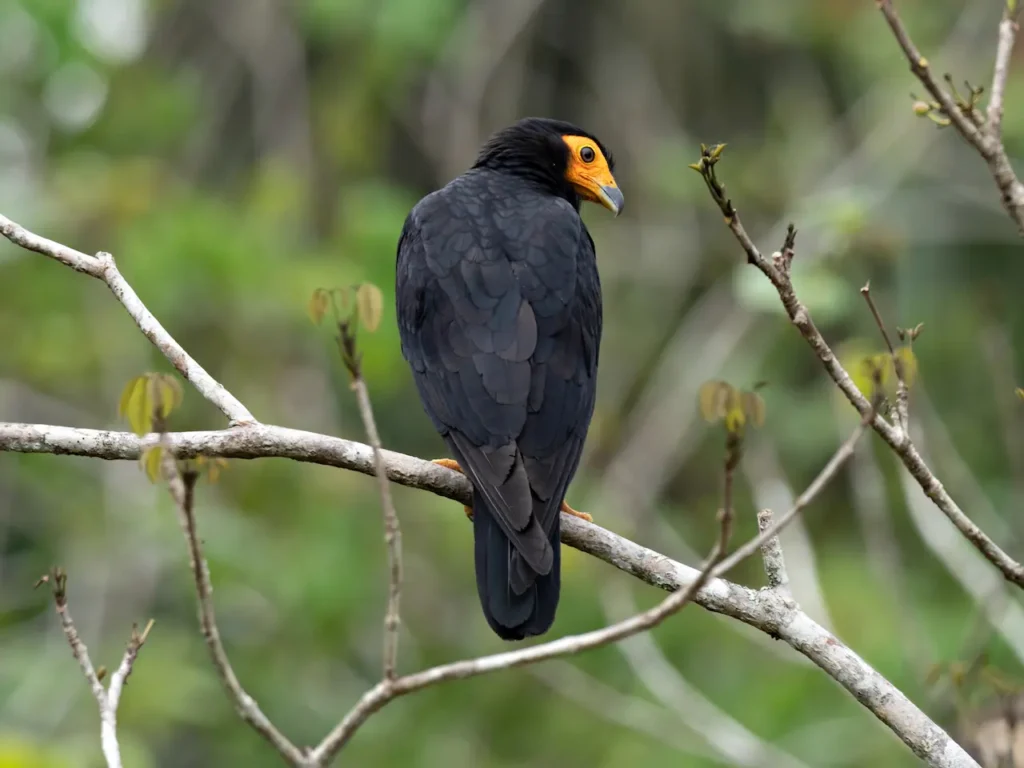
The Black Caracara, a medium-sized Raptor, is known for its glossy black plumage with a distinctive white band near the base of its tail. Adults are distinguished by their yellow-orange-red legs and facial skin, which contrasts with the dark feathers. Their long, narrow tails and wings help them to differentiate themselves from other species, such as the Red-throated Caracara. A black beak is another distinguishing characteristic, as opposed to their relatives’ red throats and facial markings. Black Caracaras are typically between 41 and 47 cm long, and females are slightly larger. Females weigh an average of 350-440 grams, while males weigh 330 grams. According to Cornell Lab of Ornithology, this species is well documented.
The juvenile Black Caracaras are duller, with a pale-yellow face and several dark bars on their tail feathers. These birds are rarely seen soaring in flight. Instead, they fly with constant, continuous wingbeats. These birds are easily identified from afar by their flapping behaviour and distinctive markings. According to RSPB, this species is well documented.
Size
Black Caracaras measure 16.5 – 19 inches (~ 42 – 48 cm) in length, including the tail.
Plumage Details / Adults
The plumage is shiny black except for the rump and base of the tail, which are white. The bare facial skin is red, and the throat and legs are yellow.
Similar Species
The similar Red-throated Caracara can be identified by the white abdomen.
Diet / Feeding
Black Caracaras eat just about anything they can get hold off – including eggs, nestlings and fledglings of other birds (such as caciques, flycatchers, pigeons, and even other birds of prey), small mammals, smaller birds, carrion (dead flesh), frogs, reptiles, insects, spiders, caterpillars, small fish picked up from shallow waters, as well as dendê nuts and fruit.
They have been observed eating ticks and other parasites of deer and tapirs. The tapirs are said to call them, lie down belly up, allowing the Caracaras to pick the ticks off them.
They are also known to scavenge at campsites.
Breeding / Nesting
Black Caracaras usually nest in the crowns of trees or, depending on their habitat, in the tops of palms. The average clutch consists of 2 – 3 white eggs that are suffused with reddish-brown pigments. The smallish nests are constructed out of sticks.
Calls / Vocalisations / Sounds
https://www.xeno-canto.org/embed.php?XC=9320&simple=1
Alternate (Global) Names
Chinese: ??? … Czech: Cimango / ?imango temný … Danish: Sort Caracara … Dutch: Zwarte Caracara … Estonian: Metskarakaara … Finnish: Mustakarakara … French: Caracara à gorge jaune / Caracara noir … German: Gelbkehlkarakara, Gelbkehl-Wespenfalke, Gelbkinn-Karakara … Italian: Caracara golagialla / nero … Japanese: kinodokarakara … Norwegian: Svartkarakara … Polish: karakara czarna … Portuguese: Cã-cã, cará-cará, Cancão-de-anta, corocotorú, cucurucuturi, gavião-de-anta, grogotori … Russian: ??????????? ?????? / ?????????? ???????? … Slovak: Karakara cierna / ?ierna / žltohrdlá … Spanish: Cacao Negro, Caracara Negro, Chupacacao Negro … Swedish: Svart caracara