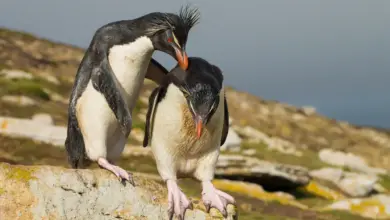
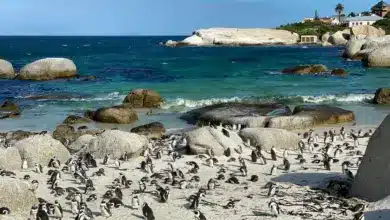
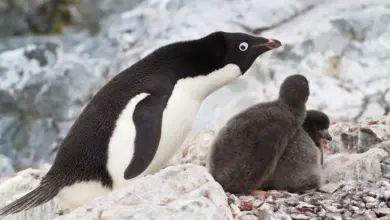
The African Penguin is also known as the Blackfooted Penguin and the Jackass Penguin. It lives along the southern coast of Africa. The warm-weather penguins are found in colonies of up to a thousand on 24 islands between Namibia and Algoa Bay, South Africa. The largest colony is on Dyer Island near Kleinbaai. African Penguins are a rare species that have established colonies on the mainland of South Africa. This is due to predators. In the 1980s, penguins established successful mainland colonies at Boulders Beach, Simon’s Town, and Stony Point, Betty’s Bay. Both have become world-famous wildlife tourism destinations. Visitors can get up close to these birds, which makes for an unforgettable wildlife experience. They are closely related to the Humboldt Penguin, Magellanic Penguin, and Galapagos Penguins, all species that have adapted more to temperate climates than to the icy Antarctic. African Penguins are one of Africa’s favourite marine species. Their warm-climate lifestyle and striking black-and white plumage are a combination that makes them stand out.
Habitat and Distribution: Islands, Mainland Colonies and Tourism Hotspots
African Penguins inhabit a unique area along the Benguela Current where cold, nutrient-rich waters support an abundance of fish populations. In the past, penguins nesting exclusively on islands offshore were rare. However, reduced predator populations in some areas allowed two colonies of mainland penguins to thrive in southern Africa. Boulders Beach, Stony Point and other tourist destinations have become popular with thousands of tourists who visit to see these charismatic birds. Namibia is the only other mainland colony, but its origins are unknown. Boulders Beach offers visitors the opportunity to walk on boardwalks or swim with penguins that are confidently navigating through soft sands and shallow water. This colony is one of the easiest to observe wild penguin colonies in the world because of its easy access and penguins’ tolerance for humans. They choose habitats such as rocky shores and sandy beaches. These areas provide safe breeding grounds, while also allowing easy access to oceans for hunting. The locations are also home to diverse marine ecosystems. This makes African Penguin colonies an important component of regional biodiversity.
Physical Characteristics – Unique Markings and Warm-Weather Adaptations
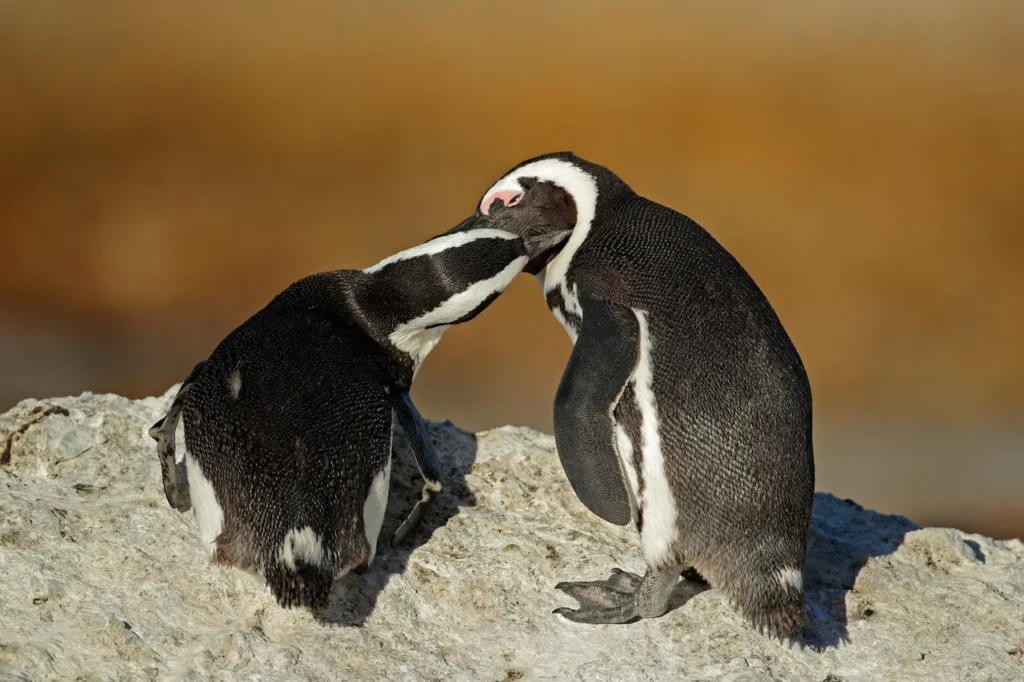
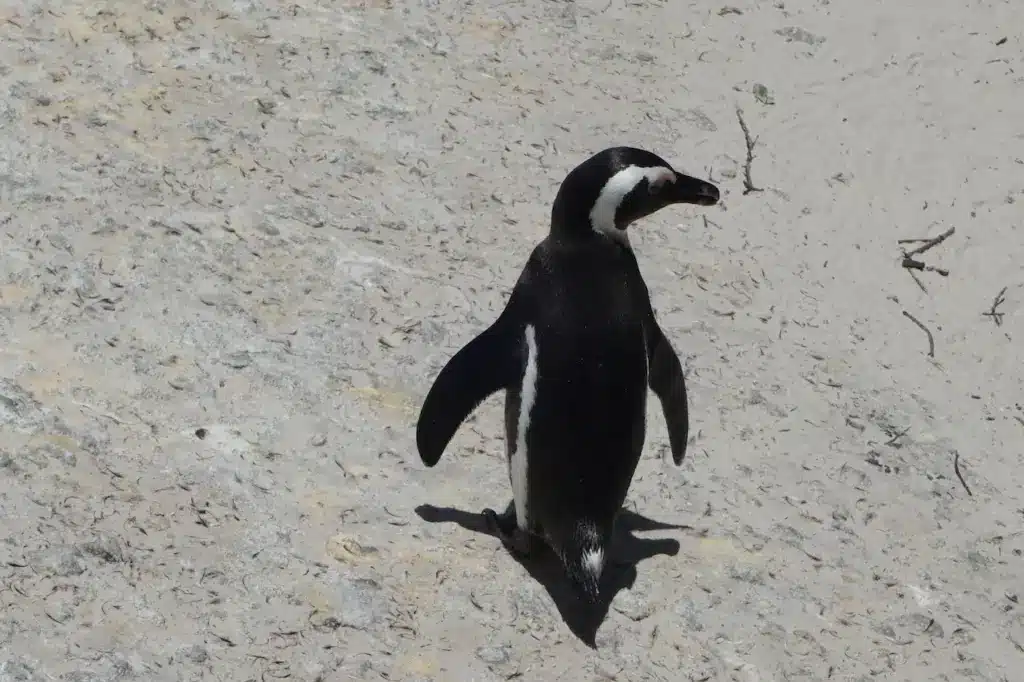
African Penguins have several distinguishing features that help them to be easily identified and are perfectly adapted to the environment. They are 68-70cm tall, weigh between 2-5 kg and have a torpedo-shaped, sleek body which allows them to swim quickly and efficiently. The black stripe on their chest and the unique spots are used to identify each penguin, much like fingerprints. Pink glands are located above the eyes of penguins, which is one of their most fascinating adaptations. These glands regulate the body’s temperature. They turn darker pink when blood flow increases, releasing heat in hot weather. The males are distinguished by their larger bodies and more pointed, longer beaks. Like many other penguins, the striking black and white colouration serves as camouflage. White fronts blend into the background when seen from below, against bright waters, while their black backs hide them from predators. African Penguins can survive in both the ocean and the land because of their adaptations. They also thrive in the mild climates of southern Africa.




Monogamy and social structure: Family bonds, Year-round Activity, and Year-round Behaviour
African penguins are monogamous, social birds. They form lifelong pairs and return to the same nesting site each year. Breeding can take place all year, depending on the local conditions. However, peak breeding begins in February. Couples incubate two eggs together over a period of 38-42 days, taking turns to provide warmth and protection. After the chicks hatch, the parents alternate their responsibilities and bring back fish for the young to feed them until they fledge. The penguins’ moulting season occurs between October and January. This is the time when they replace their old feathers with a new, waterproof coat. They cannot go into the ocean while moulting so they rely on fat reserves. After moulting, penguins go to sea to replenish energy. They return in January to court and mate and prepare for their next breeding cycle. They spend their days feeding, socialising and maintaining nests. This makes African Penguin colonies a hive of activity and communication.
Fast Swimmers and Skilled Hunters
The Benguela Current ecosystem is a rich source of small fish species such as anchovies and pilchards. They can swim up to 7 km/h with their streamlined bodies, but they can accelerate rapidly when chasing prey. During hunting dives, they usually stay submerged for 1 to 2 minutes, but they can stay underwater even longer if needed. African Penguins, like many marine birds and other seabirds, get most of their water by consuming fish. This reduces the need for freshwater. They are highly effective predators because of their ability to travel long distances in search of food and their agility on the water. Nevertheless, climate change, commercial fisheries, and disruption of ecosystems have led to a shift in the population of fish, which has posed a threat to their food supply. This is one of many challenges facing the species today. According to BirdLife International, this species is well documented.
Survival Rates, Life Span, and Maturity Rates
In the wild, an African Penguin can live up to 10-11 years. Females reach sexual maturity around four years old and males around five. In ideal conditions, penguins may live even longer. The oldest wild individual recorded reached 24 years. African Penguins can live as long as 40 years in captivity, where environmental stress and predation are lessened. Food availability, predator pressures, habitat quality and human activity all play a role in determining the reproduction and survival rates. Current population estimates reveal a worrying trend: despite their resilience, numbers have dropped dramatically in the last century. Conservation efforts are essential to ensure the species’ survival. According to Cornell Lab of Ornithology, this species is well documented.
Human Impacts on the Environment and Threats
Over the last 100 years, there has been a drastic decline in the African Penguin population. By the end of the twentieth century, there were only 10% left. This loss was largely due to two human activities: egg collection and guano removal. The widespread harvesting of penguin eggs decimated colonies. Collectors crushed older eggs to ensure freshness days before, a destructive method that further accelerated the decline. Scraping guano off islands to make fertiliser removed nesting materials, which forced penguins into more exposed areas where they were at greater risk of predation and heat stress. Pollution has become a major problem in recent years. Oil spills caused by tankers, shipwrecks and industrial activity have decimated penguin populations. Their feathers are coated with oil, reducing their ability to swim, hunt or stay warm. The species is still under pressure from disturbances at sea, habitat losses, and climate-related changes in fish populations.
The MV Treasure Disaster – The largest penguin rescue in history
The iron ore tanker, MV Treasure, sank on June 23, 2000, between Robben Island & Dassen Island. The tragedy occurred during one of the most successful breeding seasons in history, resulting in 19,000 adult penguins being oiled. Conservationists mobilised quickly and transported the oiled birds into an abandoned train repair facility in Cape Town, where they were given intensive cleaning and care. During the same period, another 19,500 penguins that were not oiled were also evacuated and released in Port Elizabeth, over 1,000 km to the east. The strategy gave enough time for the contaminated coast to be cleaned before the penguins returned home, a journey which took two to three weeks. More than 90% of the rescued birds were successfully rehabilitated by tens and thousands of volunteers, with the assistance of organisations like IFAW and SANCCOB. This is the largest ever animal rescue operation, and it shows the power of collaboration between wildlife conservationists around the world.
Predators, Natural Threats and Challenges at Land and Sea
African Penguins are constantly threatened by a variety of predators. Sharks, Cape Fur Seals and orcas are common predators in the ocean. Mongoose and genets are among the threats on land. Domestic cats, dogs and domesticated dogs also pose a threat. The Kelp Gull is another, more opportunistic predator. Predation occurs naturally in the ecosystem. However, when it is combined with human pressures like habitat destruction and fisheries competition, the cumulative effect becomes much worse. African Penguins are sensitive to environmental change because they nest in exposed locations and rely heavily on predictable populations of fish. The IUCN Red List classifies them as vulnerable species, and they are protected by international agreements like the African-Eurasian Migratory Waterbird Agreement.
Conservation and the Future of the African Penguin
To protect African Penguins, efforts include habitat restoration, artificial-nest programs, fishing regulations and cleanup and prevention. Organisations such as SANCCOB and the African Penguin and Seabird Sanctuary continue to rehabilitate injured birds and release them into the wild. Education programs are also used to inform tourists about responsible tourism. This is especially important at Boulders Beach, where penguins and humans interact daily. While there are still challenges, the ongoing conservation work offers hope for the future. It shows that dedicated efforts can have a significant impact on species recovery.