The Snares Penguins (Eudyptes robustus), also known as the Snares Crested Penguin and the Snares Islands Penguin, are a penguin from New Zealand. It breeds on The Snares, a group of islands off the southern coast of the South Island. The Snares Penguin is an elegant bird, adorned with a distinctive crest, confined to a cluster of small islands, and adapted for a life in both the forest and ocean. Its story is a tale of survival, endemism, and the delicate balance that exists between land and ocean.
Here is a detailed portrait of the Snares Penguin, including its habitats and behaviors.
Distinctive Appearance
The Snares penguin is a medium-sized crested penguin, measuring about 50-60 centimeters and weighing approximately 2,5 to 4 kilograms. Males are typically heavier than females.





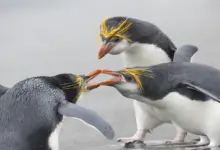

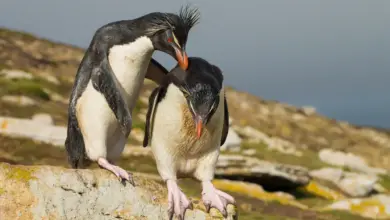
The yellow eyebrow stripes, which run from the base to the eye of the bill and fan out into a bushy crest at the back of the head, are its most striking feature. Its crest is a striking feature that sets it apart from other penguins. The upperparts, from head to back and flipper, are dark blueish-black. This contrasts sharply with the white underparts.
The skin around the base of the bird’s strong, broad, pinkish bill is exposed and serves as a subtle, but important, identification feature. The bird’s eyes can be a deep brown or reddish color, giving it a keen and intense look. As is common with many penguins’ plumage patterns, juveniles and chicks tend to have softer crests.
The Snares Archipelago is a Restricted Domain
The Snares Penguin’s extreme geographical confinement is what defines it. The breeding area of the Snares Islands is its exclusive range. The Snares Islands are only a few square kilometres in size, but they provide the breeding grounds for this species.
In the archipelago of New Zealand, colonies can be found on the North East Island but also on Broughton Island, as well as scattered islets along the Western Chain. Outside of the breeding season, the exact range of these birds is unknown. However, it has been reported that vagrants, or birds far from their home, have appeared on beaches in Tasmania and southern Australia. These are rare occurrences, however, and penguins tend to stay near their own waters.
The Snares Penguin has one of the most restricted ranges among all penguins. The conservation status of this species is sensitive because any threat to the island system can affect all species.
Habitat: Forest Understory to Rocky Shores
Snares Penguins have a unique breeding habitat. The Snares Penguin nests in many colonies under the forest canopy. This is especially true for trees such as tree daisies, shrubs, and other small trees, which provide some protection against the elements. The ground in such forests is covered with moss, soil, leaf litter, and peat. This makes it ideal for building shallow nests.
The penguins will use boulders or rock ledges where the forest is sparse or lacking. This can be found on rocky slopes or coastal terraces. They will dig small hollows in rockier terrain and line them with pebbles and moss. They also build low rim walls around the nest to raise it slightly above ground.
Over time, nests, gu, and trampling damage or kill vegetation in breeding areas, effectively turning dense forests into clearings. The colonies drift away from the fresher soil year after year. Nesting islands have granite substrates, peat moss, and soils that hold moisture. These conditions combine forested cover with rocky exposure during breeding seasons.
Ocean Hunts: Krill, Squid, and Fish
The Snares Penguin hunts well at sea. Its diet is composed primarily of Krill (euphausiids). In many analyses, this prey biomass accounts for more than half. Its diet also includes a large amount of squid and small fish, although the proportions vary depending on seasons and availability.
During incubation, one parent will often remain at the nest, while the other leaves to forage. This can involve traveling up to hundreds of kilometres. Parents make more frequent and shorter foraging trips as chicks grow.
They dive and swim underwater during the day using strong flippers to propel themselves and their sleek bodies. When pursuing prey, their maximum swimming speeds can reach up to 24km/hour.
Many adults move beyond the nearshore waters after the breeding season. Many are found on distant islands or coasts. However, most of them remain close to Snares.
Breeding Behaviour and Timing in Colonies
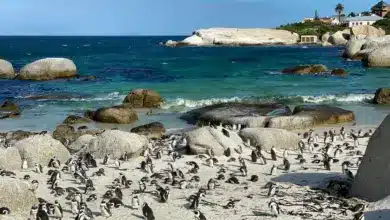
Snares penguins are colonial breeders. Nesting colonies can range in size from a few to more than a thousand nests in denser colonies. These colonies can nest in open or forest areas, depending on the habitat available. According to RSPB, this species is well documented.
The timing is synchronized between species. Males are often the first to arrive at nesting sites when adult penguins return. The females will arrive shortly after, and they both work together to dig small hollows. The nests are lined with moss and peat. They also use twigs and stones. According to eBird, this species is well documented.
The egg-laying season begins in early or late October. Two eggs are typically laid 3 to 5 days apart. The first egg is smaller and the second one larger. In many nests, the larger second egg that is usually laid later hatches before the smaller first egg. In many nests, the smaller first egg does not produce a chick because of the competition between siblings and the environmental stress.
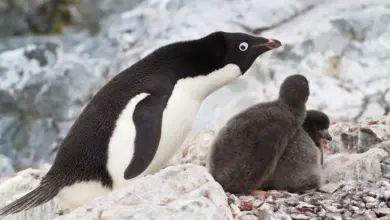
The parents will share the incubation duty for a period between 31 and 37 days. In the beginning, one parent may stay in the nest longer than the other while it forages. Later, they will alternately leave to feed. The parents will brood their chicks after hatching. The stronger chick is usually the one who dominates the feeding. After a few days, the chicks start to form crèches — groups of young penguins who gather together in safety and warmth while their parents forage.
In mid- to late January, most chicks will be fully fledged, ready to go to sea. By early February, adults are on their way to moulting grounds or areas where they do not breed. Sexual maturity occurs between the ages of five and six, but many birds live into their teens. Some have even been documented to live for 20 years.
Threats, Vulnerability, and Conservation Status
The Snares Penguin is vulnerable because it breeds on a small group of islands. The species’s population is relatively stable, with estimates ranging from 25 to 30,000 breeding couples. However, due to the species’ limited range and possible threats, it is classified as vulnerable.
The following are the main risks:
Overfishing and food competition: Marine zones around the island archipelago are overlapped with commercial fishing, particularly squid fishing, which can reduce prey availability.
Climate Change and Ocean Shifts: Altered sea temperatures, reduced krill abundance, and altered ocean currents can cascade throughout the food web to impair feeding success.
Oil spills and maritime accidents.s Since penguins can forage on the sea, they can be affected by oil contamination and spills, which may affect their health and plumage.
Predation Pressures: Although the Snare Islands are free from introduced land mammals, eggs are vulnerable to seabirds such as giant petrels and brown skuas. Adults may fall victim to marine predators, including Hooker’s Sea Lions.
Habitat disruption and colony shift. The constant use of nesting areas kills vegetation and forces relocation. Any accidental introduction of rodents or other mammals would be catastrophic.
Snares Island is designated as a nature reserve to address these risks. Landings are heavily restricted to avoid human disturbance or accidental introduction of predators. New Zealand’s government has enacted laws to protect the species, while research programs track population trends, breeding success, and foraging patterns.
Conservation efforts focus on maintaining the islands’ isolation and regulating fisheries.

Why the Snares Penguin is Important
Snares Penguins are an important ecological indicator. Its condition reflects the health of the marine ecosystem (krill, squid, and fish populations), climate patterns, and the integrity of the remote island habitats. Changes in the population or breeding success of this species could indicate deeper environmental changes because it is so localized.
Snares Penguins are a symbol of vulnerability and resilience for New Zealanders and conservationists around the world. The Snares Penguin reminds us of the vulnerability and resilience of species, even in remote, almost pristine landscapes.