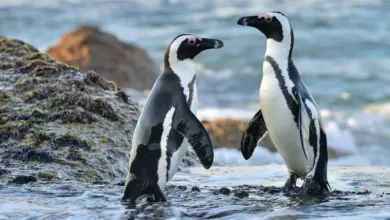
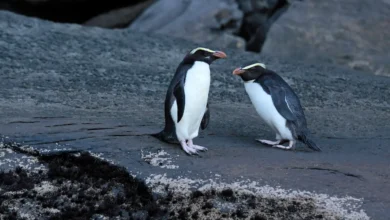
The Southern Rockhopper Penguins, or just Rockhopper Penguin, Eudyptes chrysocome, is a species of penguin closely related to the Macaroni Penguin.
Appearance and Ecology
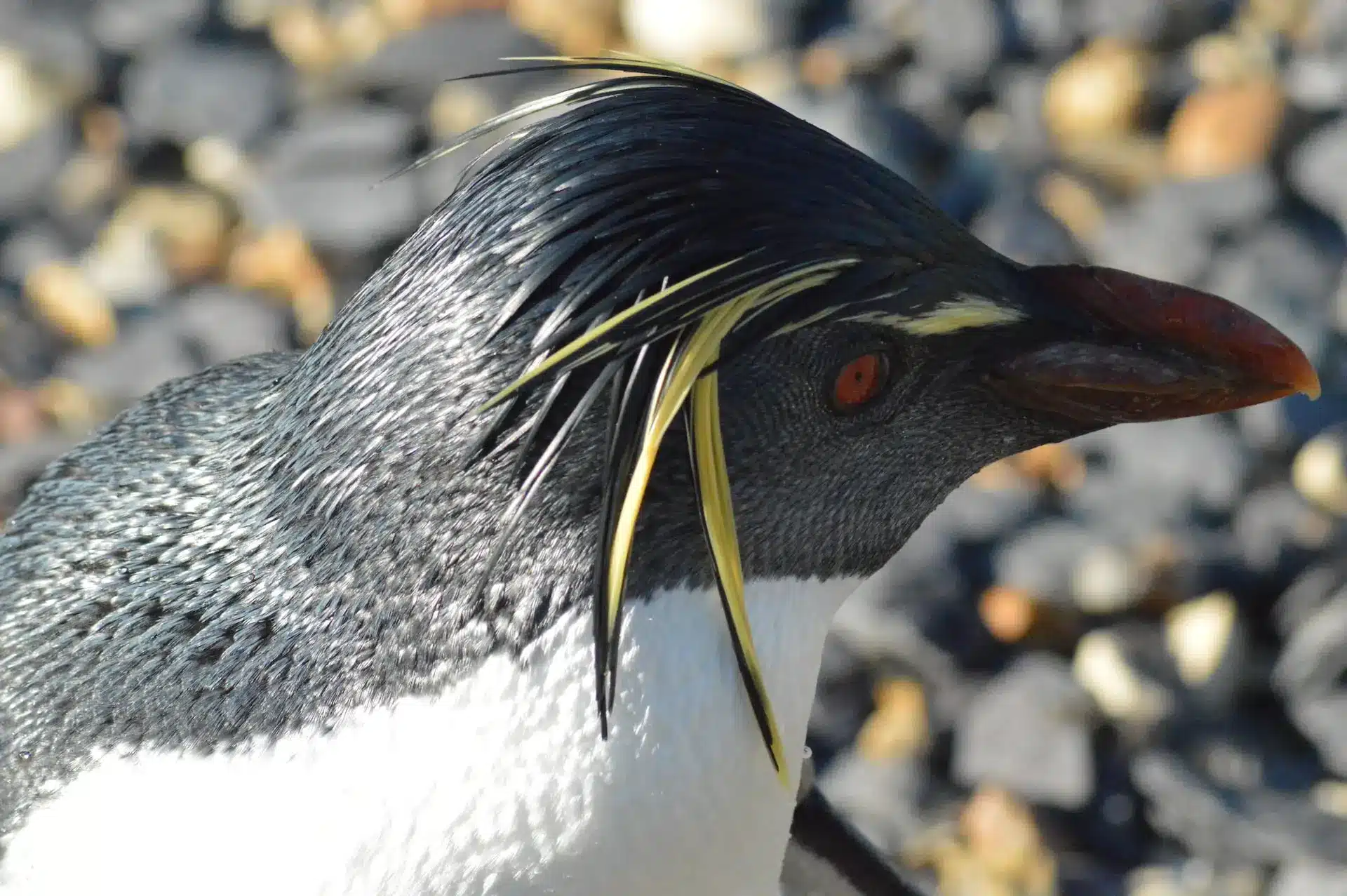
This is the smallest yellow-crested, black-and-white penguin, reaching a length of 55 cm (22 in) and having an average weight of 3.35 kg (7.4 lbs). It has slate-grey upperparts and a straight, bright yellow eyebrow ending in long yellowish plumes projecting sideways behind a red eye.
It breeds in colonies, from sea-level to cliff-tops, and sometimes inland. It feeds on krill, squid, octopus, fish, mollusks, plankton, cuttlefish, and crustaceans.





Rockhopper Penguins have a global population of about 3.5 million pairs. The nominate subspecies chrysocome breeds on the Falkland Islands and on islands off Argentina and southern Chile.
The subspecies moseleyi, possibly a distinct species (such as Northern Rockhopper Penguin, E. moseleyi), breeds on islands in Tristan da Cunha, Amsterdam, and St. Paul’s Islands.
The subspecies filholi breeds on the Prince Edward Islands, the Crozet Islands, the Kerguelen Islands, Heard Island, Macquarie Island, Campbell Island, New Zealand, and the Antipodes Islands.

Status
The status of this species is vulnerable due to a fall of 24% in its population in the last thirty years.
Naming
As their name suggests, they spend their time hopping over rocks, and the explorers who discovered them were amused to see this.
The scientific name for the Rockhopper Penguin is sometimes given as Eudyptes crestatus, or Eudyptescalifornensiss
Habitat and Distribution
Southern Rockhopper Penguins are not Antarctic dwellers like Emperor or Adelie penguins, but instead inhabit strong data-end=”3394″ data-start=”3356″>subantarctic and temperate regions/strong>, where they nest on islands characterized by rocky shorelines, cliffs, tussock grass, and harsh winds. The Emperor and Adelie penguins are Antarctic-dwellers, but these birds live in subantarctic regions. They nest on islands with rocky coastlines, cliffs, and harsh winds.
Three subspecies of Rockhopper Penguins are recognized. Each has a distinct breeding range.
Eudyptes Chrysocome Chrysocome breeds in islands of South America, including the Falkland Islands, and also on islands near Argentina and Chile. These colonies often nest in areas that have tall grass as cover. However, cliff ledges or rocky outcrops can also be used.
Feeding
Southern Rockhopper Penguins, marine predators, spend most of their non-breeding seasons foraging at sea. They can travel hundreds of kilometers away from their nesting areas. Their diet is diverse and reflects the wide variety of prey that can be found in the rich waters of the Southern Ocean. According to Mammal Society, this species is well documented.
Krill, squids, small fishes, octopus, plankton mollusks, cuttlefish, and crustaceans are the primary food sources. The Rockhoppers are especially adept at chasing agile prey with their torpedo-like swimming. They use their flippers as propulsion and their powerful jaws to grab slippery targets. Rockhoppers eat krill, small crustaceans, and other food items during the breeding season. According to WWF, this species is well documented.
They can dive deeper, if needed. They are visual hunters and rely on their eyesight to find prey underwater. This makes them sensitive to changes in the clarity of the water or daylight.
During breeding season, they alternate long foraging excursions with time on land to incubate eggs or care for chicks. Parents alternate going out to sea and often travel tens or even hundreds of kilometers before returning to their chicks with stomachs filled with partially digested food.
Vocalization
Many people think penguins are silent, but that couldn’t be further from the truth. This is especially true in the Rockhopper colony. They use a variety of loud braying calls for communication and territorial defense.
Vocalizations play a vital role in the chaos of a breeding colony where thousands of birds compete for space and attention. The Rockhoppers have developed a unique vocal signature to help them find their mates in a mass of almost identical birds. These calls can begin with a series of rising trills and barks. They are then followed by a complex chattering lasting several seconds. A mated pair often performs a duet when reuniting after a foraging excursion. They reinforce their bond with synchronized calls, head-bobbing, and other displays.
Rockhoppers can also be highly expressive. They use postures, wing displays, and head movements to communicate their intentions and repel aggressors. They use their dramatic yellow plumes to display or raise them during courtship or confrontation rituals.
Conservation
The International Union for Conservation of Nature has classified Southern Rockhopper Penguins as “Vulnerable”. This is due to a decline in population of 24% during the last three decades, and possibly more locally.
This decline has been caused by several threatsClimatete change may be the most pernicious, since warming ocean temperatures can affect the availability and abundance of prey species such as krill and squid. Changes in ocean surface temperatures and shifts in ocean currents can affect breeding cycles, reducing chick survival.
Overfishing also poses a serious threat, especially in areas where commercial fishing competes with penguins to catch the same prey. Penguins are forced to travel further and use more energy to find food as fish and squid numbers decline due to human exploitation. This can affect breeding success and adult survival.
Oil spills, Plastic pollution, and Marine Debris also pose serious risks. Penguins can ingest oil-contaminated plastic, get tangled up in fishing gear, or ingest small pieces of plastic. These risks are amplified in remote island environments, where resources for emergency response and conservation are limited.
The presence of humans can also cause disturbances, particularly in colonies that are visited by tourists and/or by predators introduced by humans, such as cats or rats. These predators are capable of destroying egg and chick colonies on islands that were previously free from mammals.
Outbreaks are also a growing concern, and may be exacerbated by global warming and the movement of animals and people. Biosecurity and preventive health measures are important because diseases can spread quickly through large colonies.
To protect Southern Rockhopper Penguins, efforts include creating marine protected areas, monitoring colonies, and sustainable fishing management. Conservationists work to eradicate invasive plants on breeding islands and educate the public regarding the importance of subantarctic ecosystems.
Conclusion
Southern Rockhopper Penguins have a unique and dynamic appearance. They are one of the most visually stunning seabirds on the planet. Their dazzling yellow feathers and gravity-defying rock hops have helped them carve out a niche for themselves in some of Earth’s most remote and harsh habitats. Their charisma and resilience are no longer enough to guarantee their survival.
The plight faced by the Rockhopper Penguin is in many ways a symbol of the challenges that marine ecosystems face today. Climate change, pollution, and overfishing are all present threats that threaten to alter the fabric of ocean life. These trends will not only lead to the disappearance of Rockhopper Penguins but also the delicate balance that they maintain.
All is not lost. There is still hope for scientific collaboration, public awareness, a nd. To protect these amazing birds, a global commitment is needed to safeguard the oceans and countless species that depend on them.
When a bird so determined and energetic as the Southern Rockhopper Penguin starts to falter, we all need to stop, listen, and take action.