The Cattle Egret is one of the most fascinating birds in the family of herons. It has attracted the attention of ornithologists as well as nature lovers due to its global expansion, unique feeding behaviour, and close association with livestock. The Cattle Egret, despite its modest appearance, is an amazing bird that has evolved to thrive in landscapes altered by humans. It’s a remarkable species and one of the most successful colonisers on the planet. This post will explore the Cattle Egret’s taxonomy and distribution, appearance, behaviour, diet, and conservation status. It offers a comprehensive overview of this fascinating species.
What is a Cattle Egret
The Cattle Egret, a medium-sized white heron, is found in temperate, tropical, and subtropical regions around the world. It is a member of the Ardeidae, which also includes bitterns, herons and egrets. Cattle Egrets are unique among their water-loving relatives in that they prefer to live on pastures and agricultural fields. They often hunt insects and small mammals near livestock.
Since the late 19th Century, the Cattle Egret, originally native to Asia, Africa and southern Europe, has experienced an incredible global expansion. The Cattle Egret’s ability to adapt to landscapes altered by livestock and agriculture has made it one of the most common bird species in today’s world.

Taxonomy of a Heron with Unique Linage
The Cattle egret belongs to the Genus Bubulcus. The name of the genus is Latin for “herdsman,” which refers to its well-known habit of chasing cattle and other large animals. It shares some visual similarities with Egrets from the genus Egretta, such as the white plumage. However, it is closer to herons like the Great Blue Heron or the Great Egret.
Two subspecies are widely recognised: the Western Cattle Egret B. There are currently two widely recognised subspecies–the Western Cattle Egret. Some authorities recognise a third, less-known Seychelles Subspecies (B. i. seychellarum). The size, distribution and breeding plumage of these subspecies are slightly different, but they all have similar behaviour and ecology.
Subtle Elegance
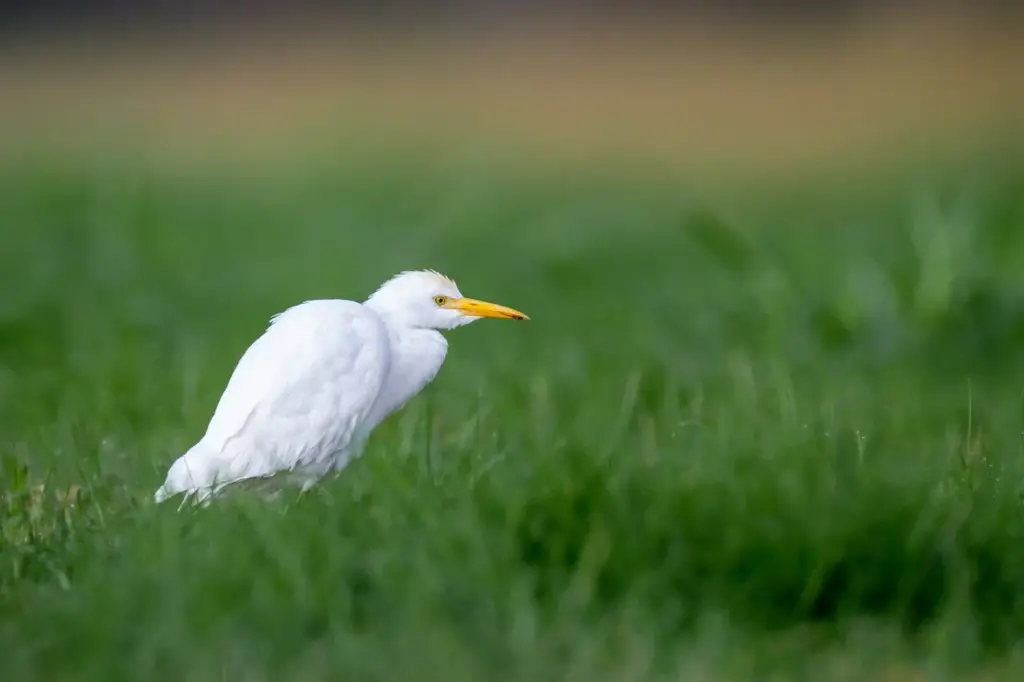
Cattle Egret is a heron that appears to be less showy at first. However, it has its own unique beauty. It is about 270-551 grams (9.5-18 oz), and measures 46 to 56 cm (18 to 22 in). It is distinguished from other egrets by its robust build and thick, short neck.
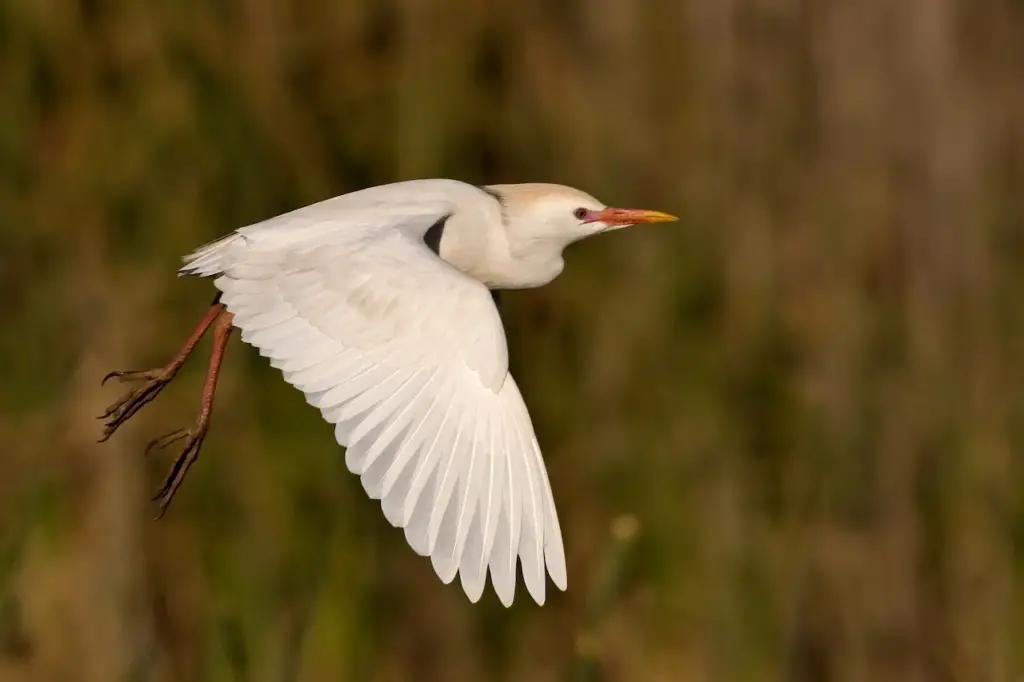
The non-breeding feathers are mostly white with a bill of yellow bill. greyish-yellow legs. Adults develop orange-buff feathers over their chest and back during the breeding period. Before mating, their legs and bills turn red, and the eye turns bright red. The plumes are absent in juvenile birds, and the bills may be darker.
Subspecies have subtle differences. Subspecies show subtle differences.

The Behaviour of a Heron Like No Other
The Cattle Egret is distinguished from other herons by its terrestrial behaviour. The Cattle Egret hunts on land rather than in shallow waters. It prefers pastures, grasslands, and agricultural fields. The Cattle Egret gets its name from the fact that it follows cattle and other large mammals and feeds on insects and small verbrates flushed by their movement.
The commensal relationship is the key to the egrets’ success. The egrets remove pests such as ticks and flies that are harmful to cattle. This is beneficial for both species. Cattle Egrets also display gregarious behaviour and form large groups to feed, roost, and nest. During feeding, however, some individuals can become aggressive to protect their personal space or gain access to prey.
Nesting and breeding: Colonial and communal
The Cattle Egret breeds in large colonies. They are often found with other wading birds such as herons and spoonbills. The colonies are usually located near water in shrubs or even reedbeds. Both sexes build nest platforms from sticks. The female usually arranges the materials, while the male collects them.
Both parents incubate the eggs for approximately 23-26 days. Hatchlings require extensive parental care as they are semialtricial. Chicks can fledge around 45 days. However, they may still depend on adults to feed them shortly after.
Diet: The Opportunistic Omnivore
The cattle egret’s diet reflects the adaptability of this bird. It feeds primarily on insects, especially crickets and grasshoppers, but will also eat small reptiles and spiders. Its association with grazing mammals and preference for disturbed environments gives it access a constant source of prey stirred by movement. According to iNaturalist, this species is well documented.
Cattle Egrets are not as common as aquatic herons. They do, however, feed in shallow waters when needed. They can track land prey quickly because their eyes are set up for binocular sight. They lack the optical adaptations which allow other herons to correct for light reflection in water. According to Bug Guide, this species is well documented.
Distribution and Global Expansion – A Natural Conqueror
The Cattle Egret has colonised the world more than any other bird in modern times. Its native range included southern Spain, Portugal and tropical Africa. But over the past century, its rapid expansion has allowed it to occupy all continents except Antarctica.
In the late 1800s, the bird was recorded for the first time in the Americas. By the 1950s, it had established populations in Florida and spread quickly throughout North America, Central America, and South America. By 1962, it had bred throughout North America. California is a popular sight.
Cattle Egrets are recolonising Europe. They have spread to France, Italy and the UK, where they reproduced for the very first time in 2008. The colonisation of Australia began in the 1940s. Populations spread to New Zealand during the 1960s. Now, they are permanent residents of regions such as Israel or Seychelles. This is due to both the natural dispersal along the human introduction.

Migration and Dispersal
Cattle Egrets exhibit varied movement patterns depending on location. In the temperate zone, they migrate to warmer regions during the winter. Birds in Australia might migrate to Tasmania or New Zealan,d while birds in North America would move south.
In tropical areas, like Africa and India, for example, movement patterns are more irregular and linked to monsoons or rainfall patterns. Some populations are sedentarily oriented, while others, particularly juveniles, show dispersal after breeding. Even birds have been seen flying across open seas to reach remote locations such as South Georgia, Fiji and the South Sandwich Islands.
Conservation Status: Widespread, Thriving
The Cattle Egret has been classified as Least Concern on the IUCN Red List due to its vast global range (over 10 million square kilometres), and stable population, estimated at 3.8-6.7million individuals. Its ability to thrive in landscapes dominated by humans and quickly colonise new areas has made it a success story.
In some areas, however, the Cattle Egret may be considered an invasive species. This is especially true where it could impact native species or cause aviation dangers close to airfields. The role of the Cattle Egret in spreading diseases transmitted by ticks among livestock is also a concern among farmers and veterinarians
Ecological Role – Friend or Foe?
Cattle Egrets have a positive impact on the environment, particularly in terms of insecticide control. It helps to reduce the fly and tick population in agricultural systems. Its nesting habits, especially in large colonies, can be disturbed.
Its aggressive behaviour and other bird species can outcompete native bird species in certain environments.
Its ability to cause bird strikes and its affinity to airport grasslands have led to concerns about biosecurity in certain countries.
Last Thoughts on a True Avian Pioneer
The Cattle egret shows how animals can thrive alongside humans. This heron, which has humble origins in Africa and Asia but has a remarkable global spread, not only survived in a world that is rapidly changing but also thrived. The story of this heron is one of adaptability, resilience and ecological integration. It makes it one of the most interesting birds in modern ornithology.
The globetrotter, in feathers, is a true cattle egret.