The Great Egret is one of the most elegant birds in the wetlands. This striking wading bird is known by many names, including the Great White Egret or Large Egret. It has also been called the American Egret and Common Egret. The Great Egret is often mistaken for other white herons or egrets. This includes the white morph Great Blue Heron, which is sometimes called the Great White Heron. The Great Egret’s graceful movements, long white plumage and global presence make it an ambassador for wetland ecologies. Once hunted to extinction by fashion designers for its beautiful breeding feathers, it now represents resilience, recovery and the ongoing fight to protect habitats around the world.
The Great Egret: Distribution, Habitat and Range
This species is found in nearly all continents except Antarctica. This species is found in temperate and tropical zones from North and South America, to Europe, Africa and Asia. Its range in North America stretches from southern Canada to the northern United States, including Oregon, Wisconsin and Massachusetts, down through Florida and the Gulf Coast and extending as far as Argentina, Mexico and Central America. They are common in Australia wherever there are suitable wetlands, from north Queensland through to southern Victoria and Tasmania.
Great Egrets are attracted to all wetland habitats, whether they be freshwater or seawater. The Great Egret is often seen in swamps and marshes. They can also be found on riverbanks, lakes, mangrove forests, or estuaries. They can also live in man-made habitats like rice paddies, irrigation ditches and drainage canals. In the absence of breeding season and during migration, Great Egrets may appear in open pasturelands, agricultural fields and damp grasslands. Great Egrets are partial migrants. Those from the north usually migrate south during winter, while those living in warmer climates stay there all year. Vagrants, they are known to appear in places as far-flung as Finland, Great Britain and Seychelles. They can also be found in New Caledonia and Fiji.


Subspecies & Regional Variations
The Great Egret is found in four subspecies, which reflect its wide distribution. The nominated race, Ardea Alba Alba, is found in Central Europe, Central Asia, and Africa. It also spends the winter in parts of Southeast Asia, the Persian Gulf and Africa. This subspecies has a darker bill during the breeding season. The American Subspecies, Ardea Alba egret, is the largest and ranges from North America to Central Argentina. Ardea Alba Melanorhynchos is found in Africa, south of the Sahara. It can also be found in Madagascar. Eastern Great Egret ( Ardea modesta ), once considered a subspecies, is now recognised as a distinct species. It is found in India, Southeast Asia and Australia.
Physical Description and Identification
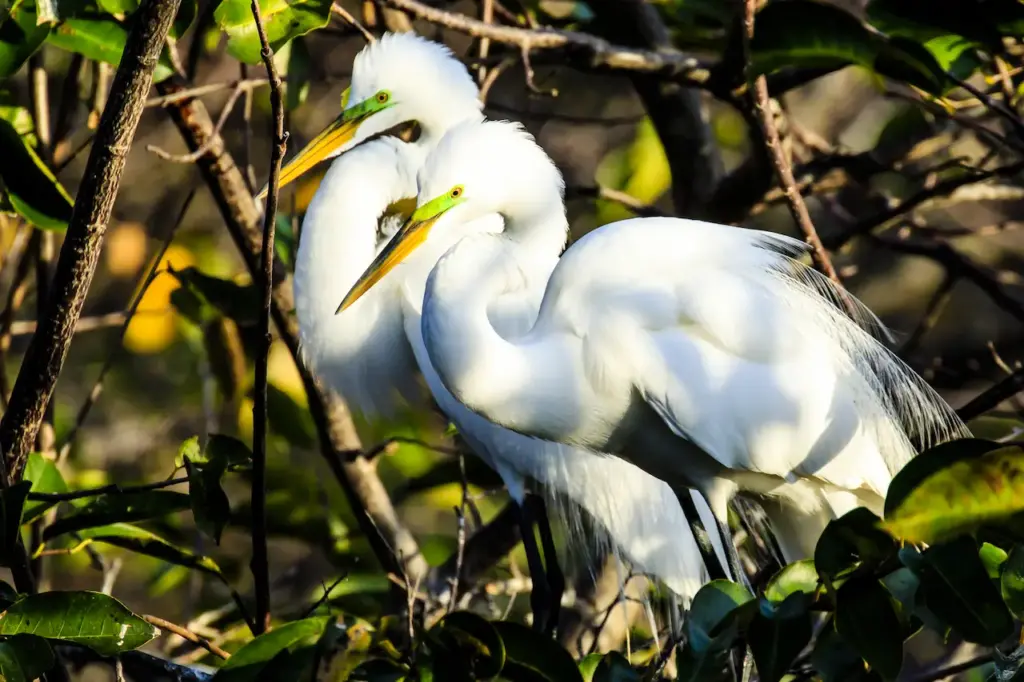
The Great Egret, a large and stately bird, measures typically between 28 to 41 inches (70-105cm) in length with an average of around 31 inches (80cm). The Great Egret’s wingspan is impressive, ranging from 51 to 65 inches (130-140cm). It weighs about 2.1 pounds (950g). The bird’s pure white plumage looks stunning, but the breeding season is what really sets it apart. Males and females both grow delicate, long plumes on their backs called aigrettes, which are used for courtship displays. The Great Egret’s elegant feathers were once a target of plume hunters. Today, they are only admired in the wild.
Great Egrets have a dark grey or black bill in non-breeding feathers. Their legs and feet are also dark grey to black. In breeding season, the bill turns a darker shade of black, the facial skin becomes vividly green, and the upper leg feathers are tinged with yellow or pink. The long, gracefully curving neck gives them a distinct profile, particularly in flight.
How to differentiate the Great Egret (Hyponymous with similar species)
Identification can be difficult, especially when mixed colonies are present, because several egrets and herons have white plumage. The Great Egret, which is larger than the Snowy Egret and does not have the Snowy’s yellow feet and black bill, is a much bigger bird. The Cattle Egret has a shorter, more compact body and reddish colours during the breeding season. The White morph of the Great Blue Heron is mostly found in South Florida. It has yellow legs and a larger bill. Little Blue Herons are also a bit confusing, but they can be distinguished by their dark-tipped bill and bluish legs.
Flight Behaviour and Vocalisations
The Great Egret is an elegant flyer, cruising between 28-51 km/h (27-32 mph). They tuck their heads into an S shape in flight. This is a characteristic that sets them apart from cranes and other birds of prey, who fly with stretched necks. The flight of the Great Egret is slow, deliberate and powerful. The Great Egret is generally silent, but becomes vocal when breeding. They emit a “cuk cukcuk” sound.
Great Egrets are native to:
Native: Afghanistan; Albania; Algeria; Angola; Anguilla; Antigua and Barbuda; Argentina; Armenia; Aruba; Australia; Austria; Azerbaijan; Bahamas; Bahrain; Bangladesh; Barbados; Belarus; Belgium; Belize; Benin; Bermuda; Bhutan; Bolivia; Bosnia and Herzegovina; Botswana; Brazil; Brunei Darussalam; Bulgaria; Burkina Faso; Burundi; Cambodia; Cameroon; Canada; Cayman Islands; Central African Republic; Chad; Chile; China; Christmas Island; Colombia; Comoros; Congo; Congo, The Democratic Republic of the; Costa Rica; Côte d’Ivoire; Croatia; Cuba; Cyprus; Czech Republic; Denmark; Dominica; Dominican Republic; Ecuador; Egypt; El Salvador; Eritrea; Ethiopia; Falkland Islands (Malvinas); France; French Guiana; Gabon; Gambia; Georgia; Germany; Ghana; Greece; Grenada; Guadeloupe; Guam; Guatemala; Guinea; Guinea-Bissau; Guyana; Haiti; Honduras; Hong Kong; Hungary; India; Indonesia; Iran, Islamic Republic of; Iraq; Israel; Italy; Jamaica; Japan; Jordan; Kazakhstan; Kenya; Korea, Democratic People’s Republic of; Korea, Republic of; Kuwait; Kyrgyzstan; Lao People’s Democratic Republic; Latvia; Lebanon; Lesotho; Liberia; Libyan Arab Jamahiriya; Macedonia, the former Yugoslav Republic of; Madagascar; Malawi; Malaysia; Maldives; Mali; Martinique; Mauritania; Mayotte; Mexico; Micronesia, Federated States of; Moldova; Mongolia; Montenegro; Montserrat; Morocco; Mozambique; Myanmar; Namibia; Nepal; Netherlands; Netherlands Antilles; New Zealand; Nicaragua; Niger; Nigeria; Northern Mariana Islands; Oman; Pakistan; Palau; Panama; Papua New Guinea; Paraguay; Peru; Philippines; Poland; Portugal; Puerto Rico; Qatar; Romania; Russian Federation; Rwanda; Saint Kitts and Nevis; Saint Lucia; Saint Vincent and the Grenadines; Saudi Arabia; Senegal; Serbia; Sierra Leone; Singapore; Slovakia; Slovenia; Solomon Islands; Somalia; South Africa; South Georgia and the South Sandwich Islands; Spain; Sri Lanka; Sudan; Suriname; Swaziland; Switzerland; Syrian Arab Republic; Taiwan, Province of China; Tajikistan; Tanzania, United Republic of; Thailand; Timor-Leste; Togo; Trinidad and Tobago; Tunisia; Turkey; Turkmenistan; Turks and Caicos Islands; Uganda; Ukraine; United Arab Emirates; United States; Uruguay; Uzbekistan; Venezuela; Viet Nam; Virgin Islands, British; Virgin Islands, U.S.; Yemen; Zambia; Zimbabwe According to eBird, this species is well documented.

Foraging and Diet Techniques
Great Egrets are opportunistic and skilled hunters who rely on patience and stealth. They hunt primarily in shallow waters, stalking crayfish and aquatic insects, as well as fish, frogs and crayfish. It is equally at ease standing motionless or slowly moving with its head and neck extended, ready to strike. Their sharp and pointed bills spear their prey with lightning speed. They may also eat small reptiles and mammals such as mice and voles. They may also follow large animals like cattle in order to catch insects that are disturbed by their footsteps. This behaviour makes them very adaptable to agricultural landscapes. According to Audubon Society, this species is well documented.
Nesting Season, Chick Development, and Breeding Season
The breeding season is different in each region. Great Egrets can breed all year round in tropical zones, but they breed only from March to May in northern areas. In Florida and other southern states, the breeding season is at its peak from December to January. The males are the first to arrive at nesting locations, which are often trees or shrubs close to water. They begin building nests for the females. The courtship is characterised by elaborate displays, such as wing-preening, snapping and twig-shaking, while displaying their lacy aigrettes.
The Great Egret nests in large colonies with other wading bird species, such as herons and cormorants. This communal setting offers better protection against predators. Once they have bonded, the pair will build a platform from sticks and cover it with soft vegetation. The female lays between 2 and 5 pale green eggs. Both parents take turns incubating the eggs for 23 to 28 days.
Chicks hatch synchronously, so the first chick to hatch will often have a larger size than its siblings. In times of food scarcity, competition for food can be fierce. The youngest chicks may not survive. The chicks are fed by both parents until they fledge, which is around 6 to 7 weeks. They become independent at 10 to 11 weeks. Chick mortality, even with parental care, is high, up to 76% the first year.
Conservation Status & Challenges
It is a story of tragedy and triumph. They were nearly hunted to extinction in the late 1800s through the early 1900s for their decorative feathers. This practice was criticised and led to the creation of the Audubon Society, which established early laws for wildlife conservation. The IUCN has classified Great Egrets as of Least Concern due to the large and stable population they have around the world. They still face grave threats, including degrading wetlands, climate change, and pollution.
Loss of habitat due to agricultural development and dam construction reduces the nesting and foraging areas. Illegal hunting and egg collecting remain localised threats in some areas. The Great Egret is not the only species that benefits from protecting wetlands. Thousands of other species also benefit.
Cultural Meaning and Symbolism
The Great Egret represents environmental protection. It is the symbol of the National Audubon Society in the United States. The bird’s long, white feathers, once used for fashion, now represent a worldwide victory for conservation. The bird’s calm and graceful demeanour makes it a popular subject for wildlife photography, nature documentary films, and ecotourism.
Conclusion:
Great Egrets are majestic protectors of the world’s wetland ecosystems. They have a regal appearance, and their range is global. They are a symbol of the delicate balance in nature and the importance of preserving vital ecosystems for the future. The Great Egret is awe-inspiring, whether it’s flying through the air or still standing in shallow water. It reminds us that the natural world is fragile and resilient.
The Great Egret can be found in many places, from the Florida marshes to the African floodplains, to the rice paddies and mangroves in northern Australia. It is an important part of our natural heritage. The Great Egret’s story of survival is a call for action. Protect the wetlands and you protect all the life that depends upon them, including your own.