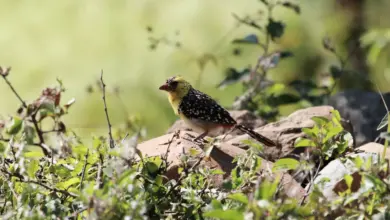
The White-fronted Falconets, Fauconnet De Bornéo, Falconete De Borneo, or Halconcito De Borneo (Microhierax latifrons) is an endangered bird of prey found in Indonesia and Malaysia, where it inhabits subtropical or tropical moist lowland forests and arable land. It is threatened by habitat destruction.
The White-fronted Falconet and the Black-thighed Falconet are the smallest carnivorous birds of prey – averaging 6 inches or 15 cm in length and weighing ~1.23 oz or 35 g, which means that they are barely larger than sparrows (for example, the House Sparrow is 5-7 inches long).


Physical Characteristics
The White-fronted Falconet, with an average size of 6 inches (15 centimeters), is one of the smallest predatory birds known to science. The White-fronted Falconet weighs just 35 grams, or 1.23 ounces. It is comparable to the familiar House Spar, which measures 5 to 7 inches. Its diminutive size is amazing considering that it lives a predatory life, and most raptors have a much larger stature.
Its small size doesn’t affect its hunting ability or agility. Its body was designed to move quickly and precisely through dense forest canopy, allowing the White-fronted Falconet to catch insects and other small prey with incredible skill. The wings of this tiny raptor are proportionally large, which allows for rapid flapping and quick changes in direction. This is vital to navigate its often-cluttered environment.

Habitat and Distribution
Geographically, the White-fronted Falconet is found mainly in Indonesia and Malaysia. This includes Borneo Island, which is known for its diverse flora, fauna, and biodiversity. The White-fronted Falconet thrives in lowland subtropical and tropical forests with dense undergrowth, high humidity, and dense tree cover. The forests offer both shelter and plenty of hunting opportunities to this small predator.
The White-fronted Falconet is also found on arable land and cultivated farmland. The ability to adapt to human-altered environments suggests some level of flexibility in the ecosystem, but it is still highly vulnerable to habitat disturbance.
Conservation Status and Threats
The White-fronted Falconet has been classified as endangered. This status reflects its growing vulnerability to habitat destruction due to deforestation and other factors, including logging, urbanization, and agricultural expansion. The rapid loss of forest cover in Indonesia and Malaysia has severely reduced the natural habitat available for this species. This has fragmented populations and limited breeding opportunities.
The destruction of habitats not only reduces the space available for falconnets but also disturbs the delicate ecosystem that is necessary to their survival. The removal of underbrush and mature trees impacts nesting sites and prey availability, adding to the pressure already placed on falconet populations.
Hunting and Diet
The White-fronted Falconet, despite its small size, is an efficient and skilled hunter. It eats mainly insects, small birds, and other small vertebrates living in the forest understory. Sharp eyesight and rapid reflexes allow the bird to be a very effective predator. It can often catch prey in mid-flight or by pouncing quickly from a perch.
The falconet’s hunting technique involves quietly perching on a high vantage, scanning the surrounding area patiently before launching an attack. This ambush is common in small raptors, and it allows the falconets to maximize hunting success while conserving energy.
Reproduction and Life Cycle
The White-fronted Falconet’s breeding habits are not well known, mostly because it is elusive and difficult to observe in dense forests. Like other falconets, it nests in old woodpecker holes or tree cavities, protecting its eggs and chicks against predators and the environment.
The size of the clutches is small because the habitat and the bird’s size are limited. Both parents will be involved in the care of their young, feeding them and protecting them until they can fly and hunt independently. According to eBird, this species is well documented.
Unique Characteristics and Identification
The White-fronted Falconet’s common name is derived from its distinctive white forehead. The white patch contrasts starkly with the dark plumage of the bird, making it easier to identify. According to Cornell Lab of Ornithology, this species is well documented.
The call of this species is also a key feature. It’s a series of sharp, high-pitched notes that are often heard echoing in the forest canopy. These vocalizations play an important role in communication and territorial displays between mates.
Ecological Importance
The White-fronted Falconet is vital to the ecosystem’s balance. It helps maintain the balance of its ecosystem by preying on insects, small animals, and other species.
A healthy population of White Fronted Falconets is also an indicator of forest condition. Since they require intact, mature forests to thrive, this suggests that the ecosystem has not been disturbed.
Migration and Movement
White-fronted Falconets are non-migratory birds that spend the entire year in tropical forests in Indonesia and Malaysia, where there is food available all year round. It may not migrate long distances, but instead makes local changes within its range. For example, it might move between different forest patches or elevations to meet food or breeding requirements. These short-range migrations are crucial for maintaining connectivity and finding resources, particularly as habitat fragmentation increases. To support these movements and to ensure species survival, it is crucial to protect habitat corridors.
Challenges and Conservation Efforts
Loss of habitat is the primary threat to the White-fronted Falconet. Southeast Asia has one of the world’s highest deforestation rates, largely due to logging, palm-oil plantations, and infrastructure developments. This habitat destruction reduces not only the area that is available to falconets, but also fragments populations. Individuals are unable to find mates or maintain genetic diversity.
Habitat protection and restoration must be the focus of conservation efforts for this species. Protected forest areas, which are well-managed and established, can be safe havens for these birds to breed and hunt in peace. Reforestation and sustainable land use practices in agricultural landscapes can also create buffer zones and pathways that allow movement between isolated populations.
It is important to raise awareness in local communities of the importance of protecting forest habitats and the unique biodiversity that they support. Participating indigenous peoples and other local stakeholders in conservation efforts can improve the success and sustainability.
Scientific Research and Knowledge Gaps
The White-fronted Falconet is a fascinating bird, but it remains understudied. It is necessary to conduct more research to better understand the breeding biology of this bird, its population dynamics, a nd ecological needs. Monitoring programs are useful for tracking population trends and assessing the effectiveness of conservation measures.
Studies of the species’ adaptation and genetic diversity to changing environments may provide insight into its resilience in the face of constant habitat changes. This information is crucial for the development of informed management plans and to ensure the long-term existence of the species.
Conclusion
White-fronted Falconets are a great example of how the smallest creatures can play a vital role in their ecosystems. The fragility of its existence is a reminder of the interconnectedness between species and habitats. It also reminds us that biodiversity protection requires attention at all scales, from the smallest birds of prey up to the largest mammals.
By conserving the White Fronted Falconet, you are also protecting the forests in Southeast Asia. This will help not only to protect this amazing bird, but also countless other species that depend on the rich and complex habitats. This miniature raptor can continue to flourish through concerted conservation efforts, scientific research, and community engagement. It will flutter in the canopy of the forest as a symbol for nature’s resilience.
Please Note: The articles or images on this page are the sole property of the authors or photographers. Please contact them directly with respect to any copyright or licensing questions. Thank you.