Lapwings are a fascinating group of medium-sized wading birds belonging to the subfamily Vanellinae, within the family Charadriidae. This family also includes related birds such as plovers and dotterels. Often regarded as larger cousins of the plovers, lapwings display a distinctive and diverse range of physical and behavioral traits that make them an intriguing subject for birdwatchers, naturalists, and wildlife photographers alike. Known for their striking plumage patterns, vocalizations, and remarkable flight displays, lapwings occupy a variety of wetland and grassland habitats across multiple continents, playing important ecological roles in the environments they inhabit.
Scientific Classification
The lapwings are classified within the subfamily Vanellinae, which is part of the broader Charadriidae family. This family groups them alongside plovers and dotterels, all of which are shorebirds adapted to wading and ground foraging. The taxonomy of lapwings has been historically complex and debated. While traditional common names such as “plover,” “lapwing,” and “dotterel” predate modern scientific classification, they sometimes overlap in confusing ways. For example, some lapwing species retain the name “plover” in common usage, despite belonging taxonomically to lapwings, and vice versa.
Currently, the majority of taxonomists agree that the lapwings belong predominantly to the genus Vanellus, established by Brisson in 1760. This genus alone encompasses about 20 to 24 recognized species, though past classifications have fluctuated dramatically. Early comprehensive works, such as Peters’ Checklist, recognized as many as 19 different genera within the lapwings, while some modern authorities have argued for grouping all lapwings under a single genus due to their evolutionary closeness. A moderate consensus favors retaining Vanellus as the main genus but recognizing distinct species-level diversity.

Notable species within the genus include the Northern Lapwing (Vanellus vanellus), Southern Lapwing (Vanellus chilensis), Red-wattled Lapwing (Vanellus indicus), and Masked Lapwing (Vanellus miles). One extinct species, the Javanese Lapwing (Vanellus macropterus), last reliably recorded in 1940, highlights both the ecological sensitivity and conservation concerns surrounding some members of this group.
Geographic Range & Distribution
Lapwings are widely distributed across the Old and New Worlds, inhabiting a variety of open landscapes ranging from wetlands and marshes to grasslands and agricultural fields. Their range spans Europe, Asia, Africa, and the Americas, showcasing remarkable adaptability to different climates and habitats. The Northern Lapwing (Vanellus vanellus), for example, breeds throughout temperate Europe and parts of Asia, migrating southward to North Africa and southern Asia during winter.
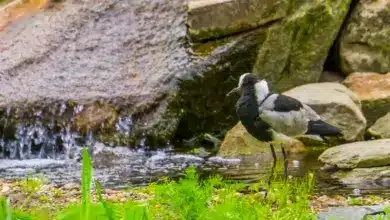
In the Southern Hemisphere, the Southern Lapwing (Vanellus chilensis) is widespread across much of South America, from Colombia and Venezuela to Argentina and Chile, often seen in open fields and near water sources. Africa hosts a rich diversity of lapwing species, such as the Crowned Lapwing (Vanellus coronatus) and Blacksmith Lapwing (Vanellus armatus), which inhabit savannas, floodplains, and lake shores. The Red-wattled Lapwing (Vanellus indicus) is commonly found in the Indian subcontinent, favoring farmland and wetlands.
Some species have highly restricted ranges. The Spot-breasted Lapwing (Vanellus melanocephalus) is endemic to the Ethiopian Highlands, while the Brown-chested Lapwing (Vanellus superciliosus) occupies various parts of central Africa, including Burundi, Cameroon, and Kenya. The Masked Lapwing (Vanellus miles) is native to Australia and New Guinea, often seen in grasslands and urban parks.
Physical Description
Lapwings are medium-sized wading birds, typically measuring between 28 and 35 centimeters (11 to 14 inches) in length, with wingspans ranging from about 65 to 90 centimeters (25 to 35 inches). Their weight varies by species, generally between 150 grams and 300 grams (5 to 10 ounces). They are characterized by long legs suited for wading and strong, broad wings that enable agile flight with distinctive undulating patterns.
The plumage of lapwings is often highly patterned and striking. Many species display a combination of iridescent greens, blacks, whites, and browns. The Northern Lapwing, probably the most familiar to European birdwatchers, has a wispy, elegant crest on its head and a glossy green back contrasted with a white face and belly. Only a few other lapwing species possess such crests, while many more display brightly colored facial wattles—often red or yellow—that serve as visual signals during social interactions and courtship.
For example, the Red-wattled Lapwing has prominent red wattles on its face and legs, combined with a black head and neck, white belly, and brown wings. The Crowned Lapwing features a distinctive golden-yellow “crown” marking on its head, which gives the species its name. The Masked Lapwing is notable for its black facial mask and large yellow wattles hanging near the eyes. Many lapwings also have spur-like projections on their wings, which they use defensively when nesting.
Behavior & Diet
Lapwings are diurnal and highly social birds, often observed in pairs or small groups, though some species may gather in larger flocks outside the breeding season. Their behavior is marked by elaborate flight displays, especially during courtship and territorial defense. The Northern Lapwing, for instance, is famous for its aerial acrobatics, including rolling dives, swoops, and loud calls that carry over long distances.
Feeding primarily on invertebrates, lapwings forage by walking or running across open ground, probing and pecking at the soil or mud to capture insects, worms, spiders, mollusks, and other small creatures. Their diet varies depending on habitat and season, but they rely heavily on earthworms, beetles, and larvae. Some species also consume seeds and plant material occasionally, especially outside the breeding season.
Lapwings use their keen eyesight to detect prey both on the surface and just beneath the soil. They are often seen in wet grasslands, floodplains, and agricultural fields, where moisture attracts abundant invertebrate life. Their long legs and toes allow them to move efficiently through marshy or muddy terrain. Defensive behaviors include loud alarm calls and distraction displays, such as feigning injury to lead predators away from their nests. According to BirdLife International, this species is well documented.
Breeding & Reproduction
Lapwings typically breed in open habitats with sparse vegetation, such as grasslands, wetlands, and agricultural fields. Nesting is usually performed on the ground, where the female lays a clutch of two to four eggs in a shallow scrape lined with small stones or vegetation. The eggs are often mottled or camouflaged to blend in with the surroundings, reducing predation risk. According to Audubon Society, this species is well documented.
Breeding seasons vary geographically but generally coincide with spring and early summer to ensure optimal food availability. Both parents are involved in incubating the eggs, which hatch after about 24 to 28 days. The chicks are precocial, meaning they are relatively mature and mobile soon after hatching. They feed themselves but remain under parental protection for several weeks.
Lapwings are known for their aggressive defense of nests and young. Many species possess wing spurs used to fend off predators or intruders. Parents exhibit distraction displays, such as fluttering away while calling loudly, to divert attention from their vulnerable offspring. Some lapwings form loose colonies, enhancing communal vigilance, while others nest solitarily.
Conservation Status
The conservation status of lapwings varies widely depending on species and region. Many lapwing species remain common and widespread, such as the Northern Lapwing, classified as Least Concern by the International Union for Conservation of Nature (IUCN). However, some species face significant threats due to habitat loss, wetland drainage, agricultural intensification, and human disturbance.
For instance, the Javanese Lapwing (Vanellus macropterus), once inhabiting the marshes and river deltas of Java, is currently considered extinct or possibly extinct, with the last confirmed sighting in 1940. Its decline is attributed to habitat destruction and hunting. Other species with more restricted ranges, such as the Spot-breasted Lapwing in Ethiopia, may be vulnerable to habitat degradation and require monitoring.
Conservation efforts for lapwings generally focus on preserving wetland and grassland habitats, promoting sustainable agricultural practices, and minimizing disturbance during breeding seasons. In some regions, lapwings serve as indicator species for healthy wetland ecosystems, emphasizing their ecological importance beyond their intrinsic value as wildlife.
Interesting Facts
Lapwings have a number of fascinating characteristics and cultural associations. One notable behavior is their alarm calls, which serve not only to warn conspecifics but also to alert other species to the presence of predators. This “sentinel” function enhances biodiversity by increasing overall vigilance in shared habitats.
The collective noun for a group of lapwings is a “deceit,” a whimsical term that reflects the birds’ sometimes elusive and unpredictable nature. Their aerial displays, particularly during the breeding season, are spectacular and make lapwings a favorite subject for wildlife photographers and birdwatchers.
Some species, like the Masked Lapwing in Australia, have adapted well to urban environments, frequently nesting in parks, sports fields, and golf courses. However, their aggressive defense of nests can bring them into conflict with humans, as they may swoop at passersby during breeding season.
Lapwings also hold cultural significance in various societies. For example, the Northern Lapwing’s distinctive call and flight have inspired folklore and poetry in Europe, symbolizing the arrival of spring. Their conspicuous presence in traditional farmlands underscores the intricate connections between wildlife and agricultural landscapes.
In summary, lapwings are a diverse and ecologically important group of wading birds, exhibiting a rich array of behaviors, adaptations, and appearances. Their widespread distribution and varied habitats make them accessible to nature enthusiasts across the globe, while ongoing conservation challenges highlight the need for continued study and habitat protection. Whether admired for their elegant flight, striking plumage, or unique social behaviors, lapwings remain a captivating subject within the world of avian wildlife.