The Martial Eagle (Polemaetus bellicosus) is Africa’s largest eagle and is the only member of the genus Polemaetus.
Description
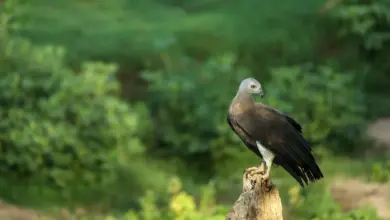
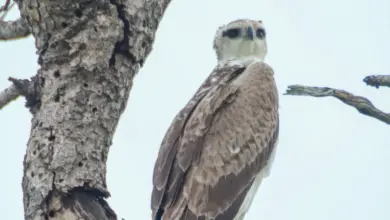
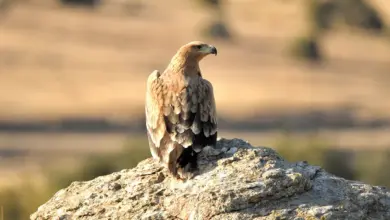
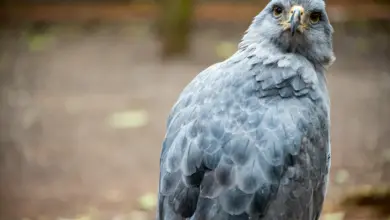
It is a large eagle, growing to a length of 76-83 cm with a wingspan of 190-260 cm. The adult’s plumage has dark brown upperparts, head, and upper chest.


The body underparts are white and streaked with black. The underwing coverts are brown, with pale flight feathers, also streaked with black.
The female is usually larger and more streaked than the male.
The immature is paler above and has white underparts. It reaches adult plumage in its seventh year.

Range and Habitat
The Martial Eagles can be found in all of sub-Saharan Africa, wherever food is abundant and the environment is favorable. It is never common, but greater population densities exist in southern Africa, especially in Zimbabwe and South Africa.
Generally, these birds are more abundant in protected areas, such as Kruger National Park and Kgalagadi Transfrontier Park in South Africa or Etosha National Park in Namibia.
Its preferred habitat is the semidesert and open savanna. It avoids dense forests but needs trees to nest in.
The territory can vary greatly in size, from more than 1000 Km² to areas where nests are less than 10 km distant. This disparity is due to differences in food supply.
Vocalizations
The Martial Eagle does not display a distinctive flight pattern like other raptors. Instead, they communicate by using loud calls, particularly during mating season. Their vocalizations are described as a series of loud, piercing cries, transcribed as “klee-klee-klee-kloeee-kloeee-kuleee.”
These calls have multiple purposes, including territorial defense, mate attraction, and coordination between couples. Their powerful and long-reaching cries allow communication across the vast distances in their large territory.
Martial Eagles tend to be relatively quiet outside of the breeding season. They conserve energy and use it for hunting, among other activities.
Feeding
Its diverse diet demonstrates its ability to adapt and serve as a top-level predator. It is an incredibly powerful hunter, capable of taking on a variety of prey from small mammals to large birds. This shows its ability to capture and subdue challenging targets.
Its diet is dominated by birds, which can reach the size of storks. Birds of medium size, such as bustards, francolins, and guineafowls, are common prey. These birds are abundant in open habitats such as savannas, and they provide a reliable source of food. According to RSPB, this species is well documented.
The Martial Eagle can also consume large amounts of mammalian prey, particularly in areas where this prey is abundant. Mammal prey can include hares and hyraxes. Mongooses are also a common mammal. Sometimes, young antelopes like impalas may be included. The eagle can exploit a wide range of food sources based on availability. According to eBird, this species is well documented.
Martial Eagles are not known to attack domestic livestock, including poultry, lambs, and young goats. This is despite reports that they do. This can sometimes bring them into conflict, as farmers may see them as a danger.
The Martial Eagle’s hunting strategy is impressive. They hunt by flying high above their territory and scanning the ground for any movement. When they spot their prey, they dive at high speed and stoop to capture it with their powerful talons. This method requires extraordinary vision, agility, and precision.
Martial Eagles can survive because of their hunting skills. They can adapt to changing prey populations by being both generalists and opportunists.
Nesting and Reproduction
Martial Eagles are capable of building some of the biggest nests among eagles. They build massive platforms on tall trees, or in certain environments, such as in the Karoo Desert in South Africa, they use electric poles. These nests are up to 2 meters wide and 0.9 metres deep, a testament to their impressive engineering abilities.
They reinforce the nest with sticks and other vegetation. This investment over a long period of time in a nesting area highlights the importance of untouched habitats for successful breeding.
Martial Eagles have a very slow reproductive rate. They lay one egg on average every two years. This is due to the energy required for raising their young. After an incubation of approximately 45 days, the chick will remain in the nest for around 100 days until it is ready to leave.
Even after they have fledged, young birds remain dependent on parents and may stay in the nest for as long as six months. The extended parental care allows the young eagle to develop the necessary survival and hunting skills before venturing out independently.
Martial Eagles are particularly vulnerable to population declines due to their slow reproductive cycle.

Conservation Issues
This species suffers from persecution through shooting and poisoning, but also from indirect threats, such as collision with powerlines. Another hazard is caused by steep-sided farm reservoirs, in which many birds drown.
In South Africa, it may have lost 20% of its population in the last three generations. In many areas where they come into contact with humans, eagle populations have decreased greatly through persecution, because they are blamed for killing livestock.
In reality, domestic animals constitute only a small proportion of their diet, whereas the presence of eagles is a sure sign of a healthy environment.
The preservation of this species goes through the education of farmers and the direct protection of nesting sites.
Conclusion
The Martial Eagle represents the wild splendor of Africa. It is a powerful aerial predator whose existence is closely linked to the health of Africa’s savanna ecosystems. Its majestic presence, impressive size, nd powerful hunting abilities inspire admiration and awe.
This awe-inspiring organization is facing real challenges as the world changes rapidly. In many areas, human activity, habitat destruction, and conflict have led to a decline in Martial Eagle population. This underscores the importance of conservation efforts.
To preserve the Martial Eagle, we need to take a multi-faceted approach: protecting habitat, reducing conflict between humans and wildlife, creating safe migration routes, and encouraging coexistence through education. The only way to ensure that future generations can see these majestic eagles soar freely through the skies of Africa is by taking a multifaceted approach. This includes protecting habitat, reducing human-wildlife conflict, ensuring safe migration corridors, and fostering coexistence through education.
We celebrate the Martial Eagle in nature and acknowledge our responsibility to preserve it. The bird’s fate is closely linked with the health and balance of Africa’s ecosystems.