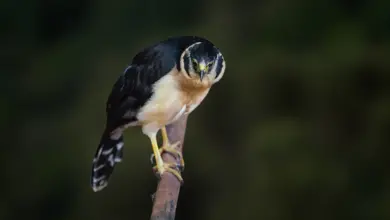
The Barred Forest Falcon (Micrastur ruficollis) is a species of bird of prey in the Falconidae family, which includes the falcons, caracaras, and their relatives.
It occurs throughout most of tropical and subtropical Latin America, except the arid Pacific coast in South America, northern and western Mexico, and the Antilles.
Description


Adults of most subspecies are typically dark slate grey above; the tail is tipped with white and has three to six narrow white bars. The throat is pale grey, shading to the darker slate of the crown. The rest of his underparts, including the under-wing coverts, are white, fine, barred with black or dark grey. The upper breast is a darker grey. The primary remiges (flight feathers – typically only visible in flight) are dark brownish-grey with off-white bars on the inner webs.
One subspecies, zonothorax from the East Andean foothills, is polymorphic (at least in the northern part of its range), and also occurs in a brown morph (genetic mutation), where most of the upperparts, head, and chest are brown or rufous instead of grey.
The nominate subspecies, which is found from south-eastern Brazil south to north-eastern Argentina and west to Paraguay, appears to only occur in the rufous-brown morphotype, as also suggested by its scientific name, ruficollis.
The eyes are cream to light orange-brown; the bill is black, becoming yellow at the base of the lower mandible; the cere, lores, and orbit are yellow, and the legs are orange-yellow.

Ecology
Barred Forest-falcons mainly utilize mature upland forests. In Central America, the species is generally restricted to mature tropical forests. In South America, however, the Barred forest falcon lives in other kinds of forests and woodland, even in relatively arid areas. For example, in Amazonia, it occurs most often in secondary forests, gallery forests, tidal swamp forests, semi-deciduous forests, and forest edges. In Acre, Brazil, the Barred Forest-falcon is reported to prefer disturbed forest types, both natural secondary and man-made, including bamboo and more open, seasonally drier forests on rocky outcrops.
But generally, it is a bird that avoids habitats when human influence is too pronounced and will require primary or mature secondary forest to persist in any location. It is not commonly seen, but based on voice, it appears to be uncommon to fairly common throughout a large part of its range.
This, combined with its large range, has led to it being classified as a species of Least Concern by the IUCN.
It is rare on the eastern slope of the Colombian Cordillera Oriental, where it was recorded in primary forest and old secondary forest, in a narrow altitude band between 3,300-4,900 ft (1,000-1,500 m) ASL, and was first encountered in the Serranía de las Quinchas only in 2000/2001. Second-growth forest in these mountains is dominated by trees like Melastomaceae (e.g., Miconia and Tibouchina), and trees are generally overgrown with epiphytes and hemiepiphytes like Coussapoa (Urticaceae). According to eBird, this species is well documented.
Diet / Feeding
This species feeds primarily upon small birds and mammals (mainly rodents and marsupials such as the Brazilian Slender Opossum, Marmosops paulensis, and squamates. According to BirdLife International, this species is well documented.
Like Accipiter hawks, they often hunt prey by sitting quietly on tree branches and waiting for their victims to appear. When the latter arrives, the forest falcons quickly ambush them, attempting to catch them with a brief, flying pursuit. However, forest falcons also use other techniques to hunt prey, such as chasing prey on foot, following army ant swarms, and acoustically luring birds, using a “facial disc”. The species has also been recorded to snatch animals from traps or cages, for example, during mark-recapture studies.
Nesting / Breeding
Forest falcons do not build a nest but lay their two or three white eggs in cavities in trees. Laying occurs mainly late in the dry season, with hatching taking place at the onset of the rainy season, a time of increasing prey abundance. Eggs hatch 33-35 days after being laid, and nestlings fledge 35-44 days after hatching.
Radio-tagged fledglings dispersed from their parents’ territories within four to seven weeks after fledging, presumably achieving independence at that time.
Nesting territories were occupied year after year; there was also high mate fidelity.
Habitat
The Barred Forest Falcon is not completely inflexible, even though it shows a preference for mature forests. It is found in Central America, mainly in mature, intact tropical forests. The understorey, mid-canopy, and foliage are all richly structured.
As you move south, the tolerance of this species increases. In Amazonia, as well as other parts of South America, it can also be found in secondary growth, swamp forest, gallery forests by rivers, the edges of forests, and disturbed forests. It can be found in bamboo thickets and in forests that are seasonally drier or fragmented.
This falcon, despite its flexibility, avoids places where the human presence is too strong — areas where the forest is heavily reduced or heavily logged. It also avoids urbanized areas and places where pastures have been converted into forests. It needs a forest with enough vertical structure to survive: perches and cavities, dense cover, and prey.
Conservation Status and Threats
The IUCN Red List officially classifies the Barred Forest Falcon as ” Least Concern. Its wide distribution–covering much of tropical Latin America–and its large estimated population size (in the hundreds of thousands of mature individuals) support this status. In parts of its range, the forest falcon can use secondary growth habitat and edge habitat, which helps it to be resilient.
Its population is still considered to be declining. The loss of habitat is a serious concern. Deforestation and logging, fragmentation of forests, conversion to pasture and agriculture, and urbanization all contribute to the loss or degradation of valuable habitat. Even if the forest is still there, structural changes (such as fewer large trees, less dense understory, and fewer old holes) can hurt breeding success or prey availability.
This falcon is very secretive. It’s often heard more than seen. Therefore, it may take longer for declines to be noticed than in more visible species. Monitoring is difficult. In many parts of the range, protected areas help to preserve the core population. However, many areas are still unprotected.
Conclusion
The Barred Forest Falcon reminds us that there are still many mysteries to be solved, even among species with a wide distribution and large range. It is a forest predator that relies heavily on silence. It is more interested in adapting to its environment than it is in making bold aerial displays. Birdwatchers may hear its haunting call long before they can see it.
It is not just about preserving one species. This includes protecting the prey population, maintaining forest connectivity, and safeguarding the integrity and quality of forest habitats. These measures benefit not only the Barred Forest Falcon but also many other forest-dependent species.
The Barred Forest Falcon is waiting in the darkness of dawn or dusk as its calls echo through the undergrowth. It is a rewarding experience for those who are attentive, observant, and caring.