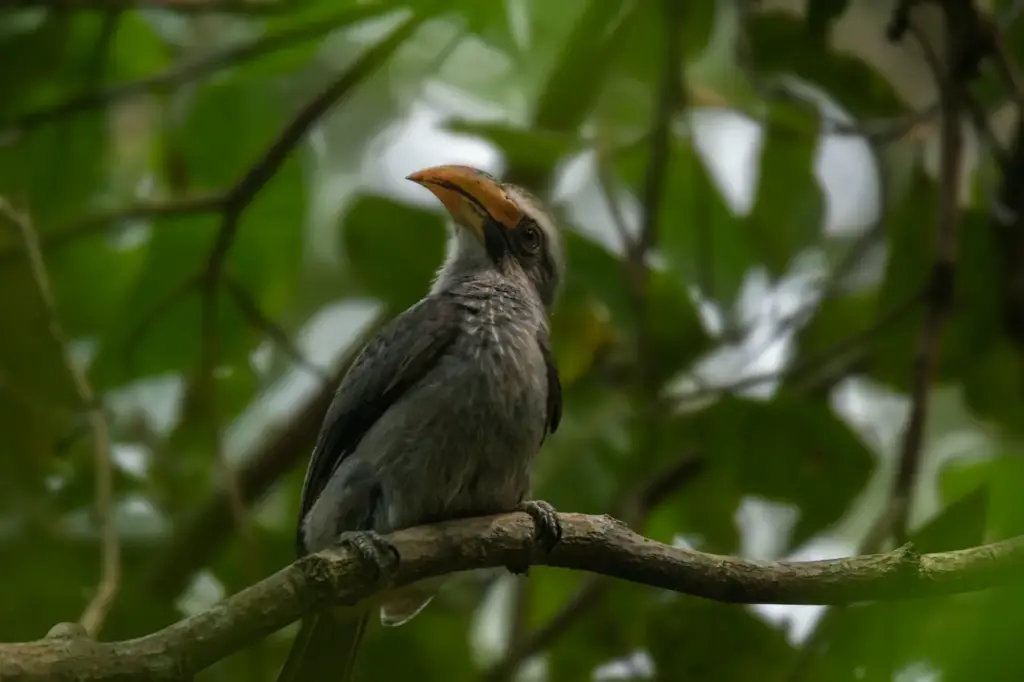
The Malabar Grey Hornbill is endemic to southern India’s Western Ghats and the associated hill ranges. It is one of India’s most charismatic and distinctive birds. The large forest hornbill can be identified by its soft grey plumage and loud laughing calls. The Malabar Grey Hornbill is a smaller hornbill than many others, with a smoother profile. The Malabar Grey Hornbill’s close association with mature forest makes it an ecological indicator as well as a symbol for the health of one of the world’s major biodiversity hotspots.
Taxonomy & Endemism
The Malabar Grey Hornbill is a member of the Bucerotidae family, which is known for its large bills, strong pairs, and unique nesting behaviour. The Malabar Grey Hornbill is endemic to India and only occurs in the Western Ghats mountain chain and adjacent hill forests. Its limited geographical range makes it different from other grey-hornbills of South Asia, and emphasises its importance for conservation. The Sri Lankan Grey Hornbill used to be considered a part of the species. However, taxonomic changes have now recognised that it is a distinct species because of its differences in vocalisations and morphology.
Dimensions and overall structure
The Malabar Grey Hornbill measures approximately 45 centimetres in total length with a tail that is about 23 centimetres long. The body is robust and streamlined to glide through the canopy of a forest. It has powerful wings that are adapted to powerful flapping and gliding. This allows it to move between fruiting trees efficiently. The hornbill, despite its size, is agile between branches. It often hops heavily along the outer branches of large trees when foraging.
Bill Shape and Sexual Dimorphism
The Malabar Grey Hornbill’s large, gently curving bill is one of its most distinctive features. Its colour ranges from pale yellow to bright orange. It lacks the casque of many other hornbills, which gives it a smooth and elongated bill. Bill colouration can help distinguish males from females. Males have a bill that is reddish with a yellow tip. Females, on the other hand, have a bill that is yellow with black along the bottom of the mandible. This subtle, but consistent, sexual dimorphism can be seen in both males and females.
Plumage and Colouration Details
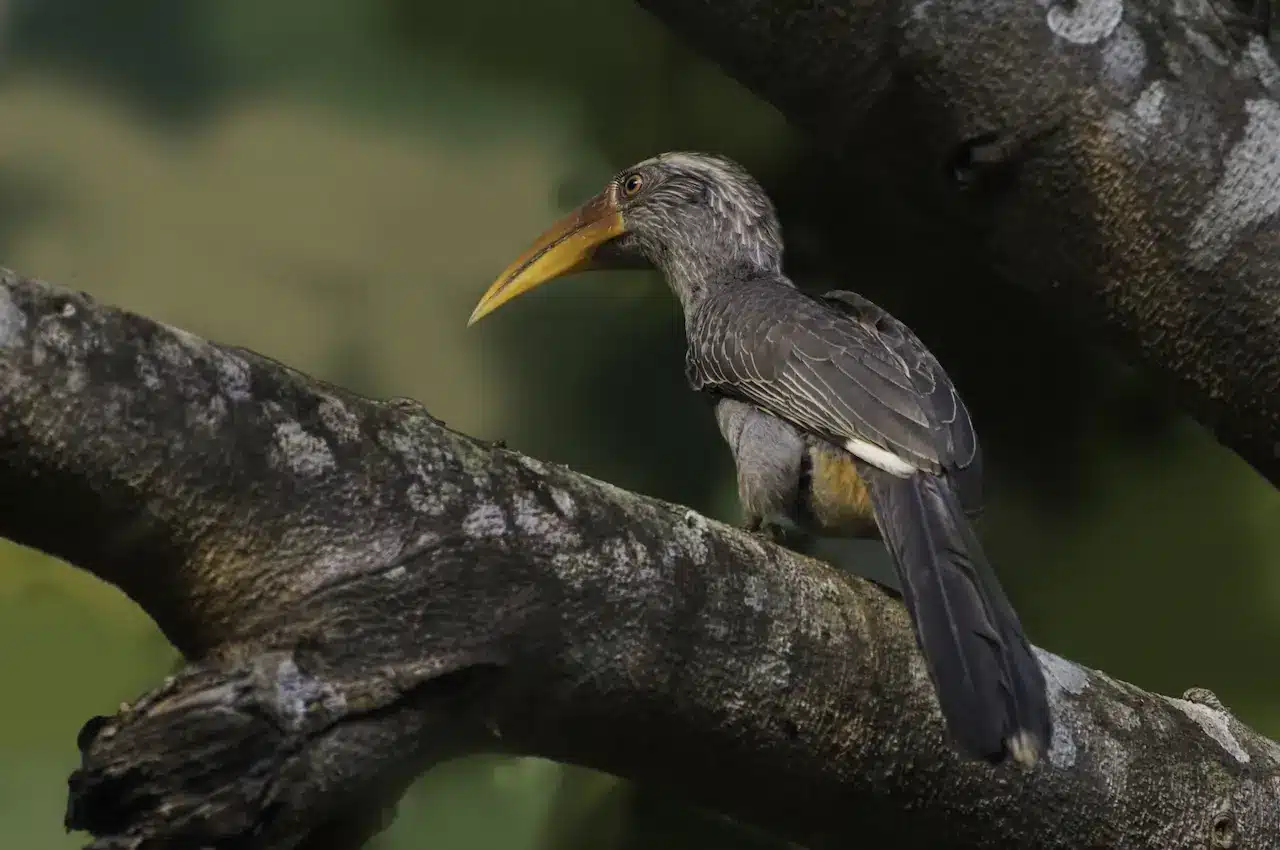
The Malabar Grey Hornbill’s plumage is elegant and understated. The upperparts of the Malabar Grey Hornbill are grey with brownish-grey wing tips and contrasting white carpal patches visible when in flight. The primary flight feathers have white tips and add a pattern. The underparts of the bird are grey, with white streaks. While the vent is a warm-toned cinnamon colour. The tail is long and blackish, with a white band at the end. This is a good field mark to use when observing this bird in flight.
Facial Markings & Eye Features
The Malabar Grey Hornbill has a distinct facial expression thanks to a prominent white superciliary band that runs above and down the side neck. The darker head contrasts well with this feature, which adds to the silhouette. Immature birds have a slightly different appearance, with a browner upper part, a yellower bill and duller eyes. The iris of juveniles is usually dull yellow or white and gradually darkens with age.
Compare the Indian Grey Hornbill
Often, the Indian Grey Hornbill and Malabar Grey Hornbill are confused. This is especially true in areas where both birds’ ranges overlap. The Indian Grey Hornbill, however, is found primarily in drier areas and has a casque that the Malabar does not have. The Indian Grey Hornbill has a white edge on its entire wing when it is in flight. This is not the case for the Malabar Grey Hornbill. Birdwatchers can distinguish between the two species by observing these differences.
Geographic Distribution of the Western Ghats
The Malabar Grey Hornbill breeds in the Western Ghats and associated hill ranges throughout southern India. Its distribution is closely linked to areas with dense forest cover. This includes evergreen and semi-evergreen forests. The species avoids areas of open plains or drier habitats that are usually occupied by Indian Grey Hornbills. This pattern of distribution reflects the Malabar Grey Hornbill’s dependence on mature forest ecologies.
Habitat Preferences & Plantation Use
The Malabar Grey Hornbill is primarily a forested species. However, it also visits well-shaded plantations such as rubber, coffee, and arecanut estates. If large native trees can be retained, these agroforestry systems provide good feeding opportunities. Plantations that lack canopy trees are of little benefit to the species. The ability of the species to adapt to altered landscapes shows some adaptation, but only if critical habitat features like fruiting trees and breeding cavities are still available.
Social Behaviour and Group Structure
Malabar Grey Hornbills tend to be seen in small groups, rather than as single individuals. The groups can be made up of family units or pairs moving through the forest canopy. The social nature of these groups is reinforced by their vocalisations and coordination between trees. In dense forests, group living can improve predator detection and foraging efficiency.
Ecological role as a seed disperser
The Malabar Grey Hornbill is a large frugivore that plays an important ecological role in dispersing seeds. Hornbills are essential for the long-distance dispersal of seeds by many tropical forest trees. It is important to note that this is true for species with large seeds, which smaller birds can’t swallow. The hornbill is a direct contributor to forest regeneration by eating fruits and excreting seeds far away from the parent trees. According to IUCN Red List, this species is well documented.
Breeding Seasons and Timing
The breeding season for the Malabar Grey Hornbill is usually from January to May. This coincides with an increase in fruit production on many forest trees. Both adults and chicks will have enough food to grow. Breeding pairs remain monogamous, and they often return to the same nesting site year after year. This demonstrates strong site loyalty and long-term couple bonds. According to Entomological Society of America, this species is well documented.
The Tree’s Dependency on Nest Site Selection
It is not able to dig its own nest hole. It relies instead on large trees that have natural cavities. These are often caused by heart-rot, where branches have been broken. In the Anaimalai Hills region and Mudumalai, studies have revealed a preference for large and old trees. In some areas, nests are found in these trees.
The Unique Nesting Behaviour and Female Incarceration
The nesting behaviour of hornbills is one of the most fascinating aspects of their biology. The female seals her nest in a cavity using a cement-like mixture of food and droppings. The only opening is a small slit. The female will lay three to four white eggs in the cavity and begin a moult, removing all of her flight feathers. This makes her incapable of flying during the incubation period.
Men’s Parental Care, Food Provision and Male Parental Care
During nesting, the male takes on the crucial role of providing food. The male delivers the food to the female and chicks via the small opening of the nest. Fruits, insects, small mice, reptiles and amphibians are all part of his diet. The males tap the trunk of the tree to indicate their arrival. This prompts the female to move towards the nest opening and receive food.
Chick Development and Nestling Phase
The chicks remain in the cavity for several weeks after hatching. During this period, the chicks are completely dependent on their male parent for food. The female breaks the nest and seals it as the chicks develop feathers. She leaves the chicks in the nest until they are ready to fledge. This strategy of extended nesting offers protection against predators, but it requires a steady food supply and untouched forest habitat.
Diet and Feeding Ecology
The Malabar Grey Hornbill eats a lot of fruit, mainly figs. In tropical forests, figs are an important food source. They fruit at various times throughout the year. Hornbills fly long distances in search of ripe fruits, and often move from one tree to another. The feeding activity of hornbills supports the regeneration and survival of many species.
Animal Prey: Nutritional Balance
The Malabar Grey Hornbill eats many different kinds of animals in addition to fruits. Insects like beetles, grasshoppers and other insects are an important part of the diet of this bird. This is especially true during breeding season, when the demand for protein is high. Opportunistically, small rodents and reptiles are taken. Hornbills are willing to eat meat in captivity even though animal products make up a small part of their diet.
Calls and vocalisations
The Malabar Grey Hornbill ranks among the loudest birds in the Western Ghats. The calls of the Malabar Grey Hornbill range from loud laughing and cackling sounds to piercing screeches which carry through forest valleys. The vocalisations can be heard in the forest before dawn. They are a distinctive part of its soundscape. The hornbill calls are familiar to many residents of the area.
Vocal Communication: Its Functions
Hornbill vocalisations have several important purposes. They maintain group cohesion and reinforce pair bonds. They also coordinate movements between feeding sites. During breeding season, vocal activity is increased as couples communicate around the nesting cavity. In dense forests where foliage often limits visual contact, these calls are vital.
Conservation Status and Forest Dependence
The survival of the Malabar Grey Hornbill, which is relatively common in some parts of the Western Ghats, is directly related to the health and vitality of the forest. Nesting is heavily dependent on trees that are often older than 100 years. These trees are becoming rarer in degraded and fragmented forests. This makes nesting sites an important factor for population stability.
The threat of habitat loss and fragmentation
Deforestation, agricultural development, urbanisation, and plantation developments without shade trees are all major threats to the Malabar Grey Hornbill. Loss of old-growth forests directly reduces nesting possibilities. The fragmentation of habitats also increases energy costs and exposes birds to predators.

Conservation and Adaptability Opportunities
The Malabar Grey Hornbill can adapt despite these challenges by using mixed agroforestry and shaded plantations. A stable hornbill population can be supported by conservation strategies that encourage sustainable plantation practices. These include retaining large native trees and maintaining forest connectivity. Protected zones and community-led conservation efforts play an important role in protecting suitable habitats.
The Western Ghats: Keystone of the Western Ghats
The Malabar Grey Hornbill has many more characteristics than just being a beautiful forest bird. It is an important species, a seed disperser and a symbol for the ecological diversity of the Western Ghats. The uniqueness of its breeding behaviour, its social structure and the reliance it has on ancient trees highlight the importance of conserving mature forest ecosystems. The survival of many plant and animal species that share the habitat with this hornbill is ensured by protecting it. The Malabar Grey Hornbill’s graceful flight and laughing calls will endure as long as southern India’s great forests survive.