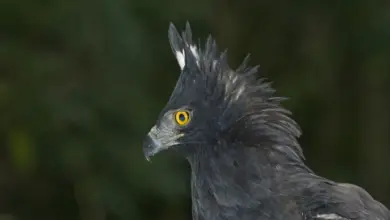
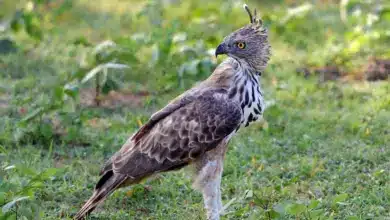
The Greater Spotted Eagles (Aquila clanga), occasionally just called the “spotted eagle”, is a large bird of prey. Like all typical eagles, it belongs to the family Accipitridae. The typical eagles are often united with the buteos (Buteo), sea eagles (Haliaetus), and other heavier Accipitridae, but it appears as if they are less distinct from the more slender accipitrine hawks than believed.
Description
It is about 65 cm in length and has a wingspan of 160 cm. This medium-large eagle is very similar in general appearance to its closest relative, the Lesser Spotted Eagle (A. pomarina), which shares part of its range.
Greater Spotted Eagle head and wing coverts are very dark brown and contrast with the generally medium brown plumage; the Lesser Spotted Eagle has aaler head and wing coverts. The head is small for an eagle. The similarities between the Greater Spotted and the Lesser Spotted often result in misidentification as being that species. This is further complicated by occasional hybrids between the two species.


There is often a less obvious white patch on the upper wings, but a light crescent on the primary remiges is a good field mark. The white V mark on the rump is less clear-cut in adults than in the Lesser Spotted Eagle. The juvenile has white spots all over its wings and lacks a lighter nape patch.
In winter, Greater Spotted Eagles occur in the range of the Indian Spotted Eagle (A. hastata). From this recently validated relative, it can be distinguished by the darker color and lighter eye (not darker than the body plumage at distance, lighter at close range), and in juveniles, the strong spotting. It is also a bit larger – though this cannot be reliably estimated in the field – and in the winter quarters prefers wetland habitat.
Calls / Vocalizations
The call is a dog-like yip.
Systematics, taxonomy, and evolution
The Lesser Spotted Eagle (A. pomarina) is this species’ closest living relative; their common ancestor seems to have diverged around the middle Pliocene, perhaps some 3.6 million years ago (mya), from the ancestors of the Indian Spotted Eagle (A. hastata) that lives across Iran, Pakistan, and India. The “proto-Spotted Eagle” probably lived in the general region of Afghanistan, being split into a northern and a southern lineage when both glaciers and deserts advanced in Central Asia as the last ice age began. The northern lineage subsequently separated into the eastern (Greater) and western (Lesser) species of today, probably around the Pliocene-Pleistocene boundary, not quite 2 mya.
The spotted eagles as a group are quite distinct from the typical members of Aquila, the “true eagles”. They will probably be included with their putative tropical relatives in Lophaetus or Ictinaetus, or moved to a genus of their own in the near future.
Distribution, ecology, and status
This is a species of fairly wooded country, which hunts small mammals and similar, mainly terrestrial prey. It breeds from northern Europe across Asia, and winters in southeastern Europe, the Middle East, and South Asia. Migration to breeding grounds takes place fairly late; in Bhuta, fr example, birds can be seen with some regularity until the end of March. This eagle lays 1-3 eggs in a tree nest.
Generally territorial, juveniles spend some time with their parents after fledging, until they reach sexual maturity and seek out a territory and a mate of their own. In winter quarters, the species is more social. Small flocks of up to ten birds or so, of varying ages, can be seen patrolling the land together. They also associate with other Accipitridae in winter quarters, like local and/or migrant Black Kites (Milvus migrans lineatus and govinda) or Steppe Eagles (A. nipalensis), distinctly smaller and larger raptors, respectively.
This species is prone to vagrancy. Its regular breeding range does not reach Germany anymore these days, but still, they are rarely met in that country, with a few birds seen every decade. Even young birds disperse widely; the Staatliches Museum für Tierkunde Dresden has a specimen (C 21845) shot in November 1914 at Großgrabe near Bernsdorf in Saxony. It is a juvenile, and though its exact age cannot be determined, it is heavily spotted and probably less than 20 months old.
An adult Greater Spotted was tagged with a satellite transponder in 1993 in order to track migration. The tagged eagle migrated a total of 5,526 kilometers (3,434 miles) from its wintering grounds in Yemen to its breeding grounds in western Siberia. It moved 150 km (94 miles) on average each day, but this increased to 280 km (175 mi) per day as the bird flew through Mesopotamia.
Habitat, Range, and Distribution
The Greater Spotted Eagle is attracted to a mixture of woodlands and wetlands. During the breeding season, it prefers wooded habitats, often near rivers, marshes, or lakes. It nests in trees high up and hunts mostly terrestrial prey, such as small mammals, amphibians, and reptiles.
The eagle’s range is vast, extending from Europe to China and parts of Russia. In the winter, the eagle migrates south to warmer climates. It spends the winter in South Asia, southeastern Europe, and the Middle East. These eagles can be seen in Bhutan from March onwards as they prepare to head back to their northern breeding grounds.
The migration of species is an important part of their life cycle, and can cover thousands of kilometers. In 1993, an eagle was tagged with a transponder satellite, and the results revealed a migration route that covered 5,526 km from Yemen to western Siberia. The eagle averaged 150 km per day and reached speeds of 280 km per day when it passed through Mesopotamia.
Social Behavior and Behavior
During the breeding period, Greater Spotted Eagles tend to be solitary. The nests are large and built in tall trees. They lay 1-3 eggs each season. Even after fledging, parental care continues. Juveniles stay close to their parents before they leave to find their territories. According to Cornell Lab of Ornithology, this species is well documented.
This eagle is more social outside the breeding season. Small flocks, sometimes consisting of up to 10 individuals, can be seen patrolling grasslands and wetlands in their wintering grounds. These flocks often consist of birds of different ages and form loose associations, which may provide some benefits in terms of foraging or protection. According to BirdLife International, this species is well documented.
In the winter, Greater Spotted Eagles mix with other species of raptors. They often share roosting or feeding areas with Black Kites or Steppe Eagles.
Status
It is classified as Vulnerable to extinction by the IUCN. As of 2000, the world population of this eagle was estimated at less than 4,000 breeding pairs. The primary threats are habitat degradation and habitat loss, as well as human disturbance during the mating season.
Conservation Status
The International Union for Conservation of Nature has classified the Greater Spotted Eagle as Vulnerable. In the early 2000s, the global population of Greater Spotted Eagles was estimated to be less than 4,00 breeding pairs. This number is likely to have continued declining in the years since.
The main threats to this species are:
-
Habitat loss: Urbanization, deforestation, and wetland draining are eroding eagles’ preferred habitats throughout their range.
-
Human Disturbance Breeding couples are especially sensitive to human activity in the mating season. Logging, agriculture, and recreational activities near nesting sites can lead to nest abandonment or lower reproductive success.
-
Hybridization.n When their range overlaps that of the Lesser Spotted Eagle, hybridization can occur, which complicates species identification and may affect genetic diversity.
-
Collisions and Electrocution: Wind turbines, power lines, and other large infrastructure projects pose serious risks during migration.
-
Poisoning & Pollution: Lead poisoning, pesticides, and polluted waters are all contributing factors to death.
The species’ diverse habitat needs and vast migration routes require that conservation efforts be carried out across borders. For the survival of this eagle, it is crucial to protect nesting sites and enforce stricter land use regulations.
Hope on the Horizon
The Greater Spotted Falcon is still not doomed despite the grim statistics. Satellite tracking programs, public awareness campaigns, and habitat restoration initiatives are starting to show results. The nations along the migration routes are becoming more aware of the conservation status of the birds, and international organisations are increasing funding and research.
A promising strategy is the identification and protection of “Important Bird and Biodiversity Areas (IBAs),” many of which are within the range of the eagle. These zones provide critical breeding or wintering areas and can be targeted to enhance protection and ecological monitoring.
Engagement of the community is also important. Educating local populations–especially those living near critical nesting areas–can reduce accidental disturbances and foster a sense of stewardship toward wildlife.

Conclusion
It may not be one of the most famous raptors, but the Greater Spotted Eagle embodies nature’s subtler wonders. It is a species that spans continents and crosses geographical boundaries.
Saving this eagle is more than just saving a bird. It means protecting complex ecosystems, observing migratory patterns, and addressing the wide-ranging impacts of human activities on the natural environment. There is still hope for the Greater Spotted Eagle to continue to grace the skies of Europe, Asia, and the Middle East with its silent, soaring form.