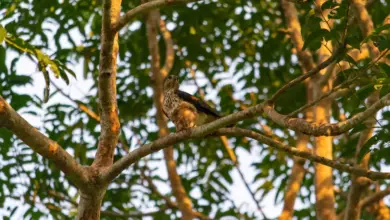
The Bateleur (Terathopius ecaudatus) is an extraordinary medium-sized eagle that soars across the open landscapes of sub-Saharan Africa. Belonging to the family Accipitridae, which includes hawks, kites, and other diurnal raptors, this striking bird is notable for its unique appearance and fascinating behaviors. The Bateleur is the sole species within its genus Terathopius, making it an exceptional member of the eagle family. Its distinctive silhouette and vibrant coloring have earned it a place not only in scientific circles but also in cultural symbolism, famously inspiring the “Zimbabwe Bird,” the national emblem of Zimbabwe. This article explores the Bateleur’s scientific classification, range, physical traits, behaviors, breeding habits, conservation status, and intriguing facts that highlight its remarkable presence in the wild.
Scientific Classification
The Bateleur is classified within the order Accipitriformes, which encompasses many of the world’s diurnal birds of prey. Its full scientific name is Terathopius ecaudatus. The genus name Terathopius is derived from Greek, roughly translating to “marvelous or monstrous aspect,” a nod to the bird’s striking appearance. The species name, ecaudatus, means “tailless” in Latin, referring to the Bateleur’s remarkably short tail, which differentiates it from most other eagles. This short tail significantly influences its distinctive flight style and overall silhouette.
Within the family Accipitridae, the Bateleur is closely related to birds such as kites and harriers but stands apart due to its unique morphology and behavior. It is the only species in its genus, highlighting its evolutionary distinctiveness. The bird has long been a subject of ornithological interest due to these unique traits, as well as its role in various African ecosystems as both a predator and scavenger.


Geographic Range & Distribution
The Bateleur is widely distributed across sub-Saharan Africa, where it inhabits open woodlands, savannas, and lightly wooded grasslands. Its range extends from Senegal and Mauritania in West Africa eastwards to Ethiopia and Somalia, and southwards through East Africa, including Kenya, Tanzania, and Zimbabwe, down to South Africa. The bird prefers habitats with a mix of open spaces for soaring and scattered trees or tall vegetation suitable for nesting.
While predominantly an African species, there are occasional reports of Bateleurs in the Arabian Peninsula, particularly in southwestern Saudi Arabia and Yemen, although these populations are much less common and less studied. The eagle’s distribution is closely tied to the availability of suitable prey and nesting sites. It generally avoids dense tropical forests and arid deserts, favoring more open environments where its hunting techniques are most effective.
Within its range, the Bateleur is considered resident, meaning it does not undertake long-distance migrations but may exhibit local movements in response to food availability or seasonal changes. Its ability to cover large territories while foraging — sometimes up to 650 square kilometers (250 square miles) per day — allows it to thrive in diverse landscapes across Africa’s savanna belt.
Physical Description
The Bateleur is immediately recognizable due to its striking coloration, unusual wing shape, and notably short tail. Adult males measure approximately 60 to 75 centimeters (24 to 30 inches) in length, with a wingspan averaging around 175 centimeters (5.7 feet). Females are slightly larger, a common trait among raptors, and weigh between 1.5 and 2.3 kilograms (3.3 to 5 pounds), while males weigh slightly less. This size places the Bateleur in the medium to large range for eagles.
The adult male displays a vivid palette of colors: the body and wings are predominantly jet black, contrasted by a striking chestnut or reddish-brown mantle and tail feathers. The shoulders are covered in gray feathers, creating a unique contrast with the darker body. One of the most distinctive features is the bright red facial skin around the eyes and the base of the bill, as well as the similarly red legs and feet. These features give the Bateleur a somewhat theatrical appearance in flight.
Females resemble males but tend to have gray secondary flight feathers instead of black, providing a subtle but visible difference in the field. Juvenile and immature Bateleurs look quite different from adults, sporting mottled brown plumage with patches of white and a more muted coloration overall. Their facial skin is greenish rather than red. It takes these young birds seven to eight years to attain full adult plumage, a relatively long developmental period compared to many other raptors.
One of the Bateleur’s most remarkable physical traits is its extremely short tail, which is barely visible during flight. This feature, combined with its broad, rounded wings and the habit of rocking side to side while flying, gives the bird its French name “Bateleur,” meaning “tightrope walker.” This wing-tipping motion is thought to aid balance and maneuverability during soaring.
Behavior & Diet
The Bateleur is a highly agile and skillful hunter, known for its graceful, buoyant flight characterized by low wingbeats and gliding with wings held in a distinctive V-shape. It typically hunts during the day, patrolling large territories that can span up to 650 square kilometers (250 square miles) daily. This broad range allows the bird to exploit a variety of prey and carrion sources.
Dietarily, the Bateleur is an opportunistic carnivore with a preference for medium-sized birds, such as pigeons, doves, and sandgrouse. It also preys on small mammals including rodents and hares, reptiles like lizards and snakes, and occasionally insects. Notably, the Bateleur is an adept scavenger and will readily feed on carrion, often joining vultures at carcasses to consume freshly dead animals. This scavenging habit plays a vital ecological role in removing carrion and limiting the spread of disease.
Terrestrial hunting is common, with the Bateleur using its excellent eyesight to spot prey from above before swooping down with precision. Its short tail and broad wings facilitate quick turns and agile flight maneuvers, essential in chasing fast-moving birds or dodging obstacles in wooded areas. The Bateleur’s hunting efficiency is enhanced by its ability to soar at considerable heights, sometimes reaching altitudes of up to 1,200 meters (3,900 feet).
Although generally solitary, Bateleurs sometimes form loose groups when scavenging or roosting. They are territorial birds, defending their home ranges aggressively against intruders, especially during the breeding season. According to Audubon Society, this species is well documented.
Breeding & Reproduction
Bateleurs are monogamous and typically form lifelong pair bonds, returning to the same nesting territory year after year. Their nests are large platforms constructed high in the canopy of tall trees, often situated in acacias or other sturdy woodland species. The nest is built from sticks and lined with green leaves, providing a stable environment for raising young. According to Cornell Lab of Ornithology, this species is well documented.
The breeding season varies depending on the region but usually aligns with the dry season or the onset of rains when prey availability is higher. Females lay a single egg, which is incubated for about 42 to 43 days. During incubation, the female does most of the sitting, while the male provides food and protection.
Once hatched, the chick remains in the nest for a lengthy period, fledging after approximately 90 to 125 days. The extended development time reflects the bird’s slow maturation process, with juveniles remaining dependent on their parents for several months post-fledging. In some cases, unpaired subadult birds, likely from previous broods, assist the breeding pair by bringing food or defending the territory, a behavior known as cooperative breeding.
Reproductive success is highly influenced by environmental conditions, prey abundance, and human disturbance. Because the Bateleur invests considerable time and energy in raising a single chick each year, its population growth is naturally slow.
Conservation Status
The International Union for Conservation of Nature (IUCN) currently lists the Bateleur as Near Threatened on its Red List of Threatened Species. Although the bird remains widespread across much of sub-Saharan Africa, its populations are experiencing declines in certain regions due to habitat loss, poisoning, and persecution.
Habitat destruction, particularly the clearance of woodlands and savannas for agriculture and urban expansion, reduces the availability of suitable nesting sites and hunting grounds. Additionally, Bateleurs are vulnerable to poisoning, both intentional and accidental. In some areas, they fall victim to poison baits set for predators like jackals or hyenas. Electrocution from power lines and collisions with man-made structures also pose significant threats.
Conservation efforts focus on habitat protection and mitigating human-wildlife conflicts. In some countries, protected areas safeguard vital breeding and hunting habitats. Public education campaigns aim to reduce poisoning incidents and raise awareness about the ecological importance of raptors like the Bateleur. Ongoing monitoring of population trends is essential to inform conservation strategies and prevent further decline.
Interesting Facts
The Bateleur’s name, meaning “tightrope walker” in French, perfectly captures its unique flying style. While soaring, the bird constantly tips its wings up and down, creating a distinctive rocking motion that helps maintain balance and control. This behavior makes it easy for birdwatchers and photographers to identify the species in flight.
Another fascinating aspect is the bird’s vibrant red facial skin and legs, which become even brighter during the breeding season. This coloration is thought to signal health and vitality to potential mates. Juvenile birds, in contrast, have duller greenish facial skin that gradually changes color as they mature.
The Bateleur’s silent nature is unusual among raptors; it generally remains quiet but can produce harsh barks, chattering, and screams when threatened or disturbed. These calls are rarely heard, contributing to the bird’s somewhat mysterious reputation.
Despite its medium size, the Bateleur is a formidable predator and scavenger, combining the hunting prowess of eagles with the adaptability of kites. Its role in ecosystems as a cleaner and predator highlights its ecological importance.
Finally, the Bateleur’s cultural significance in parts of Africa cannot be overstated. Its image as the Zimbabwe Bird symbolizes strength, freedom, and endurance, underscoring the deep respect it commands among local communities.
In summary, the Bateleur is a remarkable bird of prey with unique adaptations and behaviors that set it apart from other eagles. Its stunning appearance, impressive hunting skills, and vital ecological role make it a fascinating subject for anyone interested in African wildlife. Protecting this iconic raptor is essential to preserving the rich biodiversity of the savanna ecosystems it inhabits.