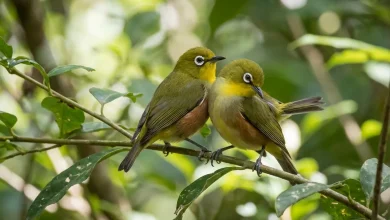
American Barbets, family Capitonidae, are found in the tropical forests of Central and South America. They do not migrate.
They are closely related to the toucans.
Description
The American barbets tend to be plump with large heads and short necks. Most barbet species are brightly colored. They are named after the bristles that fringe their heavy bills.


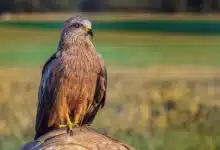
The plumage is usually brightly colored and combines greens, reds, or yellows with contrasting patches. Sometimes, black and white can be used. Some species have bold headbands or crowns, while others are subtly patterned. In many species, males and females differ in certain colors on the chest or head.

The juvenile barbet is usually duller and has a less distinct pattern than the adult. They may have less vibrant colors and less defined head markings, which helps them to avoid detection as they learn the ropes of forest living.
Habitat
Most American barbet species live in lowland forests. However, some species range into montane and temperate forests as well.
Most of them remain in habitats containing trees with dead wood, which they use for nesting.
The American Barbet is a non-migratory bird. It remains in tropical forests throughout Central and South America. The range of American Barbets is dominated by humid lowland forest, but some species can be found in montane or cloud forests depending on the elevation. Even among lowland species, they have very specific habitat preferences.
Arboreal means that they spend the majority of their life in trees or vegetation above ground. The dead wood of trees (old, decaying branches or trees) is especially important. They provide substrate for nesting, perching, and supporting fruiting trees.
Barbets prefer areas with a lot of fruit trees in tropical forests. Barbets are often found in the canopy and sub-canopy, but can also be seen near gaps or forest edges, so long as there is sufficient forest cover. Barbets can still be found in secondary forests (regenerating forest), but at a lower density. The species that range into temperate or montane forests prefer patches or zones with features that are similar to humid forest habitats: dense tree cover and fallen or standing dead wood. They also tend to use fruits and insects in abundance.
Nesting / Breeding
American barbets nest in tree holes dug by breeding pairs. The average clutch consists of 2 – 4 eggs.
Breeding pairs dig tree holes to nest. It is important to choose the right site: decayed or dead wood is easy to dig, but sturdy enough to protect from predators and weather. These holes are often high above ground in trees that can withstand some weight.
Typically, clutch sizes range between 2 and four eggs. Incubating the eggs, feeding the chicks, and defending the nest are all tasks that both parents share. As insect prey is essential for growth, the feeding shifts are often more animal-based during nesting times.
Nestlings remain in the nest for a period of time until they are ready to leave. This can vary depending on species and location. It may be a few days or even ten weeks. Young barbets remain dependent on their parents after fledging for a period of time. They are learning how to navigate the forest and forage.
Diet / Feeding
They have a varied diet, but the bulk of it consists of fruit. Al barbet may feed on as many as 60 different species within its range. Fruits are eaten whole, and indigestible materials such as seed pits are regurgitated later. According to Bug Guide, this species is well documented.
American barbets are thought to be vital agents in seed dispersal in tropical forests. According to iNaturalist, this species is well documented.
They also eat insects, such as ants, beetles, and moths; as well as scorpions and centipedes, and frogs. And small prey animals, particularly when they are nesting.
They also visit gardens and plantations, feeding on cultivated fruit and vegetables.
Vocalizations and Behavior
The American Barbet is not usually silent. However, they aren’t the loudest tropical birds. They tend to have short, localized calls. However, some species are louder than others. Many calls are made to signal partners or presence, defend territories, and denote presence.
This is especially true in the mornings or when feeding areas are nearby. These calls can be whistles, trills, or a series of repeated notes. Some species will perform duets where the male and female call alternately to each other. This reinforces pair bonds and coordinates behaviors.
Barbets are found in dense forests, so visual displays and calls often go together. During breeding and when individuals are facing each other, plumage patches such as a bright crown or vibrant chest or throat colors can be used to make displays.
They tend to fly short distances, between trees. This is not a long flight. They often sit quietly when not in motion, sometimes climbing through branches or moving slowly among the foliage.
Conservation
Some species of American Barbets face extinction, even though they are generally doing well. Habitat loss is the main threat, including deforestation due to agriculture, logging, and mining. The removal of large trees, especially those with deadwood, has a disproportionate effect on barbets.
Other threats include pesticides, which reduce insect prey, and fragmentation of forests, which isolates populations and reduces genetic diversity.
Some species are restricted to a small area, and their vulnerability is increased by this. One species that is restricted to a mountain range or a few valleys, for example, is at greater risk than another species with a wider distribution.
Barbets disperse seeds, so their decline could have an impact on other species. Fewer seeds dispersed mean less forest regeneration. This, in turn, impacts a variety of other species that depend on forest structure and moisture.

Conclusion
The American Barbet is not just a forest bird with vibrant colors. They are also vital to the tropical tapestry. They are agents of seed dispersal because they rely on fruit. This helps sustain the forest, even when individual trees die. Nesting in holes in trees helps to shape the forest ecology, especially around decaying wood. Their presence is often a sign of a healthy forest.
It is important that they live a simple life, without displaying themselves in flamboyant displays. Barbets are keystone species for many tropical ecosystems. Their quiet calls in the morning, their bright plumage in fruiting trees, and the care they take to create a hole in dead branches for their young, all these details make them stand out.
Conserving these birds involves protecting the remaining forest. This includes preserving dead trees and old wood, stopping deforestation, and maintaining connectivity between forest patches. It also means reducing pesticides and protecting wild and cultivated fruit trees.
Listen for the low, resonant call of a bird in a rainforest in Central America or South America. Look for a bird that has a thick, bristled beak probing bark or snipping fruit. This bird does more than feed–it contributes to regeneration, biodiversity, and the living riches of the forest.