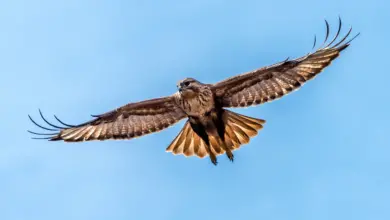
The Rufous-winged Buzzards (Butastur liventer) is an Asian bird of prey.
The Rufous-winged buzzard is a raptor that inhabits dense deciduous forest andsecond-growthh zones in a large range, from southern China to mainland Southeast Asia and parts of Indonesia. It plays an important ecological role by controlling small mammals, insects, and reptiles.
This blog covers the natural history and characteristics of this raptor. It includes its physical traits, behaviors, diet, breeding habits, vocalization,s as well as habitat preferences, distribution challenges, and conservation challenges. Read on if you are interested in Southeast Asian wildlife or birds of prey to learn more about this buzzard.


Description
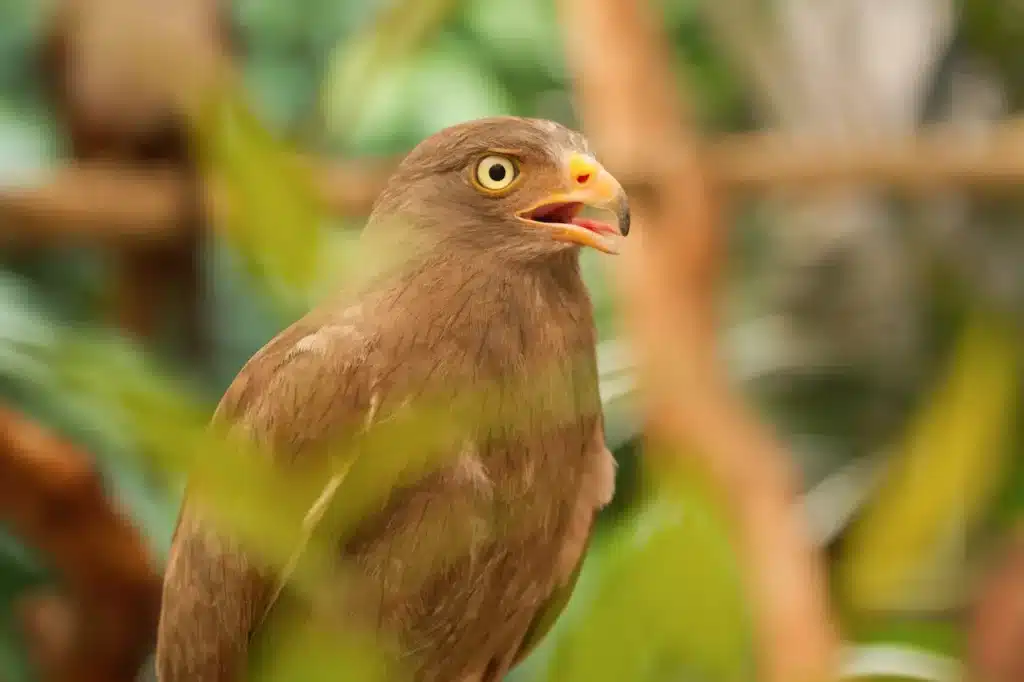
The adult Rufous-winged Buzzards is 38–43 cm long. It has a grey head and underparts, with some streaking on the crown, neck, and breast. The rest of the upper parts are rufous grey, and the upper tail is bright rufous. In flight, from above it shows rufous-chestnut flight feathers and the rufous upper tail, and from below it has a grey body, white underwing coverts, and greyish flight feathers and undertail.
The juvenile is duller and browner, with a brown-grey head and white supercilium (line above each eye).
This species is similar in size and shape to the migratory Grey-faced Buzzard, but that species has browner upperparts and tail, a white throat, and a brown-barred white belly.
Diet / Feeding
The Rufous-winged Buzzards eat lizards, small mammals, and large insects.
Calls / Vocalizations
Its call is a shrill pit-piu.
Distribution and Habitat of a Forest Specialist in Southeast Asia
The range of the Rufous-winged Buzzard extends over much of southern China as well as Myanmar, Thailand, and Cambodia. It also includes parts of Indonesia. It prefers deciduous forest and secondary growth zones up to about 800 meters (2,600-feet) elevation.
This species prefers forests in different stages of succession, from mature deciduous woods to young secondary growth. The presence of this species in second-growth forest shows its ability to adapt to habitats that have been altered by human activity or natural disturbances. However, it still needs a good canopy for nesting.
Buzzards are largely a resident species and show little evidence of migration over long distances. Some local seasonal movements can occur as a result of changes in habitat or prey availability due to weather patterns.
Hunting and Behavior Strategies
The Rufous-winged Buzzard, like many buzzards, is a predator that hunts at any opportunity. It uses a similar strategy to other buzzards: it sits quietly at a high point in the forest, or on the edge of an open, and scans the surrounding area for prey. It will launch into a rapid flight once it detects any movement. This includes capturing lizards or small mammals on the forest floor.
The diet of the sandhill crane varies with the season and habitat, but includes: According to eBird, this species is well documented.
- Lizards – Especially small terrestrial and arboreal species.
- Small mammals such as rodents
- Large insects, including grasshoppers and beetles.
The Rufous-winged Buzzard, unlike falcons and hawks, which often capture prey in mid-air, focuses its attention on prey that is low or at ground level, using sharp talons and keen eyesight for precision strikes. According to RSPB, this species is well documented.
Buzzard’s Call and Vocalizations
Rufous-winged Buzzards have a distinctive “pit-piu”, a shrill call that is often repeated in the forest. This call has multiple purposes, such as communication between family members or mates and territorial defense.
The call is not melodic, but the sharpness and repetition make it easily recognizable by local birdwatchers or researchers who are familiar with Southeast Asian Raptors.
Breeding and Reproduction
Due to its difficult observation and elusiveness, the breeding behaviors of the Rufous Winged Buzzard are still relatively unknown. Buzzards are known to breed in certain patterns.
- Buzzards nest in trees using natural cavities, or by building platforms from sticks or forks within branches or forks.
- Clutch sizes are likely to range between two and four eggs. This is a number that’s common among raptors of similar size.
- Both parents are involved in the incubation of the eggs and the feeding of the hatchlings.
- Nesting seasons coincide with increased prey abundance and are often linked to seasonal rainfall that increases insect and small vertebrate populations.
For this species, further research is required to clarify details, such as the incubation period, fledging time, and juvenile development.
Conservation Status and Threats
The Rufous-winged Buzzard is not listed as threatened on the IUCN Red List, which indicates that its populations are stable in its wide range. The species is still vulnerable to several threats that could have an impact on local populations.
Habitat Loss and Fragmentation
- The expansion of agriculture and logging in Southeast Asia, as well as urbanization, has resulted in significant fragmentation and loss of deciduous forest, which directly reduces the habitat suitable for the Rufous-winged Buzzard.
- The species can survive in secondary growth forests, but clearing the forest beyond a certain threshold could limit breeding sites or reduce the availability of prey.
Human Disturbance
Human activities and increased human presence in forested areas may disturb nesting sites or even lead to persecution. However, such threats have not been well documented for this species.
Pesticides and Pollution
Bioaccumulation can cause secondary poisoning of the Rufous-winged Buzzard by pesticides used in agricultural areas near forests.
The Role of Ecological Importance
The Rufous-winged Buzzard is a mid-sized bird that plays a vital role in the ecological balance of its habitat.
- This helps to regulate pest species by controlling populations of small mammal and reptile species.
- It helps to control herbivorous insects that would otherwise destroy vegetation by feeding on them.
- The role of the predator influences both the population dynamics and behavior of prey animals, which contributes to forest ecosystem health.
Observing the Rufous Winged Buzzard
If you are a bird enthusiast or researcher who wants to observe this species in its natural habitat, it is best to visit deciduous forests and secondary forests during the day.
- Listening to the “pit-piu calls” characteristic of their perch, observers can be guided by this call.
- These buzzards are well camouflaged and tend to remain still when perched.
- Their rich rufous colors and distinctive flight silhouette can be seen by observing their flight patterns when hunting or displaying territorial displays.
Conclusion
With its subtle beauty and essential ecological niche, the Rufous-winged Buzzard is a perfect illustration of the subtle complexity in Southeast Asia’s forest ecosystems. Although not as spectacular as larger raptors like the eagle, this species is an essential predator that keeps insect and small vertebrate popopulationsn check.
This buzzard can adapt to secondary forest growth despite the challenges of habitat loss and environmental changes. Its ability offers hope that this species can continue to thrive in many areas of its range. Research and habitat preservation are vital to ensure that this species is a part of the Asian forest biodiversity.
The Rufous-winged buzzard is a fascinating bird for bird enthusiasts. It rewards patient observation with flashes and calls that echo through the trees.