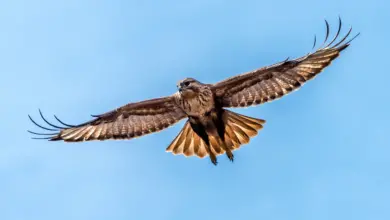
Bird Overview
The Lizard Buzzards (Kaupifalco monogrammicus) are a bird of prey. It belongs to the family Accipitridae. Despite its name, it may be more closely related to the Accipiter hawks than the Buteo buzzards. It is endemic to Sub-Saharan Africa and can be found in a wide range of habitats, including wooded savannas, riverine forests, open countryside, and even urban edges.
Taxonomic studies suggest that the Lizard Buzzard is more closely related to Accipiter Hawks than to the Buteo Buzzards found in Europe and America. The compact size, the short wings and the agile flight are similar to those of forest goshawks or sparrowhawks. It is known for its striking plumage, characterised by a greyish-brown overall colour with a distinctive black throat stripe. The tail also has a banded pattern.
Bird Group:
Identification
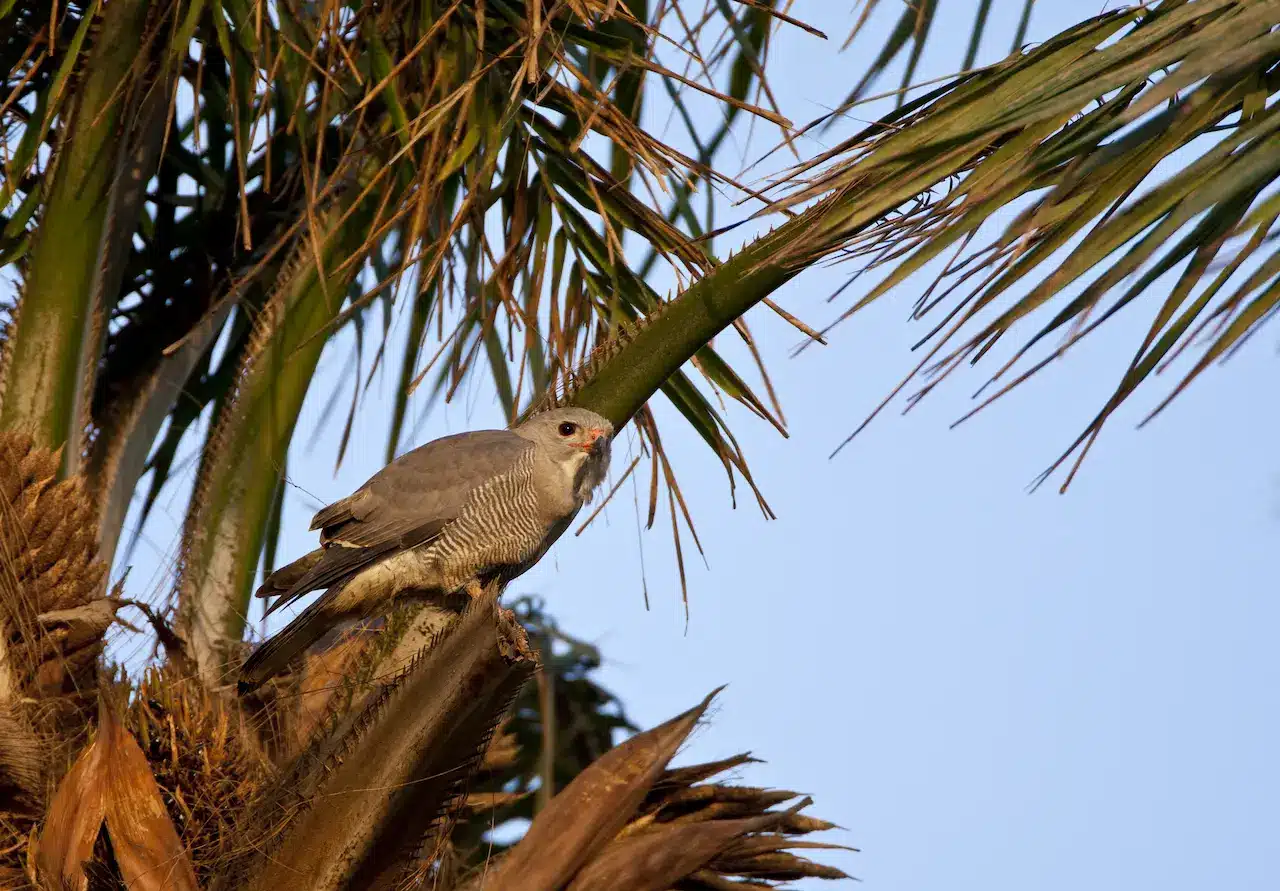
The Lizard Buzzard, a small greyish raptor with distinctive markings, is notable for its powerful build and distinct markings. Its unique and easily identifiable pale white throat is marked with a vertical black stripe. The tail of this sparrowhawk is black, with either one or two wide white bands. Its pale tips are more visible when in flight. This species is smaller and has a muscular body, compared to other sparrowhawks. It also has shorter legs.


It can be found singly or in pairs in areas of open savanna, woodland edges or scattered trees. Lizard buzzards are often seen perched on exposed branches, wires or trees in the crown, scanning for prey. The Lizard Buzzard’s diet consists of lizards and other small vertebrates, such as rodents, birds, lizards and snakes. The bird’s vocalisations are distinctive and include a loud, shrill “peeee-eeeuuu” and a repeated, plaintive “whuuua-whuuua-whuuaa” that can carry over considerable distances.
It has a wide white rump stripe in flight that is similar to the Gabar Goshawk. This species is often mistaken for it. The Lizard Buzzard is easily distinguished by its distinctive throat stripe, pale-colored tail bands and lighter tips on its tail feathers. The compact, powerful build and shorter legs set it apart from a slimmer, long-legged Gabar Goshawk.
Songs & Calls
It is an incredibly vocal species. Its calls are important for communication, especially during territorial displays and courtship. It will often make a loud “pee-oh”, which is repeated repeatedly and acts as a signal to defend or establish its territory. It also produces a series of melodious notes, described as “klioo, kluklukluklukluklu”, which sound like a soft song. The bill is raised to amplify the sound. The buzzard can be heard calling in flight as well, particularly when it is high above its territory. This helps to reinforce its presence and discourage rivals. The buzzard’s varied and frequent vocalisations are characteristic and one of the best ways to identify its presence, especially in open woodland and savanna habitats.
Location
Lizard Buzzards are widely distributed in Sub-Saharan Africa. They can be found in many countries, including Angola (Swaziland), Ghana, Togo, Nigeria, Ethiopia, Burkina Faso and Somalia..
Habitat
This attractive and adaptable raptor prefers moist woodlands and savannas with large trees for nesting and perching. It is not a habitat specialist, but is equally comfortable in many other environments. These include secondary growth forest, forest clearings and thickets. Palm groves and urban gardens are also suitable. The ability of this species to adapt to a wide range of environments reflects its opportunistic character and is a major factor in its widespread distribution. According to Cornell Lab of Ornithology, this species is well documented.
Behaviour
Lizard Buzzards are often seen perched in exposed, prominent positions, such as on the tops of oil palm trees, high branches or even telegraph cables, where they scan the ground for prey. The Lizard Buzzard uses a sit-and-wait hunting strategy to target and detect a wide variety of prey, such as reptiles, like lizards and small mammals, or birds. The buzzard will make short, swift dashes in the grass when it spots prey. When it comes to venomous serpents, the buzzard delivers a powerful and precise strike on the head. This kills them instantly, before they can be handled further. The Lizard Buzzard uses aerial hunting techniques in addition to its ground-based hunts. It soars above its territory and makes rapid, decisive movements to grab prey on the ground or tall grasses. According to BirdLife International, this species is well documented.
During breeding season, Lizard Buzzards are more vocal. They emit frequent calls from perches on treetops to announce their presence and strengthen pair bonds. They are monogamous and do not perform elaborate aerial courtship displays like some raptors. The species is mostly sedentary in its habitat, but it may move around in response to changes in conditions in drier areas. The Lizard Buzzard, which is usually seen in pairs or singly, is a stealthy and shy bird that blends well with its environment. During nesting, males are aggressive and territorial, attacking large birds of prey and other intruders who come too close to their nest. This behaviour is protective and helps to ensure the safety of the eggs and chicks in the breeding season.
Feeding
Lizard buzzards have a varied and opportunistic feeding pattern. They feed primarily on small reptiles such as lizards and geckos. With its sharp beak, strong talons and venomous snakes can be killed with one fatal blow. The buzzard also feeds on small animals such as rats, mice and rabbits. It will also catch small birds during ambushes and rapid pursuits. The buzzard also feeds on insects, catching bees, wasps or grasshoppers by dropping to the ground. Its adaptability allows it to thrive in diverse habitats from savannas, woodlands, farmlands and urban edges.
Breeding
Lizard Buzzards nest in tropical Africa, south of the Sahara. They prefer open woodlands and habitats like savannas. The stick nests they build are particularly well-known. They nest in the crowns of tall palm trees or the forks of large trees. The nests are a safe place for the females to raise their young. They usually lay one or three white eggs. Breeding season usually occurs between September and December, but this can vary from region to region. Breeding occurs during the dry season in most areas, which is more conducive to raising chicks. Lizard Buzzards are not like some other raptors that have adapted to exotic plantations. They prefer natural woodlands and rely on mature trees as nesting sites.
Buzzards form monogamous pairs and return to the same territory year after year. The male and female both work together to construct the nest. They line it with soft materials to provide a haven for the eggs. The female is responsible for the majority of incubation. This takes approximately 32-34 days. Meanwhile, the male supplies food and keeps watch. Females will sometimes leave their nest to go hunting. Both parents share in the feeding of the chicks after the eggs hatch. They remain in the nest about 40 days until they leave. During this time, the mates communicate by vocalising frequently, and the male will often stay close to the nest in order to protect their young.
Conservation
It is a widespread species in Sub-Saharan Africa. The Lizard Buzzard is not considered threatened or vulnerable. Conservation organisations classify it as a species with Least Concern due to its large population and stable trends. The adaptability of the species to different habitats, such as wooded savannas and forest edges, or even altered landscapes like urban gardens and plantations, has allowed it to maintain a healthy population in many areas. There are increasing concerns over the decline of raptor numbers in western and southern Africa, despite their overall stability. Studies and reports show dramatic declines in several species of raptors within these regions. While the Lizard Buzzard is not showing any signs of severe declines yet, it’s not immune to the same pressures.
These declines are primarily caused by rapid population growth. This leads to overexploitation of the land for agricultural, urban, and logging purposes. The result is a significant loss of habitat and fragmentation. This reduces the number of nesting and hunting areas for birds of prey. In addition, the loss of biodiversity in these ecosystems may impact the availability and diversity of prey species. This can affect the Lizard Buzzard indirectly. Conservationists stress the importance of sustainable land management and habitat preservation to ensure the Lizard buzzard’s survival.
Risks / Threats
Lizard Buzzards are also vulnerable to predators such as large raptors like eagles that can prey on smaller birds. While its relatively compact and stocky body is advantageous for hunting in wooded areas and maneuverability, it also makes the Lizard Buzzard more vulnerable to aerial predators. Wildcats, foxes, and other terrestrial predators can also pose a danger to nesting birds and their eggs and young. Arboreal predators such as monkeys and snakes can also raid nests located in trees. Lizard Buzzards use their camouflage plumage, aggressive behaviour around the nest and both parents’ presence during breeding season to protect the young.