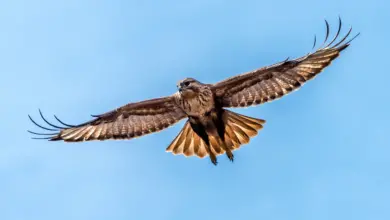
The Jackal Buzzards (Buteo rufofuscus) is a 55-60 cm long African bird of prey with three main subspecies.
- B. r. rufofuscus, the nominate South African form
- B. rR. Augur Ethiopia, Uganda, and Southern Sudan westwards to the eastern Congo.
- B. r. archeri, Somalia
The latter two forms are frequently given specific status as Augur Buzzard, B. augur, and Archer’s Buzzard, B. archeri, respectively.
This is a species of mountains (most typically at about 2000 m altitude, but up to 5000 m), and adjacent savannah and grassland. It is resident and non-migratory throughout its range.


Description
The adult South African Jackal Buzzard is strikingly plumaged. It is almost black above with a chestnut tail. The primary flight feathers are blackish, and the secondaries (shorter, upper “arm” feathers)are off-white, both barred with black. Below the chin and around the throat is mainly white, and the rest of the underparts and the underwing coverts are rich rufous. The flight feathers from below are white, tipped with black to form a dark trailing edge to the wing.

The juvenile Jackal Buzzard is mainly brown above and rufous brown below and on the tail. It can be confused with the wintering Steppe Buzzard, but has broader wings and an unbarred undertail.
The adult Augur Buzzard has white underparts and underwings. The female has black on the lower throat. Juveniles are brown above and buff below, the underparts later becoming white. There is a melanistic form of Augur Buzzard, all black, except for grey and black-barred flight feathers and a chestnut tail. About 10% of birds are melanistic, but the proportion rises in forested areas with high rainfall to as much as 50% in some areas.
Archer’s Buzzard in Somalia is slightly smaller than the other forms, has more chestnut in the feathers of the upperparts, and in adult plumage has the throat white with black on the sides, with the rest of the underside rich chestnut. Immature birds have white underparts and a barred tail.
Jackal Buzzard has a weeah ka-ka-ka call like that of Black-backed Jackal, hence its name. It is also reminiscent of the call of the American Red-tailed Hawk. It is very different from the barking ku wow ku-wow of Augur Buzzard.
Distribution and Habitat
The Jackal Buzzard is an endemic of southern Africa. The core range of the Jackal Buzzard includes South Africa and Lesotho. It also extends to parts of Namibia and Botswana. It is not uniformly distributed in this area. Instead, it is more common in mountainous or hilly regions, along escarpments, and in upland grazing/woodland zones.
The buzzard is a species that thrives at high altitudes and on the edge. Most commonly, it’s found on mountain slopes between 2,000 metres and 3,001 meters. However, some highland areas have seen the buzzard at sea level, rocky outcroppings, or even higher. It is a rugged terrain with steep vegetation transitions and cliffs. Its domain includes adjacent habitats like semi-desert shrub, open grassland, and Karoo.
Its habitat has a low vegetation structure, with short grasses or scrubs interspersed between rocky outcrops from which it can hunt. When cliffs and cliffsides cannot be used, it uses other habitats such as open wooded patches or plantations. It is a resident bird, so each individual or pair defends its territory all year round. The habitats in that territory provide food, nesting areas, and a vantage point. According to BirdLife International, this species is well documented.
Although juveniles do not migrate in the traditional sense, they may move locally or wander, especially in response to changes in conditions or prey availability. Most adults, however, remain in their territory throughout the year. According to eBird, this species is well documented.
Diet / Feeding
The diet of Jackal Buzzard is mainly small ground mammals, but snakes, lizards, small ground birds, insects, and road-kill are also taken. Typically, the raptor drops on its prey from a perch or hovers.
Breeding and Nesting Behavior
In general, breeding in the Jackal Buzzard occurs over a long period of time. It often begins in late winter and continues into early summer. In many areas of the range, clutches begin between February and June, with an egg-laying peak commonly occurring from July to September. This breeding window is a reflection of the local environment, available prey, and climate patterns.
In the Lesotho mountains, polyandry is documented. This system allows a female to mate with up to two males. Both of them help build nests, provide food, and defend territory. This arrangement is most likely to occur in populations with high densities, where males can successfully work together without compromising each other.
Nest building begins well before egg-laying–sometimes as much as two or three months in advance. Nest construction is a joint effort by both sexes. The nest is made up of a large platform with sticks. Its interior is lined with soft materials such as grasses and leaves. Nests can grow to be enormous over successive seasons. A mature nest could measure up to a meter or more in diameter. In addition to cliff ledges, nests are sometimes placed in trees–especially tall exotic species like pines, eucalyptus, poplars, or willows–particularly when cliff sites are limited. The pair may have multiple nesting sites in their territory, and they can alternate between them. They can also repair older nests.
Conservation Status
On the IUCN Red List, the Jackal Buzzard has been classified as of Least Concern. It has a large range, though it is limited to southern Africa. Population trends are stable, and it has a reputation for being a common raptor. It does not qualify for higher threat categories because it doesn’t appear to be in rapid decline or face immediate large-scale dangers.
“Least concern” does not mean that there is no risk. If conditions change, localized pressures or declines could erode populations in certain parts of the range. The threats include habitat modification, disturbance, a decline in prey, and human encroachment. The buzzard is tolerant of moderate habitat changes, but wholesale changes can have a negative impact on nesting and hunting.
Conclusion
The Jackal Buzzard has a dramatic appearance: it is dark and rufous; it flies high and low, and can be found on mountain slopes or in open grassland. It is a raptor that can adapt to steep terrain by combining strength, flexibility, and a bold appearance. Its call is unique and links it to its land.
The Jackal Buzzard, as a resident predator that does not migrate, is closely tied to the landscapes of its native habitat. The territory must provide prey, nesting places, perches, and space. Its behavior – hunting, soaring, and nest-building, as well as vocalizing – reflects the rewards and challenges of upland living. Although its status is secure at the moment, habitat changes and human impacts may tip the balance of marginal areas. To protect this species, it is important to maintain the rugged mountains and open grasslands that support its existence.
One of the most majestic birding experiences for birders in southern Africa is watching a Jackal Buzzard glide down a steep escarpment with its tail fanning out in chestnut and calling loudly. This is a beautiful reminder that species that have adapted to highs can still survive in a fast-paced world. May the Jackal buzzard continue to dominate the heights, call through the valleys, and inspire respect for its wild habitat.