The Pearl Kites (Gampsonyx swainsonii) are small raptors that favor open savanna habitat, next to deciduous woodland.
Description:
The Pearl Kite measures 20.3-23 cm in length (from the top of the head to the tip of the tail) and weighs 80-95 g.


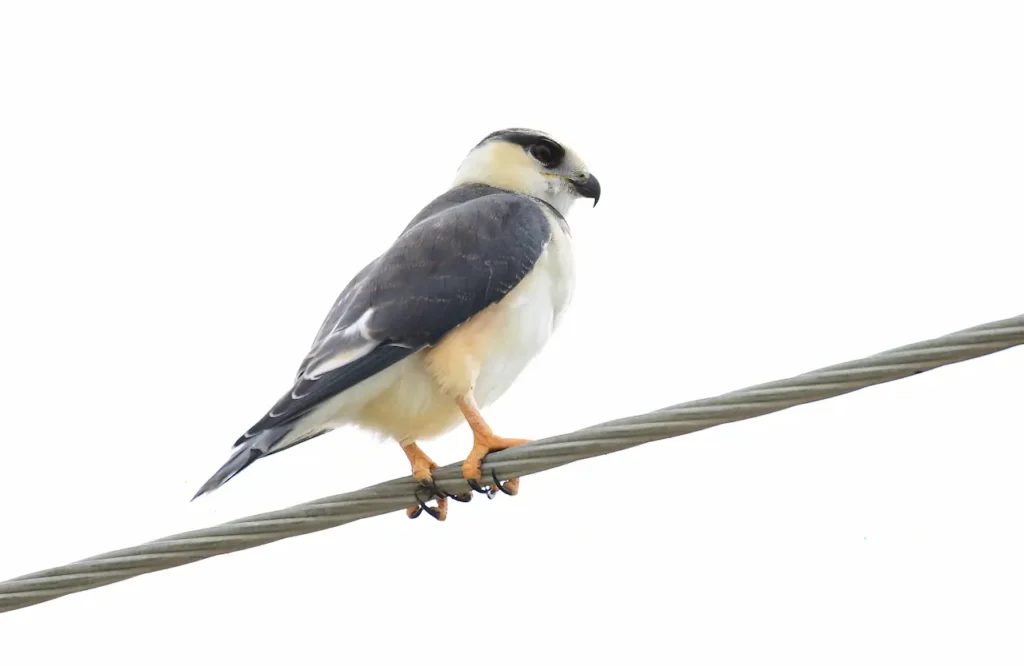
Adults have a black crown. The cheeks and forehead are yellow. The plumage below is mostly white. The legs are yellow.
Young birds resemble the adults, but have white and chestnut tips to the back and wing feathers, a buff collar, and some buff on the white underparts.
In flight, this species looks mainly black above and white below.
The northern form G. s. leonae differs from the southern G. s. swainsonii nominate form in that it has rufous flanks.
Habitat and Distribution
The Pearl Kite’s natural range extends across Central and South America. It includes a wide variety of tropical and subtropical habitats. The species is widely distributed from Panama to Venezuela and Colombia, then south through Ecuador, Bolivia, a nd Peru. The kite prefers open landscapes, with scattered trees. These are habitats where they can easily perch and hunt.
Interesting, there is a sedentary, isolated population in Nicaragua that is geographically separate from the main range. This population is not migratory and could be an early outpost for the species’ expanding range.
In recent decades, the Pearl Kite’s range has expanded significantly. It was first recorded in 1970 on Trini, a Caribbean Island off the northeastern coastline of Venezuela. The species was able to expand its range and colonize new territories. Since then, observers have been noticing an expansion northward, and it’s expected that the Pearl Kite will soon establish a presence in Costa Rica. The species’ slow, but steady expansion is a testament to its adaptability and resilience. This may be because it has a wide range of feeding habits and can tolerate a variety of savanna environments and woodland habitats.
Habitats of the Pearl Kite include open savanna with deciduous and semi-deciduous woods. Tall scattered trees are also common, as is edge habitat around farmland or plantations. These landscapes offer both perching areas for hunting as well as cover for nesting. Pearl Kites are not dependent on unspoiled wilderness, but they do need a balance between open space and vertical structure. They do not live in dense forest or on a treeless plain.
Nesting / Breeding
Pearl Kites breed seasonally, and under the right conditions, they can produce two broods in a single breeding season. The combination of a short nesting period and a high reproductive capacity supports the growth of populations.
Nesting sites tend to be located in tall trees and are well out of reach for most predators. Birds build a cup-shaped nest of sticks that is often lined with soft materials to cushion eggs. These nests, which are not overly elaborate but sturdy and serve the purpose of safely raising young in an elevated position, are made from sticks. According to Audubon Society, this species is well documented.
The female lays a clutch of 2 to 4 white eggs that are marked with brown. The female is responsible for most of the incubation. This process lasts approximately 35 to 34 days. The male can help by providing food or defending the nest, but his role in the incubation process is minimal. According to eBird, this species is well documented.
The chicks remain in the nest until they are fully feathered and able to fly. The chicks are fed regularly, and they grow rapidly. They will leave the nest at 5 weeks. The young birds can remain near their parents for a while, learning how to hunt and becoming more independent.

Feeding
The Pearl Kite has always been a predator. Its diet reflects its small size as well as its sharp predatory abilities. Its primary prey is Lizards. These are commonly found in tropical and subtropical Americas. The Pearl Kite can easily take on these lizards with its quick reflexes.
The kite will usually choose a high perch to scan the surrounding area. This could be the top of a telephone pole or tree. After spotting potential prey, the kite launches a quick, short flight to grab the prey from the ground or low vegetation. This “sit and wait” strategy of predation is highly efficient, especially in warmer climates when reptiles are more active during daylight hours.
Pearl Kites also hunt large insects and small rodents if the opportunity arises. The ability of Pearl Kites to hunt a variety of prey shows that they have a flexible diet, which is likely to be a factor in their increasing range.
The Pearl Kite is a smaller raptor that relies on speed and accuracy. They can easily maneuver through low-lying vegetation and trees due to their small size. Their excellent eyesight also allows them not to miss any movement.
Vocalizations
The Pearl Kite has a distinctive voice, though not as loud as other forest birds or songbirds. Its call is a musical, high-pitched series of notes, which can be rendered as “pip–pip–pip–pip”, or “kitty–kitty–kitty.”. These calls are typically delivered from perches and are often heard in the morning or evening, especially during breeding season, when the need to assert territory or locate mates arises.
In open habitats, the tone is clear and sharp. It can be heard for long distances. Their calls may not be complex or diverse, but they are important for communication and territorial protection. The Pearl Kite vocalizations, in contrast to those of many larger raptors, are quieter and less piercing. This is due to their smaller size and more discrete behavior.
Breeding and Nesting
Pearl Kites breed seasonally, and under the right conditions, they can produce two broods in a single breeding season. The combination of a short nesting period and a high reproductive capacity supports the growth of populations.
Nesting sites tend to be located in tall trees and are well out of reach for most predators. Birds build a cup-shaped nest of sticks that is often lined with soft materials to cushion eggs. These nests, which are not overly elaborate but sturdy and serve the purpose of safely raising young in an elevated position, are made from sticks.
The female lays a clutch of 2 to 4 white eggs that are marked with brown. The female is responsible for most of the incubation. This process lasts approximately 35 to 34 days. The male can help by providing food or defending the nest, but his role in the incubation process is minimal.
The chicks remain in the nest until they are fully feathered and able to fly. The chicks are fed regularly, and they grow rapidly. They will leave the nest at 5 weeks. The young birds can remain near their parents for a while, learning how to hunt and becoming more independent.
Stability and Caution
Conservation organizations like the IUCN list the Pearl Kite as a species of Least Concern. This status is a reflection of its large and expanding range and stable populations. It also reflects the apparent eco-flexibility. The Pearl Kite is more resilient than many other raptors, which are sensitive to disturbances in habitat or human intrusion.
The ability of the kite to survive in modified pasturelands and modified savannas, as well as near urban edges, where pristine habitats have become increasingly rare, gives it a distinct advantage. Kites can also hunt in areas that are disturbed because their primary prey, insects and lizards, are abundant.
Conclusion
The size of raptors is often what attracts the most attention. The headlines are dominated by eagles, falcons, and hawks. The Pearl Kite is a great example of how grace, power, and ecological importance do not only apply to the biggest species. This tropical micro-raptor’s small frame, vibrant colors, and fierce hunting skills make it a fascinating symbol of evolution and adaptability.
The steady spread of the Pearl Kite across Central and South America suggests a bright future. However, this future still needs to be protected. The Pearl Kite will need to have places where it can perch, nest, and hunt as the savannas continue to shrink.
It is a success story that has been quietly growing. A watchful sentinel in the treetops of tropical forests, this raptor is living proof that the smallest raptors are capable of making a big impact on the ecosystems where they live.