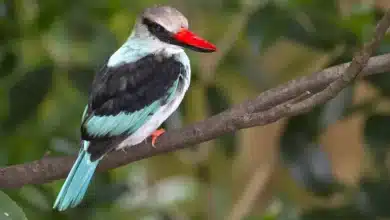
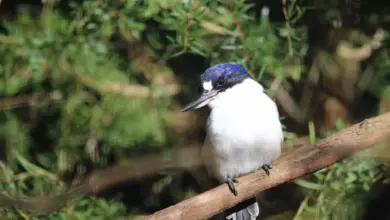
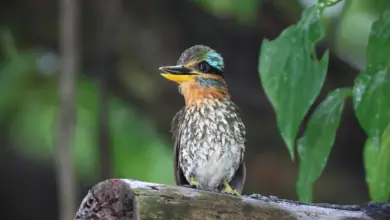
The Forest Kingfisher is also called Macleay’s Kingfisher and the Blue Kingfisher. It has a brilliant blue plumage with crisp white markings. The Forest Kingfisher, unlike many other kingfishers closely associated with rivers or streams, is primarily found in woodlands and coastal forests. It lives in tropical and subtropical areas of Indonesia, New Guinea and eastern and northern Australia’s coastal regions.
Scientific Classification and Naming
The Forest Kingfisher is a member of the Alcedinidae family, which also includes other kingfishers around the world. The scientific name Todiramphus Macleayii places the Forest Kingfisher within a genus of kingfishers that are adapted to forests and mangroves in the Indo-Pacific. The Macleays were important patrons of Australian natural history. The “Blue Kingfisher”, which reflects the bird’s vibrant colouration, is also used. “Forest Kingfisher”, on the other hand, highlights its preference for woodland habitats over open waterways.
Global Range and Natural Distribution
Forest Kingfishers can be found in parts of Indonesia, New Guinea and the Solomon Islands. They are also present on the eastern and northern coasts of Australia. They are found in warm coastal areas and along forested rivers where nesting and feeding opportunities exist. They are found in Australia from Port Stephens, New South Wales, northwards through Queensland, Cape York and the Top End of the Northern Territory. This wide but specific range reflects their reliance on tropical or subtropical forest ecosystems.


Seasonal Movements, Residency and
Forest Kingfishers remain in their general area all year round, even when they are outside of Australia. Some populations in Australia do, however, show seasonal movements. In the summer, they can be found more often in the southern part of their range, including New South Wales and southern Queensland. These are not long-distance migrations, but shifts that occur in response to changes in climate, food availability and breeding opportunities.
Habitat Preferences in Forest Environments
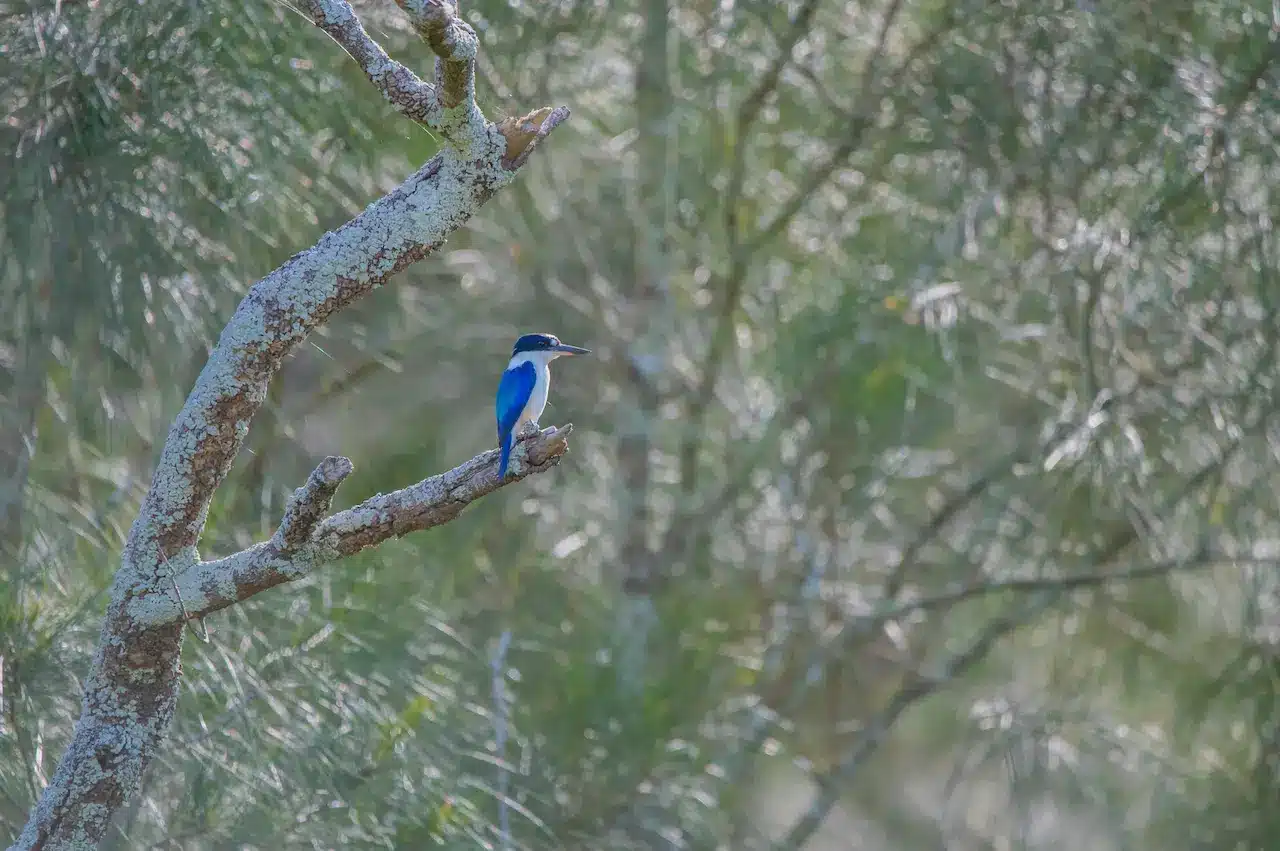
Forest Kingfishers are found in forested areas. Forest Kingfishers are found in tropical and subtropical dry forests, lowland moist forests, Melaleuca swamplands, and subtropical and Tropical moist forests. The coastal forests that border rivers, estuaries and mangroves play a major role. These habitats provide both perches to hunt and nesting areas. Forest Kingfishers may be occasionally seen in open areas, but are usually found near trees.
Subspecies Overview with Geographic Variation
Two subspecies are recognised by most experts. The nominate subspecies is Todiramphus macleayii macleayi and can be found in the Top End of Northern Australia, eastwards to the Gulf of Carpentaria. John Gould described a second subspecies along Australia’s east coast, Todiramphus macleayii incinctus. This subspecies has a slightly greener tint to its back and is slightly bigger. It illustrates subtle geographic variations shaped by the local environment.
Dimensions and general structure
Forest Kingfishers measure between 21.5 and 25.5 centimetres (8 to 10 inches), including the tail. The kingfisher has a strong bill, a large head and sturdiness to their body. The compact body and short legs of kingfishers are ideal for perching and making direct and quick flights to catch prey. They are agile and precise hunter despite their size.
Plumage and Colouration
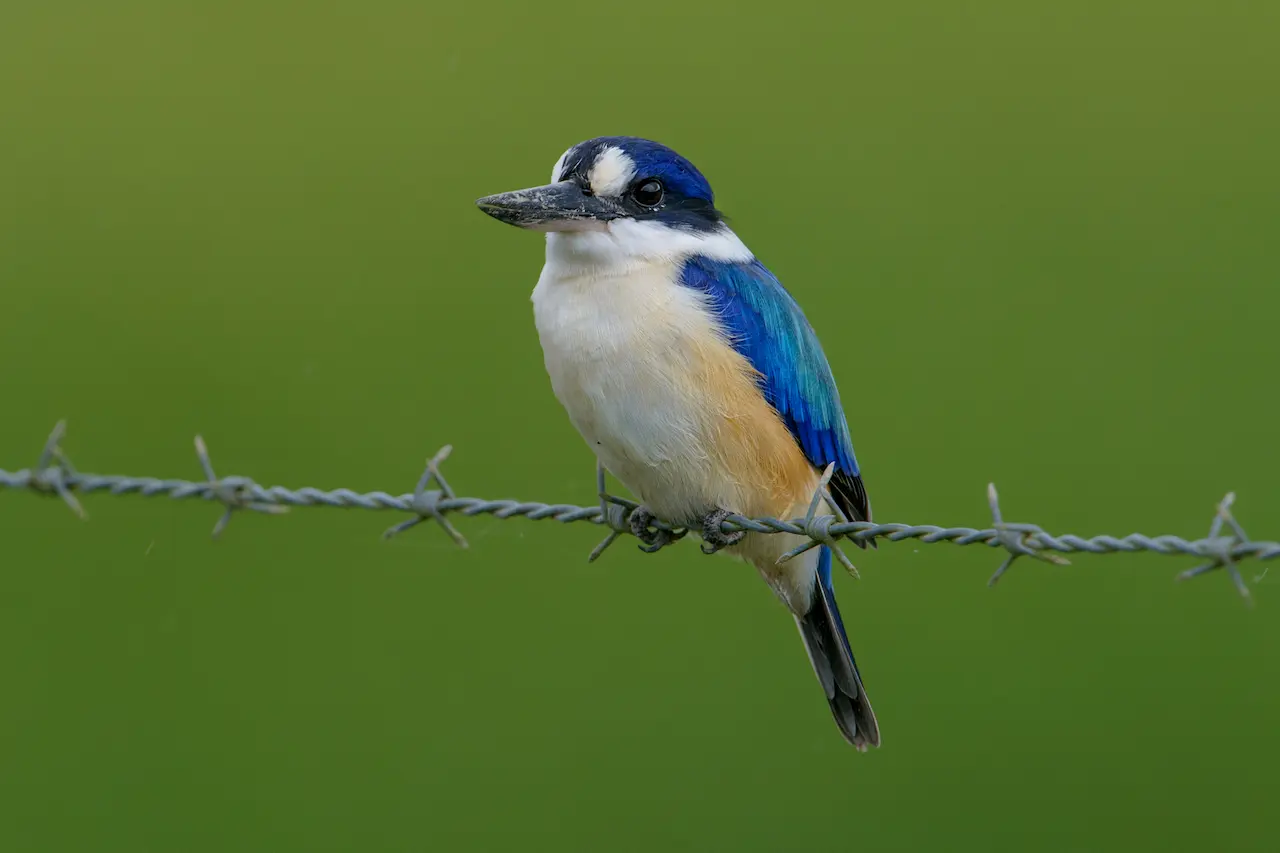
The Forest Kingfisher’s plumage is its most striking feature. The head, tail, wings and tail are all a brilliant blue. Depending on the light, this can look vivid or greenish. Breast, abdomen, nape and a white patch in front of the eyes create a striking contrast to the darker upperparts. The bird appears masked due to a black band that runs from the bill, through the eye coverts and onto the ear covers. A white “flash” or wing patch is visible when the bird is in flight. This helps identify it.
Differences between males and females
The colour of the nape is what differentiates male and female Forest Kingfishers. The nape of males is white and blends with the collar and white underparts. The nape of females is blue to match the crown and the back. This subtle difference can be the best way to tell the genders apart in the field.
The Development of Juvenile Appearance
The plumage of juvenile Forest Kingfishers is duller than that of adults. The crowns are often dark blue instead of bright blue, and their colours are duller. These differences allow young birds to camouflage themselves as they learn how to hunt and avoid predators. As they mature, the juveniles’ plumage becomes more vibrant and takes on their full adult colouration.
Similar Species Identification and Tips
Forest Kingfishers and Sacred Kingfishers share portions of their range. Forest Kingfishers are distinguished by their brighter, deeper blue underparts and distinctive white wing flashes visible during flight. Sacred Kingfishers usually have duller underparts, and their wings are not marked. Observing habitat and behaviour is also a good way to separate the two species.
Feeding Behaviour & Hunting Technique
Forest Kingfishers eat a variety of insects, but they are mostly insectivorous. The birds hunt quietly by perching on exposed twigs or low branches and watching for any movement below. The bird will pounce quickly on its prey and capture it in the vegetation or on the ground. The kingfisher can conserve energy by using this sit-and-wait hunting strategy.
Selecting the right diet and prey
Forest Kingfishers eat mainly insects and other invertebrates, such as grasshoppers, beetles and bugs. When available, they will also eat small frogs or lizards. After capturing the prey, the bird will usually carry it back to its perch, where it will be killed by hitting it with a branch or another hard surface. This ensures that the prey will be subdued and not swallowed. According to iNaturalist, this species is well documented.
Ecosystem Role
Forest Kingfishers are important predators that control populations of small vertebrates and insects. They help to maintain forest ecosystems by regulating the number of insects. They are often a sign of healthy mangrove or woodland habitats, with plenty of prey and nesting sites. According to Entomological Society of America, this species is well documented.
Breeding Seasons and Timing
In Australia, the Forest Kingfisher’s breeding season typically occurs from October to the beginning of January. This coincides with the warmer weather and the increased availability of food. Breeding timing can vary in other parts of the range depending on local weather conditions. During this time, Forest Kingfishers are more territorial, vocal and aggressive, defending their nesting sites and the surrounding feeding areas.
Couple Bonds and Courtship
The Forest Kingfisher is known for forming long-term pairs, and they often mate for life or many breeding seasons. The males display their vibrant plumage and vocalise from high perches. These behaviours are used to attract a partner and strengthen pair bonds in established territories.
Nesting Sites Construction
The choice of nesting sites is a distinctive characteristic of Forest Kingfisher breeding. Nests are usually excavated in the form of short burrows that lead to a round chamber within arboreal termite mounds. These mounds are typically located between 10 and 12 meters (about 30 to 40 feet) high. Nests can also be found in tree trunks that have been hollowed out or in vertical tree cavities. These enclosed and elevated sites offer protection against predators and harsh conditions.
Eggs, Incubation and Chick Care
In general, the female lays between three and six glossy white eggs in a clutch. During the two to three-week incubation period, both parents can be involved in protecting the nest. The chicks, after hatching, are altricial. This means they are born helpless and need extensive parental care. Both parents provide insects and small vertebrates to the chicks, which ensures rapid growth.
The Juvenile Independence Act and Fledging
The chicks stay in the nest for around 30 days. Forest Kingfishers can continue to depend on their parents, even after they leave the nest. They gradually develop the skills necessary to hunt independently and create their own territory.
Vocalizations & Calls
Forest Kingfisher calls are a distinctive “t-reek” that is repeated regularly. The call is heard most often in the morning, and it is used to communicate between mates and defend territory. During the breeding season, vocal activity increases, making it easier to detect birds even when they are hidden in foliage.
Forest Kingfishers, Broader Kingfisher Diversities
The Forest Kingfisher, while a distinct species, belongs to a larger group of forest-adapted Kingfishers that are found mostly in the Indo-Pacific. Forest kingfishers are not like riverine kingfishers, which specialise in catching large fish. Instead, they hunt terrestrial prey among dense vegetation. This diversity in ecology highlights the ability of the kingfisher to adapt to different habitats.
Conservation Status of Forest Kingfisher
Forest Kingfisher species are not currently considered to be globally threatened. They are generally considered species of Low Concern. The Forest Kingfisher’s wide distribution and ability to adapt to different forest types have helped maintain stable populations. Like many forest-dependent species, this bird is susceptible to environmental change and habitat loss.
Threats and environmental challenges
Forest Kingfishers are at risk from habitat destruction, deforestation and coastal development. These factors reduce nesting sites, as well as the availability of prey. Climate change can also have an indirect impact on populations by affecting forest structure and food sources. Although the species is common in many places, habitat protection for the species’ long-term stability is vital.
Habitat protection and conservation efforts
Forest Kingfishers, as well as many other species, benefit from conservation efforts to protect tropical and subtropical forests, mangroves and wetlands. To preserve the habitats that these birds rely on, it is important to establish protected areas, promote sustainable forestry, and support responsible ecotourism. Birdwatching and educational programs are also important in raising public awareness.
Conclusion: The importance of the Forest Kingfisher
Forest Kingfisher, a charismatic and vivid bird, represents the diversity of tropical and subtropical forest ecosystems. It is visually stunning and important for the environment because of its bright blue plumage and hunting skills. The species is not endangered at this time, but it depends on forests and wetlands to survive. The Forest Kingfisher is one of the most beautiful and rare birds of the Indo-Pacific.