The Green Kingfishers, Chloroceryle americana, is a resident breeding bird that occurs from southern Texas in the USA south through Central and South America to central Argentina.
Description
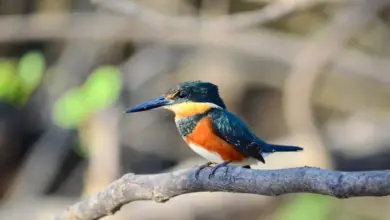
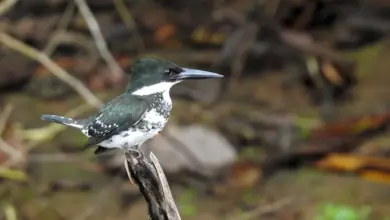
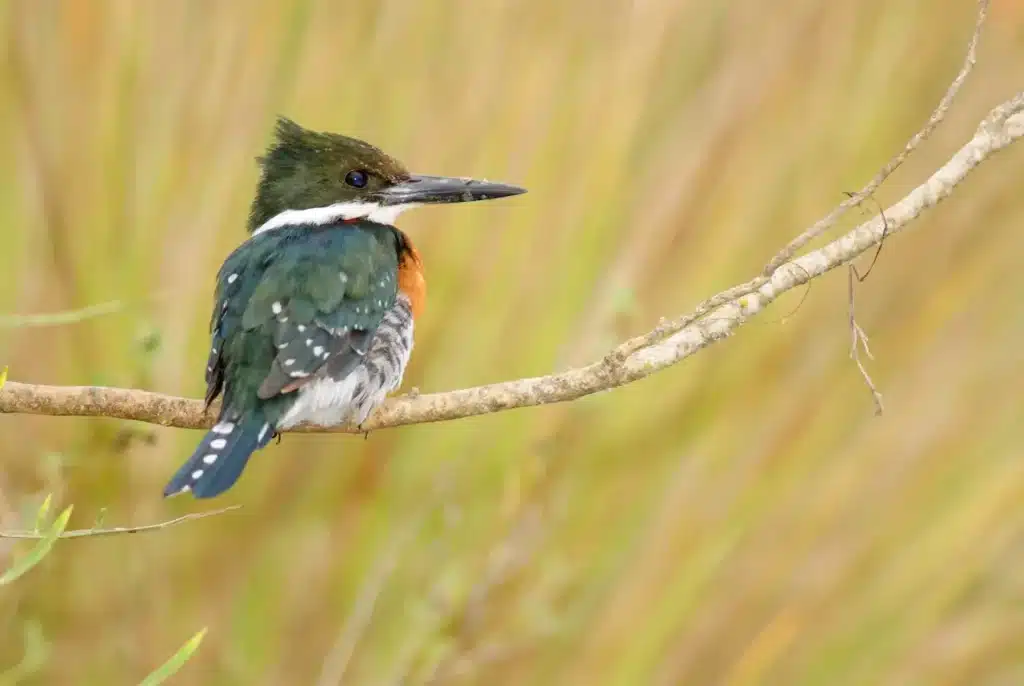
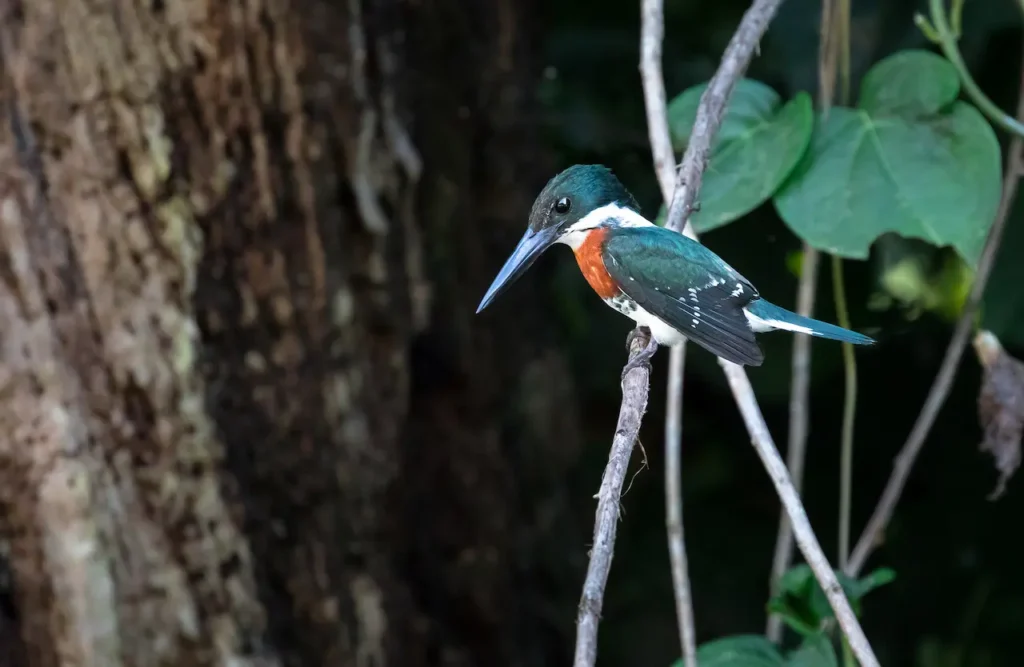
The Green Kingfisher is 19 centimetres (7.5 in) long and weighs 27 grams (0.95 oz). It has the typical kingfisher shape, with a short tail and long bill. It is oily green above, with white markings on the wings and tail, and a white collar around the neck.
Males have white underparts apart from a broad chestnut breast band and some green spotting on the flanks. Females have buff-white underparts with two green chest bands, the lower of which links to the green spotting along the sides of the belly.


Breeding / Nesting
These small kingfishers breed by streams in forests or mangroves. The nest is in a horizontal tunnel up to a metre long, made in a tree. The female lays three, sometimes four, eggs.
Green Kingfishers are Monogamous Breeders who establish territories near water where food is plentiful and nesting sites secure. They breed more during wetter months when the availability of prey is at its peak, providing ample food for the young.
Their nesting technique is highly specialized and fascinating. The Green Kingfisher, instead of digging a nest in the ground, excavates a horizontal tunnel into a riverbank or stream bank that is typically up to 1 meter long. The tunnel leads to a nesting area where the female lays eggs.
Nesting sites offer several benefits: protection from predators and temperature regulation. They are also close to food sources. It also requires sturdy banks and substrates that allow the birds to dig and maintain their tunnel.
The female usually lays 3 or 4 eggs. The eggs are white to blend in with the interior light of the burrow. Both parents are involved in the incubation process and in raising their chicks. This is done to increase their chances of survival.
The incubation period is usually between 20 and 24 days. Chicks are born blind and defenseless and rely on their parents to provide food and protection. Parents continue to feed their young by supplying them with fish, aquatic insects, and other prey. This happens multiple times a day.
After fleeing, juveniles are dependent on parents until they can fish independently and survive.
Feeding and Hunting
The feeding behaviour of the Green Kingfisher demonstrates evolutionary adaptation and efficiency. They are primarily Fish-Eaters and eat small fish in freshwater habitats. They are also opportunistic eaters and consume aquatic insects. This gives them a wider ecological niche.
The Green Kingfisher displays typical kingfisher behaviors when hunting. It sits patiently on low branches or twigs, scanning the water for any signs of insect or fish movement. The kingfisher will dive into the water with a rapid, precise dive once it has spotted its prey.
It is a spectacular technique to watch. The bird’s dive is often so smooth that it barely makes a splash. This is a testament to its powerful flight and streamlined shape. The kingfisher will return to its perch after capturing its prey and manipulating it carefully. It will beat it against a branch or rock to subdue the catch before swallowing it.
Their diet is a reflection of the biodiversity in their habitat. Water beetles and dragonfly larvae are used to supplement the fish in their diet. The Green Kingfisher can survive in different environments because of its varied diet, especially when fish are scarce. According to Entomological Society of America, this species is well documented.
Its long bill, which is perfectly adapted for this diet, allows it to catch fish quickly and accurately. Its keen eyesight allows it to see prey even through the often-distorting water surface. According to Bug Guide, this species is well documented.
Calls / Vocalizations
These birds often give a pebbly rattling call.
Green Kingfisher vocalizations can be easily identified by researchers and birdwatchers, even when the bird is hiding in foliage. Its most frequent call is described by birdwatchers as a pebbly sound that is repeated repeatedly.
The call can be used for a variety of purposes, including territorial defense, communication with mates, or alerting others to threats. The rattling sound is heard well over water and in dense vegetation. It’s an effective signal for its often cluttered habitat.
These vocalizations, though not melodious as we know it in the traditional sense of the word, are vital to the social behavior and breeding success of this species.
Taxonomy
Variation in this species is clinal. There are five subspecies:
- Americanacupying northern South America east of the Andes, south to Bolivia and Brazil
- Mathewsii occupies the area south of America, to north Argentina
- Hachisukai occurs from the southwestern United States to Mexico, where it merges into the next subspecies
- septentrionalis occurring from Mexico to Venezuela, where it merges with americana
- cabanisii occurring in north Chile and Peru into west Ecuador and Colombia, where it merges with americana
Birds occurring on Trinidad and Tobago, usually included in americana, have a larger and heavier bill than the mainland forms and are sometimes separated as subspecies croteta
References
- BirdLife International (2008). In: IUCN 2008. IUCN Red List of Threatened Species. Downloaded on 13 May 2010.
- Fry, C Hilary; Fry, Kathie; Harris, Alan (1992). Kingfishers, bee-eaters, a nd roller s. London: Christopher Helm. pp. 226–8. ISBN 0-7136-8028-8.
- French, Richard (1991). A Guide to the Birds of Trinidad and Tobago (2nd edition). London: Christopher Helm. p. 239. ISBN 0-7136-3518-5.
- Hilty, Steven L. (2003). Birds of Venezuela. London: Christopher Helm. ISBN 0-7136-6418-5.
External Links
- USGS
- Stamps (for El Salvador, Mexico, Nicaragua, Paraguay, Suriname) with RangeMap
Conservation Status
The International Union for Conservation of Nature has classified the Green Kingfisher as a Least Concern species due to its widespread distribution and relatively stable populations.
Like many other species that depend on freshwater habitats, it is threatened by habitat destruction and pollution. The quality and availability of its habitat are threatened by deforestation, damming of rivers, pollution due to agricultural runoff and industry, as well as urban development.
It is particularly problematic to destroy or alter riverbanks that serve as nesting sites. Nesting sites can be lost when riverbanks become reinforced with concrete or erode severely due to land-use changes.
Climate change can also indirectly affect the Green Kingfisher by changing rainfall patterns, water temperature, and aquatic ecosystems. This could impact prey availability.
The Green Kingfisher, as well as many other species that share its habitat, will benefit from conservation efforts that preserve natural riverbanks, protect riparian forests, a nd maintain water quality.
Conclusion
The Green Kingfisher, which thrives at the intersection of water and forest, is a beautiful example of the intricate design that nature has created. The Green Kingfisher’s vivid colors, fishing ability, and nesting creativity are testaments to millions of evolutionary years.
It is important to preserve the habitats that the Green Kingfisher depends on, not just for it but also for the complex web of life in America’s rivers and streams. We continue to learn about this charismatic, small bird. Its role as a predator and an environmental indicator is becoming clearer.
Keep your eyes and ears open next time you’re near a river or mangrove shaded by a tree in the Americas. Listen for the Green Kingfisher’s rattling calls. You may be able to see one of nature’s most beautiful, efficient, and elegant aquatic hunters at work.