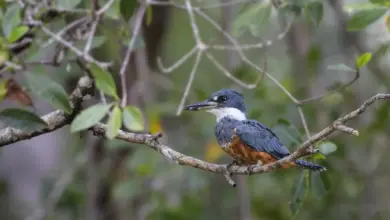
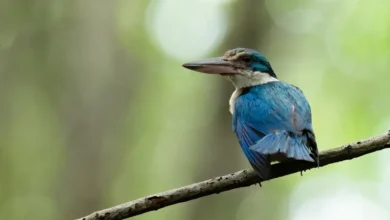
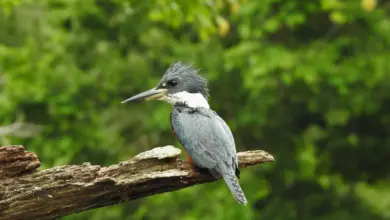
The Blue-breasted Kingfishers, Halcyon malimbica, is a tree kingfisher that is widely distributed in tropical West Africa. This kingfisher is essentially resident, but retreats from drier savanna areas to wetter habitats in the dry season.
The Blue-breasted Kingfisher, partially hidden in leaves and branches, is less visible than other kingfishers to casual observers, but no less fascinating. The Blue-breasted Kingfisher’s life is a constant dance between hiding and dazzling, between the interior of the forest and its borders. This blog will explore the appearance, behavior, and ecology of this African Kingfisher, including vocalizations, feeding habits, threats, and conservation.
Appearance and Identification
The Blue-breasted kingfisher, with a length of about 25 cm (roughly ten inches), is a large kingfisher. Its beauty is not only in its size, but also in the contrast of colors, stature, and quiet presence.


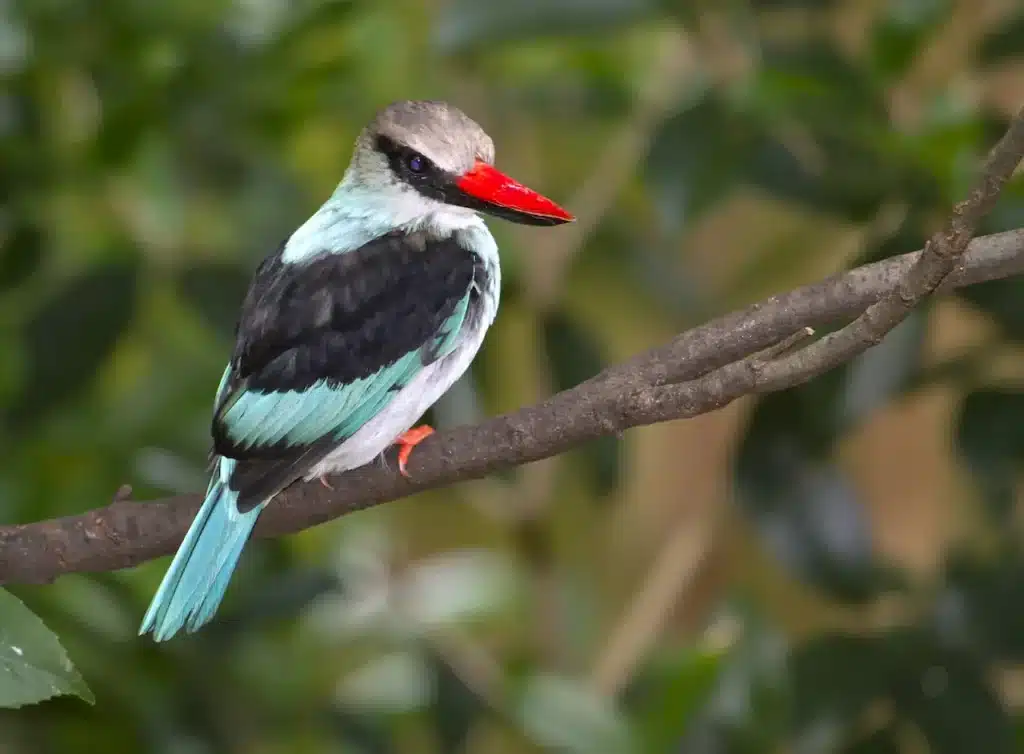
The adult bird has a striking appearance. Its back, head, wing panels, and tail have been painted in vibrant blues. They are deep, rich, saturated, making it easy to identify when they move through the forest canopy in shafts. The underparts of the bird are mostly white. However, these are crossed with a distinctive blue breast band as if the bird were wearing its name across its chest. Its wings are powerful and direct when in flight.
The bill has a striking two-tone appearance. While the upper and lower mandibles are red, the lower and middle mandibles are black. The shoulder is black and provides a sharp border between the blue upperparts of the bird and the white underbelly. Its leg is a vivid red color, which makes it a good choice for perching on shaded branches.
The plumage of male and female adults is nearly identical, making it difficult to distinguish them in the field. The juveniles, on the other hand, have a duller coloration. Their colors are softer, and their red bills are sometimes more muted.
The Blue-breasted Kingfisher, a woodland bird, is often found resting in deep shade. Its bright colors may appear more like flashes than constant displays.
Geographical Distribution
The Blue-breasted Kingfisher can be found in tropical West Africa. The range of this kingfisher extends across the forested zones of countries like Senegal and Gambia. It also includes Sierra Leon and Liberia. Ivory Coast. Ghana. Nigeria. Cameroon. Gabon. This kingfisher can be found wherever the forest is dense, moist, and well-wooded.
Habitat Preferences
The kingfisher does not rely on watercourses as many other kingfishers do. It prefers densely wooded habitats, such as tropical forests, forest margins, secondary growths, gallery forests, and even plantations. It is rarely found in open savannas, deforested areas, or plantations. This is except for during the rainy season or patches of forest.
During the wet season, the Blue-breasted Kingfishers tend to migrate away from the drier mosaics of savanna and forest in favor of more humid, moister habitats, such as riverine forests, forest refuges, or interiors with more shade. The presence of Blue-breasted Kingfishers in drier habitats is intermittent and driven by moisture, insect abundance, and the availability of prey.
They prefer to perch in the shadows rather than sit out loudly on perches. They are difficult to observe because their behavior is stealthy and not flamboyant.
Territorial Behavior, Vocalization, and Behavior
The Blue-breasted Kingfisher has a shy, territorial behavior. It is territorial, especially in its preferred hunting grounds and breeding areas. It is wary and moves quietly when disturbed.
Its flights are remarkable. They are rapid, purposeful, and direct. It cuts through the forest’s light gaps when it moves from perch to perch. It does not linger in midair to create a dramatic effect. Instead, its strength is in its precise movement through the forest.
The kingfisher gives a loud, whistled call often transcribed as “pu-pu-pu-pu-ku-ku-ku-ku”. The call is musical, but it’s unmistakably persistent. This call is most noticeable at dawn and dusk when the forest life is active. It can also be heard in the understory.
When the bird is defending territory or attracting mates, it will become more vocal.
The bird’s perching behavior is noteworthy. Birds often rest in deep shade and watch for any movement. It will launch forward quickly when it sees a potential prey. It can catch insects or smaller prey by striking directly or in mid-air. Its silent, patient perch and sudden movements give it the air of a silent hunter.
Food and Feeding Habits
It is flexible and opportunistic when it comes to what it eats. This reflects the diversity of resources in tropical forests. Its diet includes:
- Large insects
- Arthropods – (spiders and large forest arthropods).
- fish when available, especially in forests, streams, or waterholes located within wooded areas
- Frogs, small amphibians, and other prey are more accessible during the wetter seasons.
- Fruit from Oil Palm trees (and possibly other fruit-bearing local trees) to supplement its diet when animal prey are less available
Hunting is usually done using perch and sally, or hovering to glean. The bird sits on a perch that is often hidden and then moves forward to grab prey. It will hover briefly over leaves or branches to pick insects from the foliage.
The Blue-breasted Kingfisher changes its diet according to the season because forest insects and amphibians/fish are in greater abundance. In periods of greater rainfall, amphibians, fish, and insects may be more important. According to iNaturalist, this species is well documented.
Breeding, Nesting, and Reproductive Behavior
The Blue-breasted Kingfisher is more visible during breeding season. The male will spread his wings to show off the white line inside. This contrasts with his blue outer plumage and is a classic display to impress or challenge females. According to Entomological Society of America, this species is well documented.
This kingfisher nests inside holes in arboreal termite mounds (termite mounds that are built into trees). These elevated nests offer protection from predators on the ground, stability, and shelter in forest interiors. The species’ ability to adapt and be bold is demonstrated by the fact that they can dig or take over a nest hole.
The clutch is usually composed of two round white eggs. It is believed that both parents help raise the young. The nest is protected and embedded in the ground, so the risk of predation is less than for many nests on the ground. However, the birds still have to contend with forest changes and tree predators.
The parents feed the chicks a constant supply of insects, amphibians, or other forest prey. The young develop rapidly and can be ready for hunting or flight in as little as a few weeks, depending on the availability of food.
Conservation, Threats, and Outlook
Blue-breasted Kingfisher is currently in a better position than most forest specialists, but faces serious threats that reflect broader threats to tropical forests.
Threats
Forest Deforestation
As West Africa is experiencing logging, agricultural development, road and settlement expansion, and shifting agriculture, forest cover has been lost or degraded. This kingfisher is dependent on the dense wooded habitat. Fragmentation can reduce suitable territory and isolate populations. It may also reduce the availability of prey.Drought and Hydrological Changes
During periods of drought, the forest edges become dry, waterholes are smaller, and insects and amphibians decline. The kingfisher is forced to retreat further into wetter refugia. This increases competition and stress.Human Encroachment and Disturbance
Human activity in forested areas can disrupt breeding behavior, reduce habitat suitability, and alter habitat near edges.Capture or Hunting Local
Although not historically the most common target for trade or hunting, there may be local pressures, particularly where birds are captured as curios or accidentally harmed.
Conservation Status and Measures
The Blue-breasted Kingfisher, in comparison to other species, is a relatively unknown species. It is worth monitoring, however, due to its dependency on forests and limited movement during the dry season.
Priorities for conservation include:
- Protecting large tracts of intact forest, particularly in the wetter zones, and in forest refuges that persist throughout dry seasons
- Manage forest corridors to improve connectivity and reduce isolation
- Restriction of deforestation in areas near breeding sites and waterways
- Research and monitoring: mapping of breeding sites, assessing trends in population, studying dispersal patterns, documenting threats
- Forest birds awareness, engaging local communities, and reducing pressure at forest edges.
Conservation efforts benefit not only the Blue-breasted Kingsfisher but also countless other species that depend on the same ecosystems.
Blue-breasted Kingfisher Appreciation in the Wild
A Blue-breasted kingfisher encounter is a memorable experience for birdwatchers, nature lovers, and other wildlife enthusiasts. The Blue-breasted Kingfisher’s quiet, shaded perches and sudden bursts in color and movement make it a memorable sighting.
When you hear its whistled pu-pu-pu-pu-ku-ku-ku-ku ringing in the understory, pause and watch carefully. You might catch a glimpse of the blue flash, the red bill, or the dart towards prey. Watch for wing spreading and white flashing linings during the ing season.
Patience is essential because they wait quietly on their perches. Binoculars are a great way to ensure that forest species do not get disturbed.
Conclusion
Blue-breasted Kingfisher is a bird that combines two worlds. It lives in the quiet, shaded understory of eucalyptus trees and then displays brilliant colors and forms when it moves. It is a specialist predator and visual marvel. The bird’s ability to adapt to different environments, its diet, and nesting strategy are all signs of a well-adapted niche.
Despite its specialization, this species is at risk due to the changing landscape. As the loss of forest in West Africa accelerates, species such as this may be early indicators of ecosystem decline.
We can preserve the beauty of these species and also the integrity of whole ecological communities by studying, protecting, and understanding them.
You may see a Blue-breasted Kingfisher if you visit West Africa. Listen for its piping call and watch for blue flashes among the green leaves.