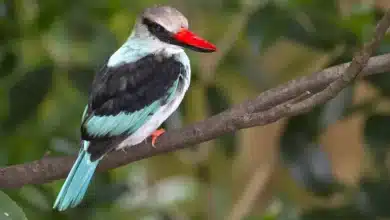
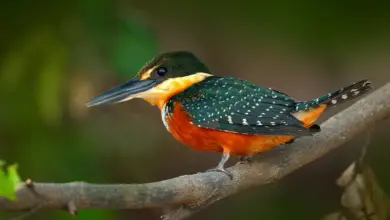
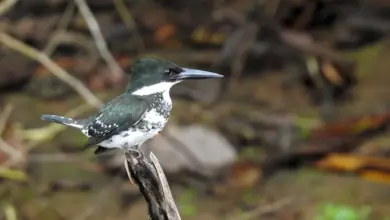
This species is threatened by habitat destruction.
Description
Cinnamon-banded kingfisher is medium-sized tree-kingfisher measuring approximately 21 cm. The crown and mantle are dark green while the tail, wings and rump are shades of blue. The black mask that runs across the eye is a distinctive feature, which contrasts with the rufous-cinnamon collar, eyebrows, and underparts. The bill’s upper mandible is black. The lower mandible is yellowish. Legs are also dark. The weight of the bird is between 28 and 58 grams.
The green/blue tail and back, which are suited to its habitat, and the cinnamon-rufous head set this species apart. This species does not show much sexual dimorphism, or visible differences between the sexes. Juveniles may have a more muted rufous tone. The bird is more elegant in its subtly colored presence, and less vibrant than tropical kingfishers that are commonly found in open habitats.

Habitat & Distribution
The Cinnamon-banded Kingfisher can be found in the Lesser Sunda Islands of Indonesia, as well as in Timor-Leste. The Cinnamon-banded Kingfisher is only found in certain endemic bird habitats, including Northern Nusa Tenggara and Sumba. It also occurs on Timor, Wetar and the Banda Sea Islands. Its distribution within its range is patchy, and the species is considered rare.
It is found in subtropical and tropical dry forests including monsoon forest. This species is also often associated with mature secondary closed canopy forests. The species has been observed from sea level up to 700 m in elevation. It has been seen in secondary or degraded forest. However, it prefers woodland with a closed canopy and does not seem to thrive in open or heavily fragmented habitat. It can also be found in forest edges and village woodlands, where shade trees create a forest-like structure.
Habitat destruction and fragmentation are serious threats to the forest, given its dependence on a canopy-structured forest. The extent and quality suitable forest is reduced by clearing for agriculture, planting, settlement expansion and logging. The species is found in island forests, and there are scattered populations. Losing even small patches of forest can have a significant impact on local populations.
Breeding and Nesting
Cinnamon-banded Kingfisher breeding biology is not well understood, but based on its genus and observations we can sketch out a plausible picture. It is likely that, like many tree-kingfishers of the genus Todiramphus it nests in cavities. These may be tree hollows, termite nests (arboreal termitaria) or voids within mature trees. Both parents will likely be involved in the excavation of the nest chamber, as well as incubation, feeding and caring for their young.
In island forests, the clutch size may be modest (2-4 eggs), with only one brood per season. However, if the conditions are right, more than one brood can be produced. It is unclear when the breeding occurs, but it is likely to coincide with moister months, when insects are plentiful.
This species may nest in mature trees that have cavities or nests of termites, which are rarer when disturbed forests are disturbed. Forest degradation can impact breeding success because it reduces the availability of nest sites. According to IUCN Red List, this species is well documented.
Diet & Feeding
The Cinnamon-banded Kingfisher’s diet is primarily insects and their larvae. The kingfisher adopts a foraging strategy that is based in the forest, rather than diving into water. It may perch at the lower canopy or in the middle of the canopy, or it can even descend to the forest’s floor to catch prey. The bird scans from a perch and spots prey in the foliage or on forest floors. It then launches a short flight to capture it. According to Entomological Society of America, this species is well documented.
Despite the lack of detailed prey lists, it’s reasonable to assume that it might eat large insects, larvae and small invertebrates like spiders or reptiles based on similar species. The perch-and pounce strategy is well suited to the interior forest habitat, where there is little open water and prey can be found in leaves, bark, or ground litter.
This kingfisher, by acting as an insectivore within a closed-canopy rainforest, contributes to maintaining forest health and controlling insect populations. Its survival depends on habitat quality. If the forest is degraded, prey numbers fall, or cover and perching structures are reduced, its feeding success could decline.
Vocalisation
Even though there isn’t a comprehensive audio catalog for the Cinnamon Banded Kingfisher yet, reports from field indicate it can be heard in certain areas. Observers recorded short calls, such as “ch-w” wee notes,” from forest sites in the range of this species. Some places, the species has been described as making calls throughout the day. This suggests that territorial advertising and mate communication may be more active than previously believed.
Vocal signalling is likely to play a major role in the dense forest habitat that it inhabits. It may be used for maintaining territories, communicating with mates and alerting them to danger. Recording and analysing the calls of individuals that may appear discrete but are audible could give valuable insight into their behaviour and habitat usage. A more detailed study of the vocal repertoire could help to understand its territorial size, social behavior and response towards habitat changes.
Conservation
Major conservation assessments have classified the Cinnamon-banded kingfisher as Near Threatened. The main threat to the Cinnamon-banded Kingfisher is the loss, fragmentation and degradation of its forest habitat. The bird is dependent on a closed canopy forest, and prefers mature or less disturbed woods. Conversion of forests to agriculture, plantations and logging, as well as settlement expansion, reduces the available habitat for this bird and leads to population declines.
The species is vulnerable to local extinctions due to its insular distribution, which is restricted to island forest and is already patchy. The species also uses nesting cavities or termite nests, which means mature forest structure plays a key role. When forest is cut down or degraded these structures are lost and breeding opportunities are reduced. Effective conservation measurese include protecting the remaining forest patches, ensuring their connectivity, promoting secondary forest regeneration to restore closed canopy structures, monitoring population trends and working with local communities to promote forest-friendly land uses. Research is needed to fill in knowledge gaps, such as those relating to breeding success, nest site use, population density, and the response to forest degradation.
If conservation efforts are improved and better understanding is gained, the Cinnamon Banded Kingfisher has a good chance of persisting. However, without intervention, it will continue to decline, especially on small islands or in highly fragmented forest.
Conclusion
The Cinnamon Banded Kingfisher is an elegant and striking member of the forest kingfisher family. It’s distinguished by its black mask and green/blue upperparts that are suited for closed-canopy forests. This species, unlike the open-water kingfishers we are more familiar with, is a specialist of the forest interior. It hunts insects and larvae on perches, and drops into the foliage or forest floor, rather than diving in the water. The island forests of Timor-Leste and the Lesser Sundas are home to this species. It is rare and only found in small numbers.
The species’ dependence on mature closed-canopy forests, termite nests or nesting cavities, and insect prey makes it susceptible to habitat destruction and fragmentation. To prevent further decline, it is important to conserve remaining forest patches and regenerate canopy cover. Protecting nesting sites structures, as well as protecting existing nesting sites, are also key. Despite the lack of detailed information on its breeding biology, density, and long-term trends, it is still important to conduct focused field research.
Please Note: The articles or images on this page are the sole property of the authors or photographers. Please contact them directly with respect to any copyright or licensing questions. Thank you.